BJP disrupted the Assembly twice in seven days, unable to back or oppose contentious motions. Amid the noise and a lot of data revelations, six free gas cylinders became the session’s most tangible promise, reports Maleeha Sofi
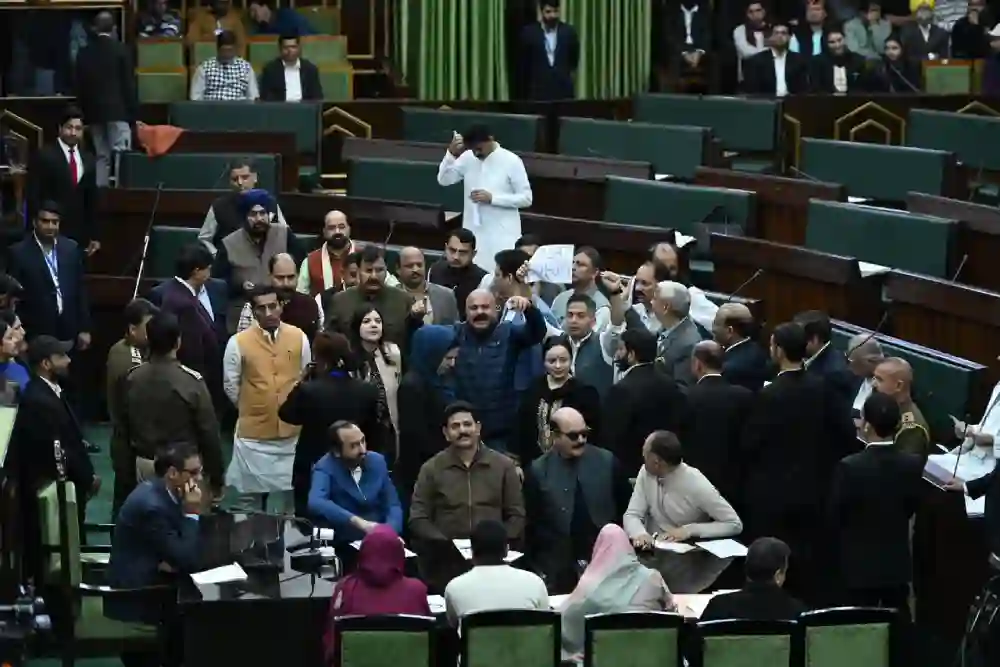
Twice in four sitting days, the Bharatiya Janata Party, the principal opposition in the Jammu and Kashmir assembly, found itself cornered between support and opposition, and twice it chose neither. It chose noise instead.
On September 21, the opening day of the Session, BJP members descended into the Well of the House even before business began, raising slogans against the government. The obituary references had barely concluded when they took over the floor. The House was adjourned by 11 am.
Question Hour, the one slot where ministers are cornered on hard numbers, was lost to the din. The Congress reading of the walkout was blunt. The BJP, it said, could see the Treasury and Opposition benches uniting over the unfulfilled promise of statehood, and chose to disrupt rather than answer for seven years of undelivered promises on casual labour.
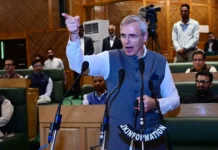
The pattern repeated on September 25, the last of the four days that have concluded so far. Omar Abdullah moved a resolution demanding immediate restoration of full statehood, and tied it to the Assembly’s own autonomy resolution of June 2000.
The reference was enough to trigger uproar. BJP objected, shouted slogans and disrupted proceedings rather than engage with the resolution’s text. Omar challenge to them afterwards was pointed. Debate the resolution, vote on it, and let the people see where the party stands. Neither abstain, nor walk out, nor make noise. The BJP did none of what was asked, and all of what was expected.
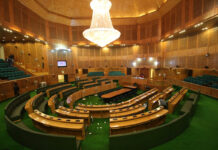
Between these two flashpoints sat four days of a Legislative Assembly that, on paper, is a limited instrument. It cannot question the police, the judiciary or the all India services that run much of the administration. Like the pre-1947, Praja Sabha, it could force open the government’s own paperwork on reservation, jobs, energy and education, turning the Question Hour into the most reliable source of hard data on Jammu and Kashmir in months.
And if one single announcement is likely to outlast the noise in public memory, it is the confirmation that six free LPG cylinders a year will now reach every Antyodaya Anna Yojana household, a promise from the Chief Minister’s February budget finally cleared by the Council of Ministers.
Merit Squeezed
Nowhere did the session offer more without resolving less than on reservation. The Social Welfare Department confirmed that a Cabinet Sub Committee formed nearly two years ago, in December 2024, to rationalise the reservation policy has finished its work and sent its report to the Competent Authority. What happens next remains undisclosed. The government would not name a single Open Merit percentage, saying it varies across direct recruitment, undergraduate courses and postgraduate courses.
What the reply did confirm is the scale of the squeeze, and it falls unevenly. Scheduled Castes hold an eight per cent reservation, Scheduled Tribes a combined 20 per cent, Other Backward Classes eight per cent, residents of Backward Areas 10 per cent, those near the Line of Control four per cent, and Economically Weaker Sections another 10.
Between 2018 and 2026, the government issued 17,62,474 reservation certificates in total, with 14,17,028, or over eighty per cent, going to the Jammu division against just 3,45,446 in Kashmir. Scheduled Tribe II data tells the same story. Of 5,73,667 certificates issued, 5,04,007 went to Jammu division and only 69,660 to Kashmir, with Srinagar district recording a mere 46.
The arithmetic leaves Kashmir facing the brunt of a shrinking Open Merit window without the offsetting reservation cover that Jammu’s certificate holders enjoy. With admissions and recruitment increasingly routed through categories the valley draws on far less, and with the government sitting on a rationalisation report it will not release, colleges in Kashmir are being filled by a narrower and more contested merit pool, one that critics say is dragging academic standards from mediocrity toward outright rot even as the government insists constitutional values and merit remain protected.
Empty Posts
If reservation defined who competes for a government job, vacancy data defined how few jobs there actually are. The government told the House that 40,672 posts under direct recruitment quota lie vacant, comprising 3,318 gazetted, 24,427 non gazetted and 12,927 multi-tasking staff positions. A separate reply put the wider figure, covering all recruitment modes, at 64,439 sanctioned posts lying empty, split between 6,391 in Jammu, 42,572 in Kashmir and 15,476 at the Union Territory level.
Of the direct recruitment vacancies, 13,834 have stayed unfilled for more than two years, a delay the government attributed to rule amendments, departmental restructuring and pending court cases. Over the past two years, 17,902 posts went to the Services Selection Board and 2,150 to the Public Service Commission, and the two agencies together made 11,465 selections since 2024. Against the government’s own election manifesto promise of one lakh new jobs, data tabled in the House shows only 899 have materialised so far, a rate that would take over two centuries to fulfil the pledge.
Health Crisis
No department carried a heavier share of that shortfall than health. A written reply put the figure at 12,614 vacant posts across medical officers, paramedics and nurses, with 2,891 medical officer posts and 9,723 paramedical and nursing posts lying empty. SKIMS alone carries over a thousand vacancies across both categories, and the Directorate of Health Services in Kashmir has 967 unfilled medical officer posts on its own.
Against this backdrop, 5,753 dental surgeons sit registered as unemployed, with the government conceding no dedicated recruitment drive has reached them since 2008. Funds must be found first, the reply said, and relief will come only in phases.
Power Numbers
Energy data filled entire annexures. Government departments and Central establishments together owe the Power Development Department Rs 4,385.30 crore in unpaid electricity dues, led by the Public Health Engineering Department at Rs 1,476.11 crore.
Even after a 6.83 per cent tariff hike expected to add Rs 251 crore in revenue, Jammu and Kashmir will still carry a subsidy burden exceeding Rs 4,500 crore to meet power purchase costs. Domestic revenue collection in the Kashmir valley rose from Rs 1,238.07 crore in 2024 25 to Rs 1,455.90 crore in 2025 26, and the promised 200 units of free electricity for AAY households remains tied to a rooftop solar scheme still at the tendering stage.
Hydropower brought better news. Six NHPC stations, with a combined capacity of 2,250 megawatts, have paid Jammu and Kashmir Rs 5,537.32 crore over five years through water usage charges and free power entitlements, though the government confirmed no proposal exists to give the Union Territory greater ownership of these projects. Peak power demand this year touched 3,063 megawatts against an available supply of 2,899 megawatts, a gap bridged through short term arrangements, while 5,73,955 smart meters have been installed since October 2024.
Teacher Relief
Education, the largest department in the Jammu and Kashmir government by sheer headcount, produced the session’s most unanimous vote and its most debated one. On September 22, the House passed a resolution urging the Centre to exempt all teachers appointed before January 1, 2019, from the Teachers Eligibility Test.
The Education Minister told the House the government would approach the Supreme Court to press the case, framing the exemption as a matter of dignity rather than competence. Legislators across party lines backed the resolution, though some argued the test should remain mandatory for new recruits even as long serving teachers are spared it.
Critics outside the chamber were less generous, reading the exemption as a concession to a teaching workforce that forms one of the government’s most reliable vote banks, arriving just as the Supreme Court’s own 2025 ruling had made the test mandatory nationwide. Whatever its motive, the arithmetic favours the government. Education touches more households, through more employees, than almost any other department in Jammu and Kashmir, and few decisions this session will be felt as widely.
Book Purge
The session’s final thread returned to control rather than money. The Higher Education Department told the House that 21,81,582 books have been screened for objectionable content since July, a scanning exercise confined to Jammu and Kashmir and without parallel elsewhere in the country.
Of these, 4,249 titles have already been withdrawn from circulation, overwhelmingly from the Kashmir division, which accounted for 3,996 against 253 in Jammu. A further 1,752 titles await expert review, and 518 copies of nineteen titles formally banned under an order dated August 2025 have been pulled outright.
The Opposition pressed for the full list to be published, accusing the administration of targeting anything bearing the word Kashmir in its title, including works by respected historians. The government’s defence rested on the claim that colleges and universities must uphold constitutional values and academic rigour, and that the screening followed clear and objective criteria. Neither side offered the House a published list, leaving librarians, and readers, to guess at what else might disappear before the exercise ends.
After the Noise
Four days in, the pattern of this session is already legible. Every time the Assembly edges toward a question the BJP cannot comfortably answer, the party retreats into disruption, and every time it does, the government uses the resulting silence to table another tranche of data it might otherwise have preferred to bury quietly in an annexure.
Reservation policy remains suspended between a finished committee report and an undecided Competent Authority, with Kashmir bearing the sharper edge of a narrowing merit window. Forty thousand vacant posts sit beside a health department too short staffed to keep pace with its own hospitals. A tariff hike buys the exchequer little relief while dues pile up in departments that should be paying their own way. Teachers have won a reprieve that outlives any single budget cycle, and readers have lost access to books that outlive any single minister.
None of this resolves itself in a chamber where slogans crowd out scrutiny. But the paper trail this session has forced into the public record, cylinder by cylinder, vacancy by vacancy, certificate by certificate, is not nothing. It is, for once, more durable than the noise that produced it, and it will still be there for the House, and for the people it answers to, long after the Well has emptied and the slogans have faded.