Chattabal’s century-old fish market thrives on tradition and trade, yet vendors remain without a permanent home despite decades of promises and pending land transfers, Babra Wani reports
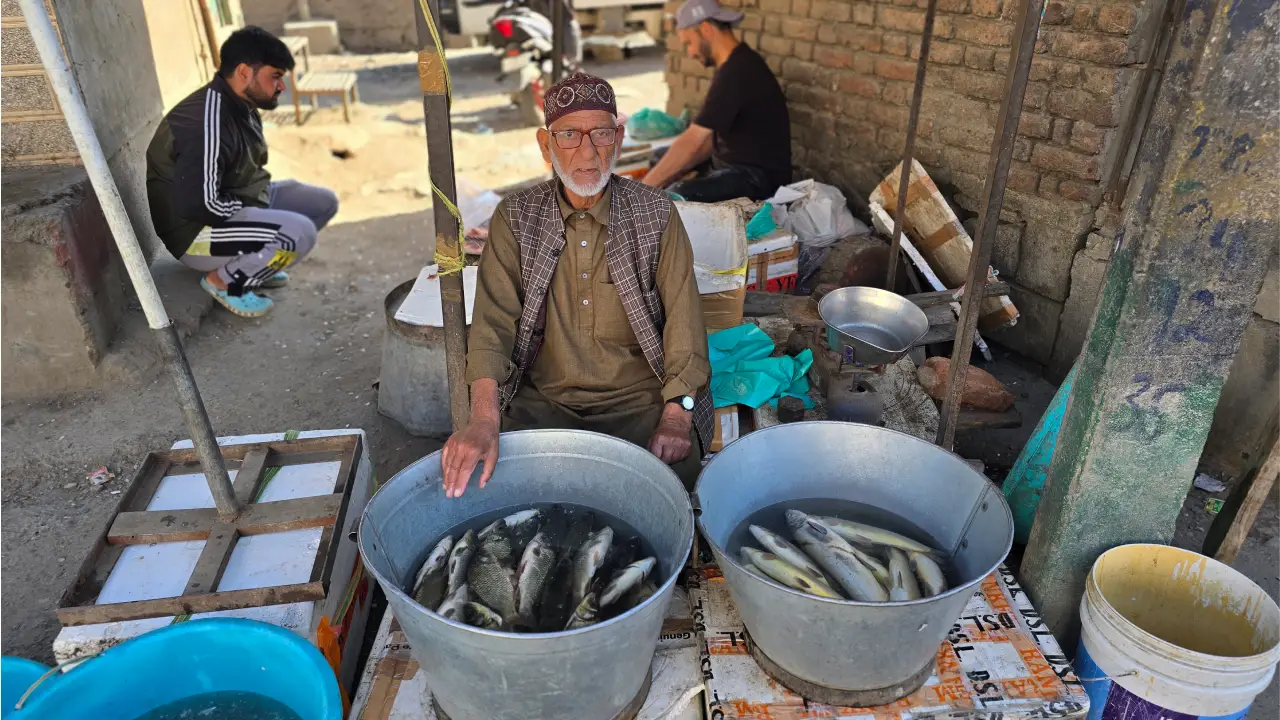
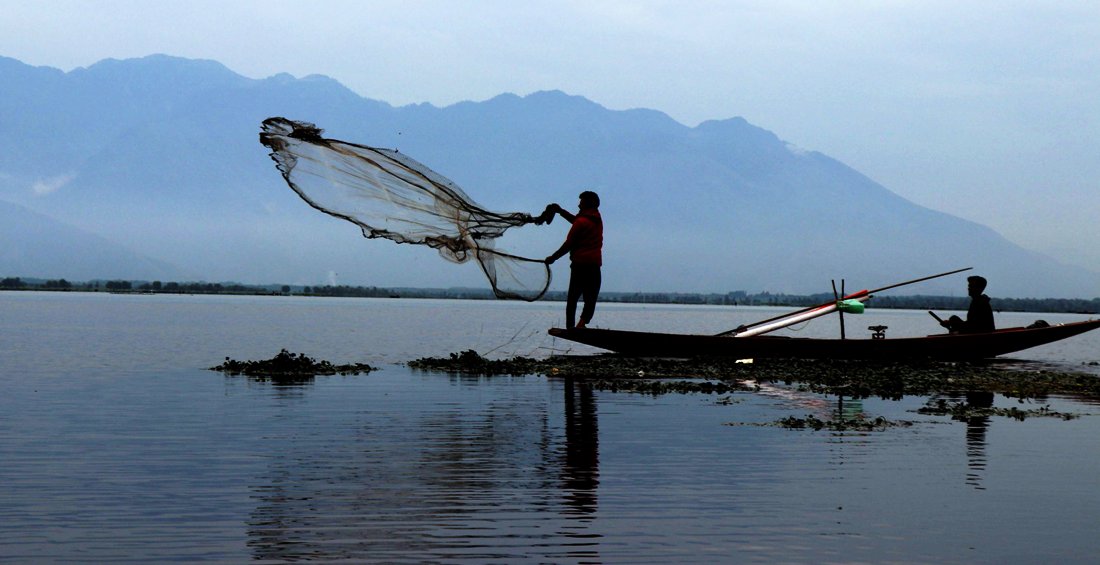
Every morning, as prayers end in Srinagar’s mosques, Hilal and Shakeel set out for work. Both head towards Dal Lake. Hilal fishes its waters. Shakeel, a vendor at Chattabal fish market, buys his catch to sell from a cart.
Their routine never changes through the year. For Chattabal, it has become the market’s pulse, its voice and its very life.
Long before the rest of Srinagar stirs, Chattabal finds its rhythm. By the time the city wakes fully, vendors have settled into their spots, and customers have begun arriving. At this busy corner of the city, the fish trade is a livelihood shaped across generations, sustained by Kashmir’s waters and carried forward by people like Shakeel.
Family Trade
Shakeel, 31, has worked in fish trading since childhood, following his father, who no longer sells fish. He started at 15 and has now spent 16 years in the trade.
He never attended school. Years of dealing with customers taught him to speak languages beyond Kashmiri. As a boy, he never planned to follow his father into the trade. Fate decided otherwise. He runs a fish cart in the market. His uncle owns two shops there.
“We start early in the morning, around 6am or 6.30am. After offering our morning prayers, we wait for customers, and some days it is our customers who wait for us,” he said, laughing.
Steady Custom
Shakeel receives a steady stream of buyers, with people travelling from across Srinagar and nearby villages to purchase fish. He estimated serving 100 to 150 customers a day, and 400 to 500 across a week. Customers arrive from across Srinagar, and some travel from villages in Pulwama, Shopian and neighbouring areas.
The fish sold at Chattabal comes from local water bodies, including the Jhelum and Dal Lake, along with Sumbal, Hajin and Bandipora.
Vendors like him mostly serve local customers rather than commercial restaurants. “Our fish is a bit costly, while restaurants have to purchase in bulk and mostly source their fish from outside.”
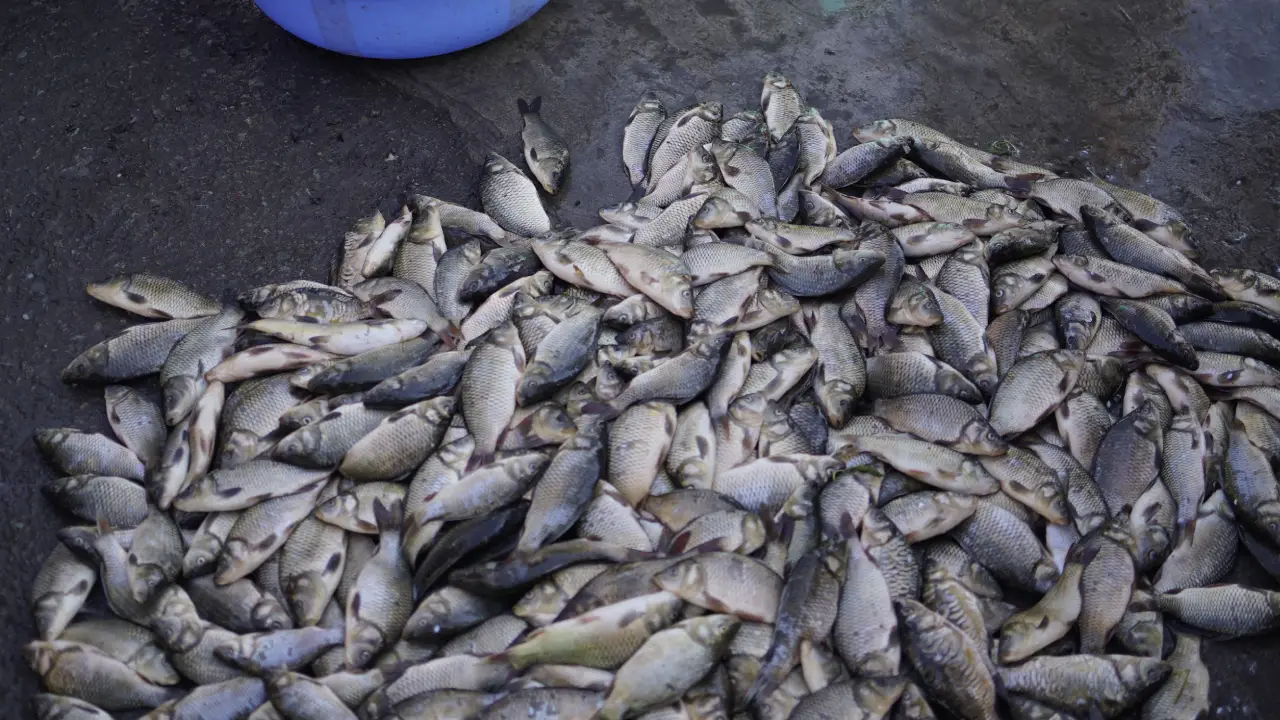
Among the varieties on sale, Shakeel named a fish he called Panjab Gaad, or carp, as especially popular.
Market Elders
Shakeel’s uncle, Shabir Ahmad Dar, is president of the market and owns two shops there. He has taken over the family business, which passed from his grandfather to his father, both of whom served as president before him.
Dar said the market has operated for at least 120 years. His family has stayed in the fish trade across that time, with the next generation continuing the business.
“My grandfather was here when the fish used to come here by boat. I have seen those times too, Dar said, recalling the market’s heydays. “Now there are vehicles. In those days, even essential supplies such as ration were transported by boats. There was lot of water, and the entire system was different.”
Dar said the market handles at least 20 to 30 tonnes of fish, supporting hundreds of people. The market has sixty vendors and retailers, 14 are whole-sellers, and 15 are shopkeepers. Every day, the market gets two to three truckloads of fish.
By the end of the day, “we mostly finish selling all the fish and if there are some left behind then we store the dead fish in the freezer while the live ones we put back in water.”
Fish Numbers
Chattabal is one of Kashmir’s main fish markets. Officially, the registered markets and fish outlets operate mainly in Srinagar’s Hari Singh High Street, Anantnag’s Ashajipora, Pahalgam, Akad, Numbal, Dandipora, Panzath, Wanpora and Khullchor, Kupwara’s ADF Office and FDO Office Handwara, and Jammu’s Narwal Fish Market.
Retail trade, however, leans heavily on an unorganised network of local bazaars, town squares and roadside vendors across all twenty districts, from Chattabal, Amira Kadal and Hazratbal in Srinagar to Sopore, Pattan and Baramulla town, alongside transit hubs such as Kanji House, Warehouse and Satwari in Jammu.
Department of Fisheries data puts annual fish production across Jammu and Kashmir at 31,700 metric tonnes for the 2025-26. Officials said almost 10,000 metric tonnes are imported from outside.
During 2024-25, Jammu and Kashmir recorded an aggregate fish yield of 29399.78 tons. Kashmir division contributed the larger share at 20420.52 tons, against Jammu division’s 8979.25 tons. Non carp indigenous and miscellaneous varieties accounted for the largest volume, at 13505.16 tons, closely followed by carps at 13244.47 tons, while cold water trout reached 2650.14 tons.
Bandipora led as the top fishing hub with 5669.528 tons, driven largely by miscellaneous and carp catches, followed by Baramulla with 3510.063 tons and Srinagar with 3084.34 tons.
Interestingly, Anantnag retained its lead in trout cultivation, harvesting 515.943 tons, nearly a fifth of Jammu and Kashmir’s total trout yield. Jammu district led carp production in its division with 2358.034 tons. Shopian recorded the lowest yield in Kashmir division, at just 88.225 tons, reflecting sharp variation across the region.
Land Battle
Despite its long history, Chattabal market still operates without a designated space. The stakeholders said they have sought a proper market for decades, but repeated appeals to the authorities have failed to bring a permanent solution.
“We have been asking for a marketspace for the last 60 years, but nothing has materialised,” Dar said. “We have been shown land at different places and have also identified locations ourselves, but the matter has remained unresolved.”
“We have been promised one place to another. At times, we are told that the payment has stopped, at other times, we heard that it has been released. But we still waitfor the space,” Dar added.
The lack of space has created difficulties for traders, customers and commuters alike. The market opens early morning, when trucks carrying fish arrive and vendors prepare their stock. The resulting congestion, particularly from larger vehicles moving through the area, has become a recurring concern.
Residents have repeatedly complained about noise and congestion linked to the market. Traders themselves, Dar said, want to move to a designated location rather than continue in a spot where their presence causes inconvenience.
Dar said the market begins at around 4.30am every day, including in winter. Fishermen and suppliers arrive from across Kashmir, including Bandipora and Sopore, bringing fish sourced from local waters and beyond.
“There is a possibility of opening restaurants around the market. But where is the space? Without a proper market, it is difficult to take such initiatives forward,” he said.
With fish sold in an open roadside setting, Dar said vendors have little control over the risks that come with such conditions.
The Official Side
Abdul Majeed Tak, Kashmir’s Director Fisheries, said the directorate has already been working towards building a retail cum wholesale high tech fish market, with land identified at Nowgam, Srinagar.
“The land belongs to the tourism department and we have taken up the matter with them,” Tak said. “We have actually initiated everything and we are done with the most part, 99 per cent process has been completed we are just waiting for the order from the department to transfer the land. That is the only part that is pending now.”
He added that the market would bring a significant boost to both the people and the government.
Mushtaq Ahmad, Assistant Director, said Kashmir’s fish marketing sector remains largely unorganised, particularly compared with other states that have dedicated fish landing centres and organised markets.
He said a proposal for a hygienic, modern fish market was first submitted in 2017, with land identified at Tengpora. The central government had earmarked funds for the project. However, the proposal met prolonged delays after local concerns emerged over possible congestion and unpleasant odours.
“People thought it would be a fish market with all the associated nuisance and smell, but that was not the case,” Mushtaq regretted. “It was intended to be a completely hygienic, modern fish market. But people took things to the court, which eventually resulted in a stay.”
Although the department eventually won the case after years of proceedings, the area has since undergone considerable urbanisation. Tengpora has developed into a busy commercial hub, prompting the department to reconsider the location.
“Now, even we feel that the site is no longer suitable. It has become an economic hub, and a fish market there may not be appropriate,” he said.
The department has since identified an alternative site at Nowgam, near the railway station, where preliminary work has begun. The location is considered strategically suitable, as fish can also be transported by train. The proposed facility is meant to function as a large wholesale fish market, supplying towns across the region.
Mushtaq added that the proposal is nearly approved, but land related formalities remain pending. Once completed, the department hopes to develop a modern wholesale fish market at Nowgam, which could help organise fish distribution and strengthen the region’s fish marketing infrastructure.
Going Digital
One fish seller, Abid, took over his ancestral fish business and has also begun selling online. His family has traded fish for generations, with his own involvement spanning around 15 to 20 years. His grandfather and great grandfather were also fish traders, making it a longstanding family occupation.
Today, he runs two shops at Chattabal and employs four to five people. Unlike his father, he has adapted to online orders, which he began accepting around two years ago.
“It is a modern age, and we have to move with the times,” he said, explaining his decision to offer online sales. The idea came from hearing about the difficulties faced by people who struggle to visit the market because of work commitments. “Doctors and people on duty often do not have the time to go to the market,” he said.
Even so, Abid does not rely mainly on online orders. His business is phygital. He caters to just 10 to 15 orders a day, with most business still coming from customers visiting his shops directly. Timely delivery is a challenge, as “riders are not available when we need them.”
He sells Kashmiri fish, trout and locally available golden fish, and also provides cooked fish to customers.
Despite his optimism, Abid remains frustrated with the current situation. “We have space issues, and operations are really difficult.”