From Srinagar’s bylanes to Kulgam’s orchards, Kashmir’s water sources are vanishing. Taps, springs, canals, lakes and glaciers are all showing that scarcity is deepening, reports Afreen Ashraf
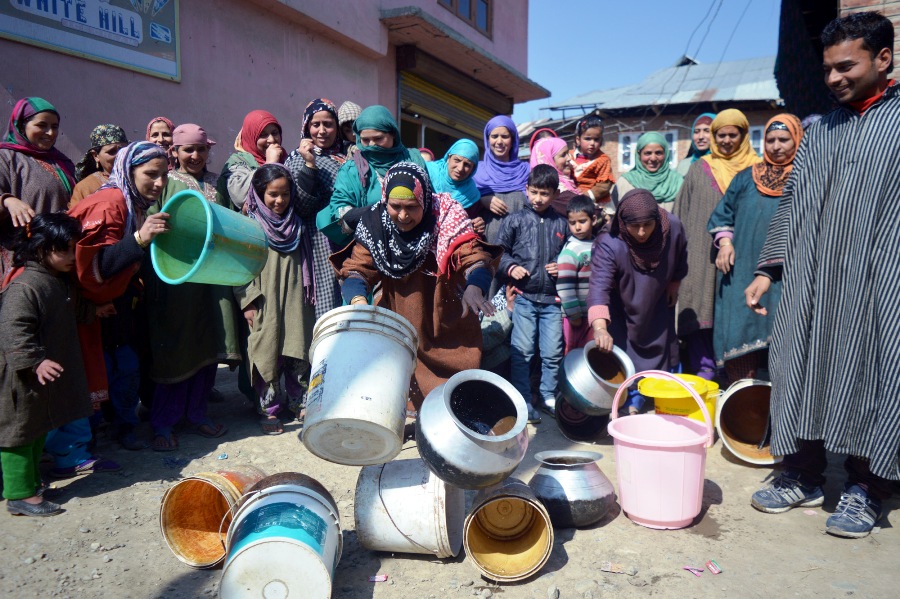
“Hye toofaan, hye toofaan; treshi dadi mearikh eas Musalmaan“, (what a turmoil: look, we Muslims are being killed by thirst). This slogan echoed through the kochas of Srinagar a few months ago as women took to the lanes to protest the water shortage in their neighbourhood. The crisis has slowly become part of daily life. Taps no longer run as they once did. Supply now comes for a few hours a day, sometimes at hours residents can barely use.
The shortage is no longer a minor inconvenience. It interferes with the basic routines of everyday life. A resident recalled that her elderly mother-in-law had to use the washroom at a nearby mosque to perform wuzu because there was no water at home. “There are people in the locality who are ill, and need to be taken care of. Some of them cannot walk properly; they are vulnerable to this crisis,” she said.
City’s Thirst
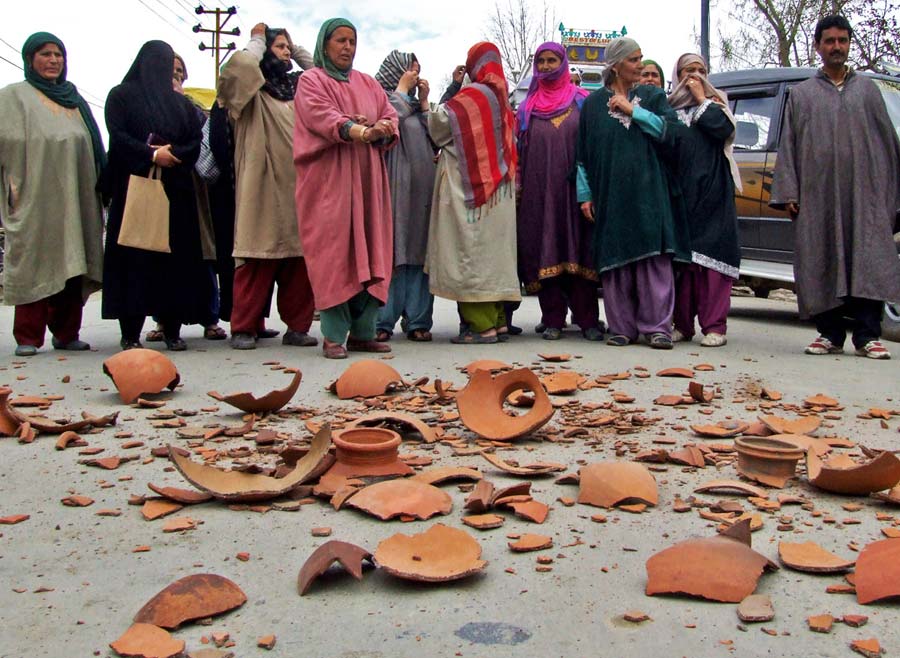
The problem is not confined to homes within Srinagar’s lanes and by-lanes. Across the city, residents have taken to the roads in small groups.
Shameema, 56, of Buchpora, living with her husband, said the decline in flow has been noticeable for more than a year. “Earlier the water flow decreased, but now it has almost become a rare sight; we only get water for a few hours a day, and at night,” she said. “But what are we supposed to do with that water at night?” Shameema has a spinal problem, and her husband has a pacemaker. Neither can carry heavy loads, so storing water in buckets is not an option.
Wahid, another Srinagar resident, described how the uncertainty disrupts ordinary plans. “A few days ago, I had to visit a friend on short notice. And I had to wait until 7 pm for the water to take a shower,” he said.
Individually, these look like small disruptions: a delayed bath, a couple struggling with a daily task, a locality facing an unreliable line. Together, they show how quickly the absence of a basic necessity can reorganise a family’s entire schedule.
 Village Roots
Srinagar’s kochas are only one part of a larger picture. The crisis stretches into villages, where streams, springs and other natural sources have long supplied water. Here, uncertainty touches not only kitchen taps but paddy fields, apple orchards and livestock sheds.
Before tube-wells and pipelines, villagers relied directly on springs, streams and canals, not merely for drinking, but as the backbone of livelihood. Official spring census data shows that 3,313 of 6,553 villages in Jammu and Kashmir had springs, while irrigation records state that canals were once the mainstay of water distribution in the Valley.
That dependence is now uncertain. Some residents have turned to tube-wells dug in their own courtyards or a neighbour’s. Others remain dependent on unreliable water lines, or on a line connected to a spring. In agriculture, dependence runs in layers: some farmers rely on small canals and streams, while others are shifting paddy fields towards horticulture, which they see as less water-dependent.
Yaseen Hyder, a resident of Zoorigund, Budgam, said the canals that once carried a strong flow no longer do. “The canals used to carry much more water than they do now,” he said. “We are increasingly being forced to use motor pumps for irrigation.” He added that in some areas, water sources have disappeared altogether. “Earlier we did not feel it as much because it used to rain frequently. But ever since the rainfall and snowfall have started declining, we have begun to feel the shortage much more.”
The effect is visible in the fields. Official data shows the total area under paddy cultivation in Kashmir has declined by more than 11,000 hectares over five years, from 1,41,340 hectares in 2020 to 1,30,050 hectares in 2025. The fall is sharpest in Budgam and Kulgam. In Budgam, paddy area fell from 25,000 hectares in 2020 to 15,545 hectares in 2025; in Kulgam, from 16,000 hectares to 11,141 hectares. Farmers attribute the shrinkage to prolonged dry spells, changing weather patterns and the conversion of fertile land into commercial use.
Nasir, an apple orchard owner in Kulgam, points to water’s critical role in cultivation. “We are very dependent on water. Unlike paddy, we may need less water, but once a year, we need water in abundance,” he said. His fields are increasingly at risk as traditional channels weaken. “The water flow of the canal around my land has gradually declined.” For Nasir and his neighbours, the Aharbal has long supplied several villages, but its flow has thinned. “Earlier water used to travel naturally through the landscape, but now we have to do that manually, by carrying water or using pumps.”
Vanishing Sources
This is what sets the village crisis apart from a shortage at the tap. Households, fields, canals, streams and springs are all connected. When one source weakens, the effect ripples across the entire chain, touching both daily life and farming.
The scale is now visible in official figures. Data presented in the Lok Sabha last year showed that Kashmir’s extractable groundwater reserves had declined by 63 per cent between 2020 and 2024. The problem, in other words, is no longer confined to supply and distribution; the natural reservoirs themselves are disappearing.
A village may still look green from a distance. Orchards may still bear fruit, paddy fields may still stretch across the landscape, streams may still flow through parts of it. But beneath that appearance, the relationship between people and water is shifting. The question is no longer whether Kashmir has water, but whether enough of it will reach the people, fields and livelihoods that depend on it, when they need it most.
Landscape Warning
For generations, Kashmir’s mountains, glaciers, springs, lakes, wetlands and groundwater have functioned together as a vast natural water infrastructure. The present uncertainty is not the result of one failed season. It reflects a weakening of the natural systems that have historically kept water available year-round, an early sign, perhaps, of wider ecological disruption across the Himalayan region. The evidence is mounting.
Kashmir’s lakes and wetlands are disappearing. A CAG-linked account reports that 518 of 697 lakes in Jammu and Kashmir have either shrunk or been lost, with 315 said to have disappeared entirely since 1967. This is not only an environmental loss, it also signals a collapsing natural storage system that once regulated flow, absorbed excess water and sustained ecological balance.
“Kashmir’s growing water scarcity is closely linked to the gradual weakening of its natural system. Our lakes and wetlands store water, recharge groundwater and sustain springs and streams,” Raja Muzaffar, an environmental activist, said. “But their security is increasingly at risk.” Wetlands and lakes act as natural sponges, absorbing excess water during heavy rainfall and snowmelt and releasing it gradually. With Kashmir facing both flood risk and growing scarcity, their shrinkage is a serious concern.
The smaller channels worry Muzaffar just as much. “I am more worried about Kohls,” he said. “They are not getting that much attention, and they are being destroyed.”
Asif recalls a Kohl near his area that disappeared years ago after commercial construction covered it. Akhbar Ahmed, in Ganderbal, remembers a channel that once ran through his front yard and supplied water for his cattle. Today, he said, little or no water reaches that side. The first Census of Water Bodies identified 9,765 water bodies across Jammu and Kashmir, with encroachment reported in 103 of them. The census does not separately track Kohls, but the count hints at the scale of the network now under pressure.
Kohls were basically water channels emanating from major rivulets to irrigate paddy fields or supply drinking water to the villages. While the mass conversion of paddy fields into apple orchards left these channels unused, and water lines into people’s homes turned the village channels into festering drains.

Weather’s Toll
The immediate weather has only worsened matters. In 2026, Kashmir recorded a 42 per cent cumulative rainfall deficit between January and May. The shortfall was not uniform. Shopian, Kulgam, Anantnag and Budgam were among the districts hit hardest, while Srinagar too recorded below-normal rainfall. Kashmir depends heavily on seasonal fall for its water; when it declines, streams, springs and groundwater come under pressure, weakening flows, drying canals and straining supply exactly when it is needed most.
Nasir said the reduced precipitation has put the apple crop at greater risk of premature fruit fall, and that trees did not get the dormant period they normally need this year. He estimates his area’s cultivation has fallen by around 30 per cent compared with last year.
“Much of the land has dried; it has lost its fertility,” he said. Residents also worry about newer, higher-yield apple varieties. “These new varieties require more water than those traditionally grown in the area. No doubt that will be beneficial, but right now we can’t sustain our own product. How will we innovate?” Nasir asked.
Melting Reserve
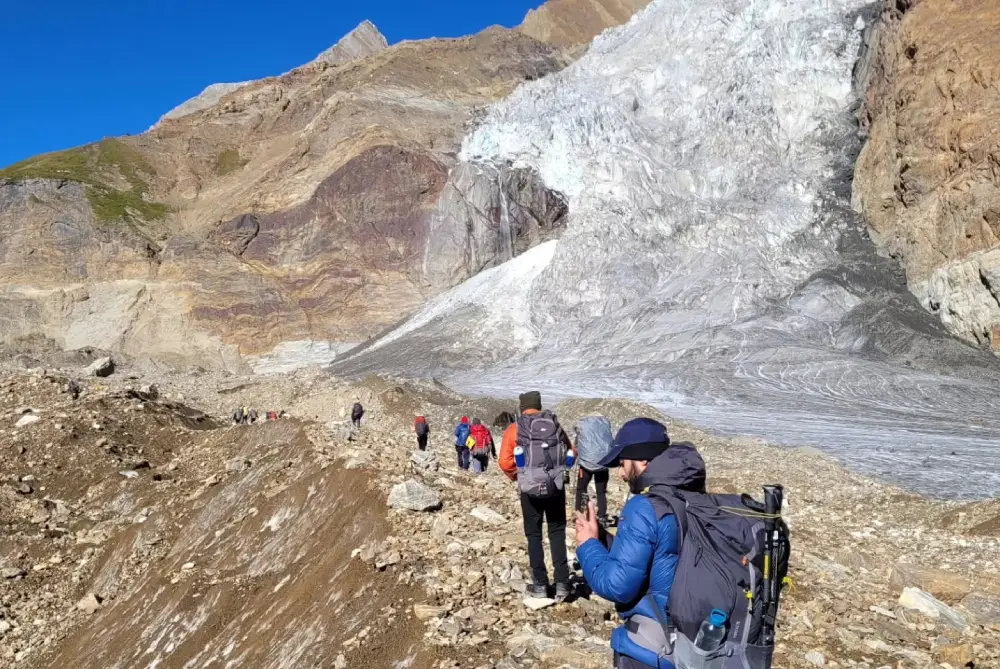
The mountains are changing too. Kashmir’s glaciers and seasonal snowpack have long acted as a frozen reservoir, holding precipitation through the colder months and releasing it gradually as temperatures rise. That reserve is shrinking.
Glacier studies and reports in 2026 have renewed concern over Kolahoi and Thajwas, with one account noting that Kolahoi has lost more than a quarter of its area over roughly six decades and continues to retreat. Faster melting may swell rivers for now, but it draws on a shrinking reserve; as the ice recedes, so does the water available for the future.
Bigger Picture
Taken together, these threads tell a larger story than any single dry spring, shrinking lake or rainfall deficit. Kashmir is not simply facing a shortage of water at the tap. It is seeing stress across the entire system that collects, stores, moves and replenishes that water, from the mountains and glaciers to the lakes and wetlands, from the groundwater beneath the Valley to the springs that bring it back to the surface. The concern, then, is not only how much water Kashmir has today, but whether its natural water infrastructure will still provide enough of it tomorrow.