As drug abuse emerges as a major challenge in Jammu and Kashmir, law enforcement agencies have launched an intensified campaign to dismantle cartels and hold those involved accountable, reports Masood Hussain
Lau Gujjar, born Gulzar Ahmad in Sarore Adda and now based in the Chak Waziru hamlet of Bishnah, has emerged as the key figure in Jammu and Kashmir’s crackdown on narcotics. Officials describe his case as a test of the region’s fight against the drug trade, which has consumed thousands of lives and pushed families to bankruptcy.
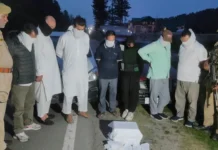
After remaining on the run for over a decade, initially in connection with petty offences and later for alleged involvement in large-scale drug trafficking, Lau was arrested on April 4 during a coordinated raid in Prithvipur, Miran Sahib. Authorities said he was found in possession of 340 grams of heroin and a loaded Glock pistol.
Investigators allege Lau’s network sourced heroin from Pakistan using drones, and some consignments would arrive through Kartarpur (Punjab). His arrest follows earlier detentions in the same network. His brother Falla Gujjar was arrested in February. Another brother, Yaqoob Ali, was arrested in September 2023. Police have also questioned his parents, who were taken after his arrest.
During interrogation, sleuths assert he revealed supply routes and clients. The network, they claim, extended into Punjab and Himachal Pradesh. After his arrest, nine more people were detained. These include Manna Bibi, Mushtaq Ahmad, Roshi, Majida Bibi, and Bachu Pehalwan.
A Special Investigation Team is now probing the case. Officials estimate the network trafficked up to 360 kilograms of heroin. Its value is put at around Rs 792 crore. The monthly movement was about five kilograms. Bank accounts linked to the accused have been frozen. Nine properties have been identified for possible demolition, and some of them have already been demolished.
A Test Case
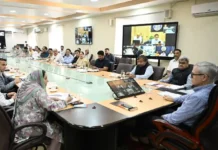
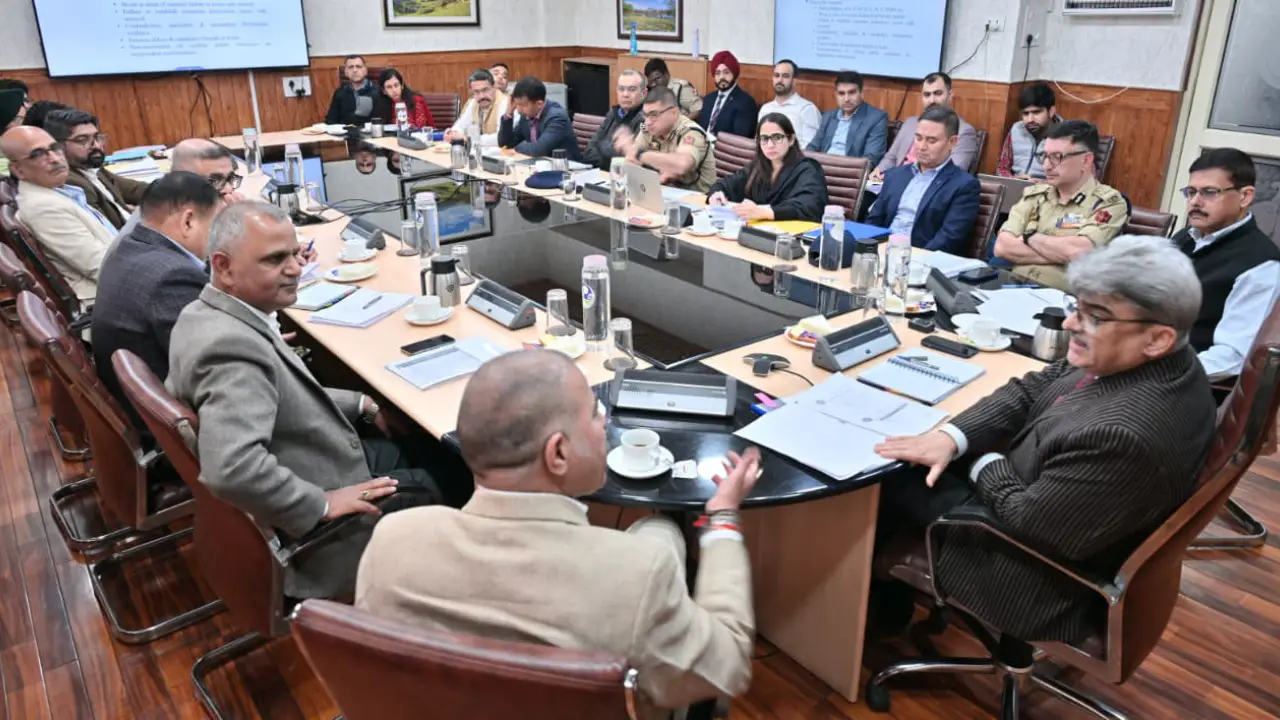
On May 5, when senior officers of Jammu and Kashmir’s law enforcement and civil administration gathered for the NCORD (Narco Coordination Centre) meeting in Srinagar, the atmosphere was a blend of cautious optimism and hard-nosed urgency. In the data-driven stocktaking, it was Lau’s capture that gave the security grid a lot of leg room in explaining its fight against the drug mafia.
The backdrop could not have been starker. Jammu and Kashmir Lieutenant Governor Manoj Sinha, has set a 100-day deadline to dismantle the drug networks corroding communities across Kashmir and Jammu. Every department, police, health, excise, revenue, and prosecution has been placed on notice. This made the meeting less of a review and more of an accountability
The granular data shared by the security grid pointed to an encouraging trend in law enforcement. At the same time, however, it underscored the scale of the problem on the ground.
The Numbers
Between January and March 2026, the meeting was told that police registered 542 cases, arrested 716 persons, and seized 640 kg of narcotic drugs. The number of cases represents a jump of nearly 20 per cent over the same period in 2024, when 453 cases were filed.
Other than cases registered by the Railways and the ANTF, Jammu emerges as the erstwhile state’s new drug capital. As many as 429 people were arrested in 276 recently registered cases, against 323 in Kashmir, where 250 cases were registered.
Perhaps more telling than raw case numbers is the value of property attached from drug proceeds. In the first quarter of 2026, properties worth Rs 18.49 crore were frozen or attached, compared to Rs 5.04 crore in the same quarter of 2024.
Commercial quantity cases, the benchmark of organised trafficking rather than petty peddling, have also spiked. Thirty-one such cases were registered in January–March 2026, compared to 19 in the previous year. Significant seizures include 2.337 kg of heroin recovered in Kupwara, 1.972 kg of cocaine seized in Samba and 8.85 kg of charas recovered by the Anti-Narcotics Task Force in Jammu from an inter-state syndicate.
In the first quarter of 2026, forward-backwards link analysis was carried out in 24 cases, leading to the arrest of 28 drug dealers and the attachment of properties worth Rs 53.77 lakh. Two individuals were detained under the Prevention of Illicit Traffic in Narcotic Drugs and Psychotropic Substances (PIT NDPS) Act, a preventive detention law that allows authorities to hold traffickers without bail for up to a year when the evidence trail is strong but the trial is distant.
The cumulative figures under PIT NDPS are striking.
Detentions have covered 101 individuals whose 120 properties worth Rs 24.04 crore in total have been attached. These are assets built on drug money: houses, vehicles, land, and commercial establishments.
Under the SAFEEMA, the J&K Smugglers and Foreign Exchange Manipulators Act, 38 properties with a combined value of Rs 18.49 crore were confirmed for confiscation in the first quarter of 2026 alone.
So far, properties worth Rs 15 crore have been demolished and properties worth Rs 12 crore attached, the meeting was informed.
The Non-Kinetic Squeeze
One of the most underreported dimensions of Jammu and Kashmir’s counter-narcotics strategy is what the administration calls Non-Kinetic Action, formalised under SOP No 240 dated April 17, 2026. It makes a drug trafficker administratively and socially expensive, entirely apart from criminal prosecution.
Under this SOP, conviction or even arrest in an NDPS case can trigger a cascade of consequences: cancellation of a driving licence, suspension of vehicle registration, revocation of an arms licence, cancellation of a contractor licence, loss of government-provided accommodation, and withdrawal of government-provided security. Passport impoundment, coordinated with the CID, is an additional lever available to enforcement agencies.
In the first quarter of 2026 alone, 489 driving licences were recommended for cancellation, and 140 were cancelled; 700 vehicle registrations were recommended for suspension, and 140 were suspended. In the full year 2025, 290 driving licences were cancelled and 260 vehicle registrations suspended.
Prosecution Problems
Enforcement numbers mean little if cases collapse in court. The NCORD presentation was unusually candid about the weaknesses in the prosecution chain.
In 2024, there were 135 convictions, including four commercial cases. In 2025, it was 140 convictions, including 20 in commercial cases. The 2026 Q1 saw 23 convictions, including in three commercial trafficking cases.
The meeting was told that since 2010, the Jammu and Kashmir Police have registered 2435 cases, of which 2331 are charge sheeted, and 1839 are under trial.
In 2025, 134 commercial-quantity NDPS cases ended in acquittal. The reasons are documented and damning: non-compliance with critical sections of the NDPS Act at the investigation stage; breaks in the chain of custody; failure to establish conscious possession beyond a reasonable doubt; contradictory or incomplete prosecution evidence; delays in forensic reports; and the absence of independent civilian witnesses.
Now the meeting decided that the concerned would conduct a stage-wise analysis of all 2,200 under-trial commercial-quantity cases, from charge stage through cross-examination to final arguments. In the first quarter of 2026, prosecution witnesses attended 1,435 court hearings in special NDPS courts, with 839 witnesses successfully examined. Both figures mark significant improvements over previous quarters, the meeting was told.
A parallel problem is the sheer pace of trial. Special NDPS courts in J&K carry a backlog of over 6,150 cases, with an average of more than 1,200 pending per court. The broader judicial system carries an additional 4,800 NDPS cases. Now additional video conferencing infrastructure is being added to help witnesses record their statements.
The Enemy Within
Perhaps nothing undercuts a government’s war on drugs more devastatingly than the discovery that its own employees are part of the problem. The aggregate picture is already damning.
Across all departments combined, 734 government employees have been identified as being involved in NDPS cases. Against these, departmental proceedings have been initiated in 616 cases. Of those, 176 employees have been dismissed from service, 57 have been compulsorily retired, and various other punishments, including reductions in rank, stoppage of increments, and censure, have been handed out in a further 183 cases.
The most detailed and closely tracked data concerns the Jammu and Kashmir Police itself. Of 211 police personnel found involved in NDPS cases, 104 have been dismissed, representing the most decisive action taken by any department. A further 83 have received other punishments ranging from compulsory retirement to a reduction in rank. Only 21 cases remain under process, a relatively small residual number that the department has committed to resolving within the current quarter.
The School Education Department presents one of the most alarming profiles in the NCORD data, not because of the volume of cases, but because of what the cases represent. Teachers and school staff involved in the drug trade occupy positions of trust and daily proximity to children who are the primary targets of drug networks.
Of the 29 employees identified in NDPS cases within this department, five have been dismissed, and 21 cases are under process. The department has been sluggish in acting against these staffers.
Jal Shakti (Water Works) department has dismissed 20 of the 23 employees involved in NDPS cases. Rural Development and Power Development departments have 13 employees each, with NDPS cases and have dismissed three and four, respectively. Health and Medical Education has dismissed four of its 17 NDPC-accused employees so far.
There are 13 staffers from agriculture, 11 from housing and urban Development, 10 each from Revenue and Consumer Affairs, seven from forests, six from Road and Buildings, three from Youth Services and Sports, three from banks and cooperatives, two from Social Welfare and one from Finance departments who have NDPS cases against them.
A Scale of Vigil
While it is practically impossible to physically chase every nook and corner where drugs are accessed, sold or consumed, the CCTV is emerging as a witness and a guard. The meeting was told that more than 23,800 retail and wholesale chemist outlets and pharmacies across Kashmir and Jammu are now covered by CCTV cameras and a mandatory Computer Billing System that digitally logs every transaction.
Between January and April 2026, six pharmacy licences were cancelled for non-maintenance of records. Seizures of Tapentadol and Pregabalin from unregulated channels during the first quarter were valued at nearly Rs 40 lakh, quantities that, had they reached the street, would have sustained addiction among hundreds of individuals across Jammu and Kashmir.
What is interesting is that Jammu and Kashmir has identified 160 hot spots as far as the drug menace goes, and all these spots are watched through a 2815 CCTV network with shared shareholding. The fascinating part is that these include 1982 CCTV owned, managed and monitored by the civilians, the meeting was told. Jammu, Baramulla, Anantnag and Kulgam have two-digit hotspots, unlike other districts.
Private de-addiction centres have also come under tighter regulatory scrutiny. Of the 17 functional private DDCs across Jammu and Kashmir, 13 are now compliant after inspections. In Jammu, one centre has been sealed and two have had their registrations cancelled. Kashmir has four DDCs operational in the private sector. A statutory order framed by the Health Department under Section 71 of the NDPS Act now provides the regulatory backbone for this oversight, closing a loophole that had allowed poorly run centres to operate without accountability for years.
Challenges Ahead
Right now, when LG Sinha is moving from town to town with his anti-drug yatra, the crisis remains. The meeting was told that in 2025, government agencies destroyed all the poppy cultivation and the charas (cannabis) plantations that wildly grows. This year, they are still waiting for the satellite imagery to act on.
As part of the three-year Comprehensive Plan, currently being formulated, the Narcotics Control Bureau is expected to be the nodal agency. Plans include putting a mechanism in place qt the district level in which ANTF standards will be implemented. It envisages infrastructure development, enforcement and legal action, rehabilitation and health intervention, technology and surveillance, community participation, and a robust review-and-monitoring mechanism.