After a gunman nearly killed Farooq Abdullah in Jammu, Kashmir’s legislators spent a furious Assembly sitting demanding to know why the administration has stripped their security, and who will answer when the next attack comes, reports Syed Shadab Ali Gillani
Weeks had not passed since a gunman had nearly shot Farooq Abdullah dead at a Jammu wedding. The Assembly had since convened. And legislators arrived to find that the security cover at Nawai Subh, the ruling National Conference’s historic headquarters in Srinagar, had not been thinned. It had been completely withdrawn.
Around the same time, escorts and personnel were being pulled from MLAs across the non-BJP benches, apparently without notice and without explanation. The explanation that eventually reached Congress chief Tariq Hameed Karra, when he rang a senior police official to protest, was terse: companies had been redeployed for elections in West Bengal, and there was, in any case, no fuel. Karra reportedly told the officer he would supply his own petrol; just do not leave him unguarded on the streets of Srinagar. The answer, apparently, was silence.
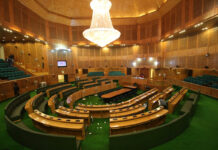
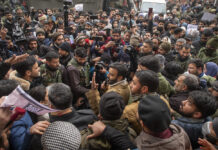
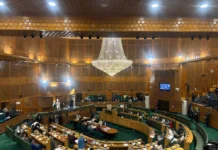
The revelation detonated the proceedings. For the better part of a day, lawmakers from the JKNC, Congress, CPIM and PDP abandoned the official agenda to confront what they termed as “a deliberate and dangerous dismantling of their protection”. The debate went far beyond protocol or the usual grievances about administrative slights.
It became a reckoning with a more fundamental question. Is the state willing to protect the very people it sends to govern a region where the price of politics has, for thirty years, been paid in blood? This session made plain that the answer is nowhere near settled.
The Wound Still Fresh
The attempt on Farooq Abdullah’s life was a rupture of an unusual kind. Militancy has claimed scores of political lives across three decades in Jammu and Kashmir, party workers, sitting legislators, ordinary voters who turned up on election day and did not come home. But those killings arrived from a familiar, if brutal, direction.
The assailant at the Jammu wedding was not a Kashmiri militant. He was a non-Muslim from Jammu, firing at the most recognisable face in mainstream Kashmiri politics at point-blank range during a public function. The shock was not only in the act but in its geography and its author.
That the administration’s response was to remove the last guard from Nawai Subh stunned even the Chief Minister. Omar Abdullah, speaking to reporters outside the House, called it ‘incomprehensible’ and noted that his father visits the office two to three times a week.
He was careful with his words, but the weight was unmistakable: the security at the headquarters had not been reduced but completely withdrawn. He wanted the administration to explain what compelled that decision. He received no immediate answer, and the question hung over the sitting all day.
Inside the Assembly, Speaker Abdul Rahim Rather issued what amounted to a public ultimatum. Security in Jammu and Kashmir, he said from the chair, cannot be treated as an administrative afterthought or adjusted at bureaucratic whim. The gravity of past incidents must guide present decisions, he said. If the administration genuinely believes the situation has normalised, Rather asserted, let it say so plainly and declare the region risk-free. And if it cannot say that, the protections must be restored without delay.
It was about as close to a reprimand from the chair as parliamentary convention allows, and the administration’s silence in response spoke for itself.
A Party Built on Its Graves
For the JKNC, an unguarded Nawai Subh is not merely a security question. The building has, for decades, been the public face of the party’s effort to hold the mainstream together in a region where outlaws have repeatedly tried to make it ungovernable. Ordinary citizens come there with grievances; workers and leaders pass through it daily.
Hasnain Masoodi, an erstwhile High Court judge, now representing Pampore in the assembly, argued that a party whose cadre has been killed in large numbers over three decades, and whose headquarters remains a living hub of public activity, should have had its protection strengthened in the wake of the attempt on Abdullah’s life and not removed entirely. He called the withdrawal a “well-planned conspiracy”.
His colleague Nazir Gurezi drew a comparison the House found difficult to dismiss. Punjab and Himachal Pradesh, where there is no insurgency and no credible militant threat, maintain security details at political party offices as a matter of course. Jammu and Kashmir, dealing with an active militancy and still absorbing the shock of a near-assassination, has removed the cover from its ruling party’s most important address.
The Lieutenant Governor controls this apparatus, Gurezi reminded the House, and would therefore bear responsibility for whatever followed.
The Arithmetic of Vulnerability
The outrage moved quickly from buildings to bodies. Congress’s Nizam ud Din Bhat (Bandipora) laid out the contradiction with clinical precision. Elected representatives who, by the nature of their work, attend sessions, making speeches, taking positions that upset powerful people, are more exposed than ordinary citizens, were losing their escorts. Administrative officers, who do none of those things, were travelling with heavy cover, he pointed out.
In his own Bandipora constituency, Bhat said, he has no house guard. A political worker from an unnamed party in his neighbourhood, by contrast, is protected by seven personnel. He invoked the Reorganisation Act: a member of this House stands constitutionally equal to a Member of Parliament. The current arrangement treats them as something considerably less, and he wanted to know on what basis that distinction had been made.
City lawmaker Salman Sagar added a detail that sharpened the irony further. Intelligence agencies had, not long ago, placed several legislators on a militant hit list and briefly equipped them with bulletproof vehicles, a tacit acknowledgement that the threat was real and specific. Those protections were then quietly revoked.
In his own Hazratbal constituency, Sagar said, the local Station House Officer calls periodically to advise him against entering certain areas. The security establishment, in other words, knows the risks well enough to warn him informally. It has simply decided not to do anything formal about them.
A Police State, or a Picnic?
The most scalding assessment of the day came from Karra himself. A former Finance Minister, he spoke outside the House with the kind of freedom the corridor affords. He described the administration as a collection of officers who treat a posting in Jammu and Kashmir as a working holiday, present in body, indifferent to the consequences of their decisions, and entirely unaccountable for their failures.
Karra connected the security collapse directly to the Pahalgam massacre in which 26 tourists were killed, arguing that the same pattern — cover deployed, cover withdrawn, disaster following, had played out there first and was now being rehearsed with elected officials as the exposed party. After Pahalgam, Karra noted, not a single officer had faced consequences. No suspension, no transfer under duress, no official acknowledgement of culpability. The administration had fixed accountability nowhere. And yet it continues to move through the Valley in convoy.
Of the Assembly’s ninety members, Karra estimated, sixty are now without any protection whatsoever, a figure he put to the administration with a grimness that the chamber absorbed in near-silence. “When they come to put a wreath,” he said, “it will be too late.”
Friction within the House
Not every voice pointed in the same direction.
Sajad Lone, who acknowledged he too has no house guard, took a different line from the one his fellow legislators expected. He accused the ruling JKNC of performing grief rather than pursuing remedies. He suggested that members write formally to the Home Ministry, where the government does have representation, rather than converting the session into a public protest.
It was a pointed observation about the NC’s structural position: they lead the elected government but do not control the security apparatus. Lone was making sure the House understood the gap between the two. The implication, not entirely unfair, was that the outrage was partly theatre.
Javed Baig did not take it quietly. He invoked the murder of Lone’s own father as evidence that security failures in this region are not abstract and not theatrical; they end lives, including the lives of people in that very chamber. He accused Lone of reflexively siding with the administration and the BJP whenever lapses were raised, and warned that the power the LG currently holds over these levers will not last indefinitely.
Deputy Chief Minister Surinder Choudhary, threading a more careful line, insisted that security must be determined by threat and sacrifice, not by political convenience. Any arbitrary withdrawal is inappropriate, he said, and the matter, having been raised across party lines, would surely have reached the LG’s attention. It was measured, and it stopped well short of a commitment.
From the BJP benches, RS Pathania read the situation entirely differently. The escorts, he suggested, had been temporarily redeployed for a neighbouring state’s elections. Since the legislators were in Jammu for the session in any case, their security personnel were idle back in Kashmir. To make a crisis of a routine redeployment lasting three weeks was, he said, precisely the kind of drama the JKNC reaches for when it runs short of more substantial arguments.
Interestingly, ever since Omar was elected to power, the responsible on security situations comes from BJP lawmakers and not the Lok Bhawan, where the power rests.
The Unanswered Question
By the time the session ended, no assurance had arrived from Raj Bhavan. The legislators left with their demand on record and the structural reality fully visible to anyone who cared to look: the elected government of Jammu and Kashmir does not control the police, the security postings, or the movement of officers.
The home department answers to the LG, not to the Chief Minister. When Minister Sakina Itoo was asked whether the government would intervene, she was candid to the point of bleakness: the home ministry, she said, is simply not under the government’s control.
That is the fault line the session exposed, and it runs deeper than any individual security decision. The people who bear the political cost of governing Kashmir, who make the speeches, attend the funerals, absorb the anger of constituents, and take positions that generate enemies, have no authority over the apparatus meant to protect them from the consequences of doing so. The LG holds that authority. The elected government watches, and protests, and is told the matter will be looked into.
Karra, in his final remarks outside the House, put it with the directness the occasion seemed to demand. The administration, he said, decides what the threat perception of elected officials is, and then assigns itself protection on an entirely different scale. Officers who are supposed to be protecting life and property are instead, in his view, playing games with both.