Retaining Urdu as a formal requirement for revenue administration posts is insufficient on its own. A structured set of countermeasures, beginning with comprehensive digital integration and support for Urdu, is necessary to prevent its gradual marginalisation, argues Haseeb A Drabu
While the outrage over removing knowledge of Urdu as a mandatory requirement for revenue administrators is completely justified, it appears somewhat misplaced – the change has not been notified. However, the mere issuance of a stakeholder consultation notice is enough to raise suspicions and spark insecurities and angst.
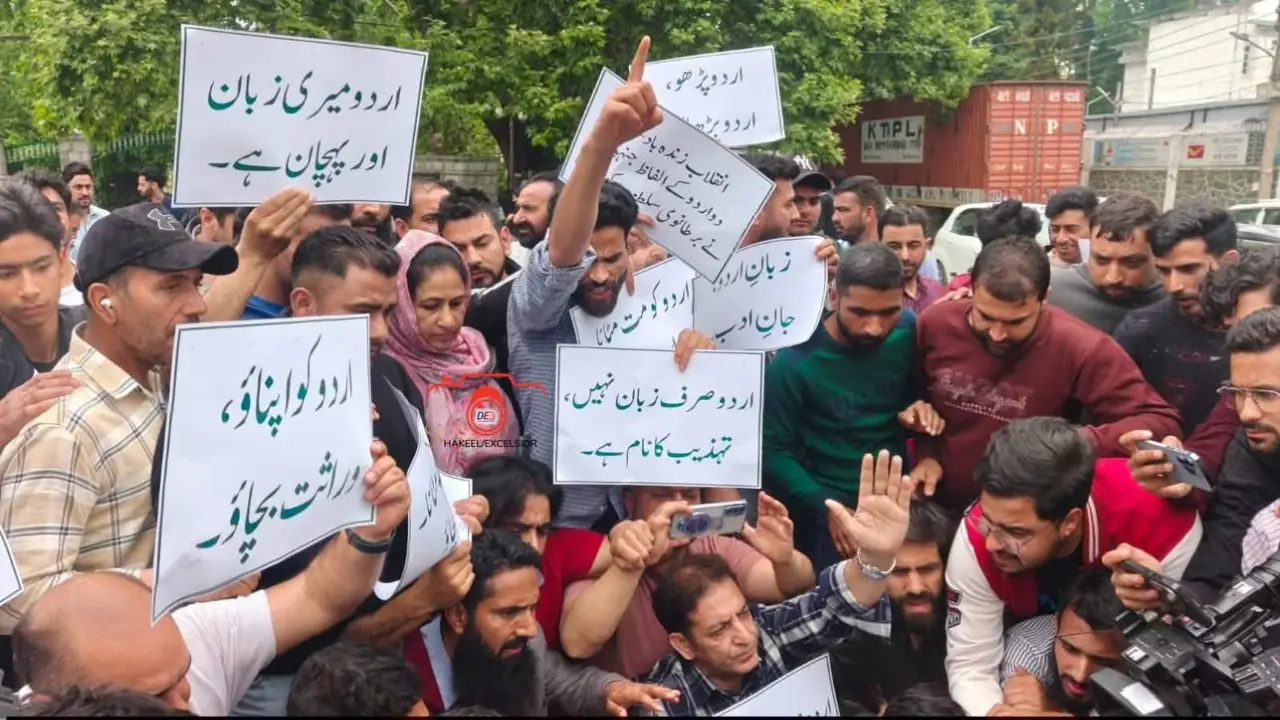
The intent and optics of the move are poor. Especially after the Jammu and Kashmir Official Languages Bill, 2020, ended Urdu’s status as the sole official language by adding Kashmiri, Dogri, Hindi, and English alongside it. Also, the Central Administrative Tribunal’s directive to the Jammu and Kashmir Service Selection Board (JKSSB) allowing candidates proficient in any of the five official languages has further accelerated this shift.
The issue extends beyond employment. It concerns the risk of rendering Urdu, the historical lingua franca of administration, redundant in one of the most critical domains of governance: land ownership. It becomes particularly emotive when framed as an assault on Muslim identity, even though there are compelling administrative grounds to retain the Urdu as a mandatory qualification for revenue posts.
Across Jammu and Kashmir, be it Jammu, Pir Panjal, Chenab, or the Valley of Kashmir, all land records remain in Urdu Nastaliq script. The entire revenue system, including the Record of Rights (Jamabandi), crop inspection (Girdawari), and mutations (Intiqal), operates in Urdu. These Persian-origin terms underscore the system’s historical roots in the British-era Mahalwari settlement of Punjab, indicating that is neither Kashmir-specific nor Muslim-oriented.
Systemic Shift
However, over the years, there have been developments, especially the technical, efficiency-driven reforms, that carry deeper structural consequences for the Urdu language. The systemic change that has already marginalised Urdu is the digitalisation of land records.
While the benefits of digitisation are undeniable, improves transparency, reduces corruption, speeds up mutations, and enables online access, it effectively eliminates Urdu from day-to-day use.
Launched nationally in 1996, digitisation gained momentum in the Jammu and Kashmir only after the abrogation of Article 370. By early 2025, Jamabandi records had been digitised in 6,838 of 6,850 revenue villages. The new system and software are primarily in English (with some Hindi elements), offering minimal or no support for Nastaliq script. Old handwritten Urdu records have been scanned as images, but new entries, searches, mutations, and extracts are generated in English.
This administrative upgrade has brought along a systemic shift that erodes Urdu’s institutional role, accelerating its decline from a working official language to a more symbolic or cultural one. The revenue administrative “operating system” of Jammu and Kashmir, where Urdu was deeply embedded, has been rewired making its marginalisation an inevitable by-product of modernisation. The fact is that digitisation is not culturally neutral.
The Persian Case
Considering such transformative developments, the larger question Kashmir must confront is far deeper: how does Urdu survive as a living tongue in the Valley. Languages do not live or die by government orders, notifications, or recruitment circulars. They survive or perish through the daily choices of societies and the utilitarian spirit of the markets. The life of a language is not in government circulars, but through the civil society and the market of commerce.
History offers a stark lesson. Persian was the court language of Kashmir for centuries under the Mughals, Afghans, and early Dogras. It shaped administration, literary culture, and elite discourse. Yet it receded rapidly once Urdu, a more accessible, Persian-influenced vernacular, emerged in the late 19th century as the practical link language of governance. Persian survives today only in classical scholarship, the Sufi recitations at shrines and scattered loanwords in Kashmiri. No royal farman or administrative decree could keep it alive once society stopped using it at home and in the bazaar.
Ironically, the Kashmiri civil society has, in a perverse twist, helped Urdu at the direct expense of Kashmiri. In countless urban and semi-urban homes parents consciously shifted to Urdu believing it elevated their social standing and offered better prospects for their children.
The result is painful but clear: Kashmiri became the language of grandparents and villages, while Urdu became the default domestic lingua franca. This is the real cultural blow. Kashmiri’s literary riches and its unique Dardic grammar deserve transmission in the cradle, not merely in academic seminars or cultural programmes. Urdu gained ground, but at the cost of the Kashmir’s own linguistic soul.
The Market
The market question is even more unforgiving. Urdu was once the language of commerce in Kashmir. All trade accounts were maintained in Urdu. For instance, wataks, the invoices and account notes that ran the apple trade and horticulture economy, were written in Urdu until recently. Local mandis, commission agents, and exporters conducted business in it.
But liberalisation, computerisation, banking reforms, and national supply chains changed everything. Contracts, phytosanitary certificates, payment and export invoices and even banking apps operate in English. Urdu lost its utility in the very sector that still drives rural Kashmir’s livelihood. Nor does socialisation happen in Urdu.
Today, the “market” for Urdu is largely cultural and marginally administrative, confined to the revenue records. There too, with the digitalisation of land records, it has lost primacy, if not relevance as a bridge language. Urdu serves as a language of archival record and functions as a bridge language, not a growth language.
The Urdu Significance
Urdu should certainly be given due prominence. It is part of our shared civilisational inheritance. But its revival and propagation cannot be outsourced to the civil secretariat. What is most important to realise is that official status and recruitment rules cannot nor have ever saved a language that people themselves have stopped speaking at home or stopped needing in the marketplace. Persian did not survive on farman; Kashmiri will not be revived by notifications; Urdu will not endure through job circulars.
The space where Urdu can, and must, be given a sustainable, high-value role lies in academia. Between Kashmiri as the intimate language of the Valley and English as the language of the world, Urdu occupies a natural middle ground as the language of specialised scholarship. A substantial body of Kashmir-specific historical material from the late 19th century onward exists primarily, and sometimes exclusively, in Urdu.
The Dogra-era shift in 1889, when Maharaja Pratap Singh replaced Persian with Urdu as the court language, triggered an explosion of Urdu historiography, journalism, and scholarship. Works such as Tareekh-e-Kashmir by authors like Maulvi Shad or Hargopal Kaul Khasta, Tarikh Nigaristaan-e-Kashmir, and similar texts preserved local narratives that later English-language histories often summarise or reinterpret.
The political awakening from the 1920s to the 1970s was documented and shaped through Urdu newspapers. Historians studying the freedom movement, the Praja Sabha, or the Sheikh Abdullah era rely heavily on those primary sources. English secondary literature frequently cites them, but the originals, and the nuance they carry, are in Urdu.
The Way Out
Treating Urdu as the language of historical record and research creates exactly the kind of market that ensures survival: academic publishing, research grants, conferences, and digital humanities projects. University-level research clusters at University of Kashmir’s Departments of History and Urdu, could explicitly prioritise Urdu-source doctoral work.
Fellowships for Urdu Historiography of Kashmir would generate genuine demand. Digital preservation is equally vital: scanning and OCR-ing the Urdu archives and pairing them with English summaries or parallel texts would allow global scholars access while keeping the original language alive among local researchers. Publication incentives, peer-reviewed journals or a dedicated Kashmir Studies series that accept Urdu papers alongside English ones would mirror how Persian or Arabic survives in specialised Indological or Islamic studies: not as a mass language, but as the scholarly key to certain archives.
This approach avoids the usual trap of reducing language to symbolic identity politics. Done right, it strengthens both Urdu’s survival and Kashmir’s own historical self-understanding. The only risk is if we treat the exercise as ritual rather than rigorous scholarship. The niche could usefully extend to related fields but it must remain anchored in historiography to retain its intellectual credibility and economic logic.
From a purely administrative standpoint, it is not enough retaining Urdu as a mandatory requirement to get a job in the revenue administration. There is need for a series of countermeasures starting with full Urdu digital support to prevent linguistic erasure. The government must build safeguards of bilingual records, and Nastaliq integration to prevent an irreversible tilt toward English. Similar shifts have occurred elsewhere in India, where regional languages lost ground to English in e-governance.
The national Digital India Land Records Modernisation Programme mandates local-language support. To be fair, the Jammu and Kashmir government in 2021-2022 did well to introduce Trilingual Digital Land Passbooks. Every landowner can get a digital passbook with land details (ownership, mutations, etc.) in Urdu, Hindi, and English. This was explicitly designed to make records accessible while preserving Urdu’s historical role in revenue documentation. A key feature that needs to be actively propagated is the automatic transliteration of Records of Rights into Kashmiri, which is one of the 22 languages listed in the Eighth Schedule of the Indian Constitution.
Ultimately, Urdu’s future in Kashmir will not be decided in the Revenue department or the information department of the Secretariat. It will be decided in homes that choose what language children speak at dinner, in publishers who print new Kashmiri-Urdu literature that people buy, in digital creators who produce content young Kashmiris consume, and in local markets that find fresh economic reasons to use it. The larger point, applicable in equal measure to Kashmiri, is that we must outgrow the habit of expecting government to breathe life into a language when society itself has stepped back.
The real issue, then, is not only confined to whether Urdu is mandatory in a recruitment rule. It is whether we, as a society, continue to value it for what it uniquely offers: a rich, irreplaceable archive of our modern history.
Give it that academic space, seriously and un-apologetically, and Urdu will not merely survive; it will contribute meaningfully to Kashmir’s intellectual life. Ignore that space, and no circular will save it. The mohalla and the market, not the ministry, will deliver the verdict.
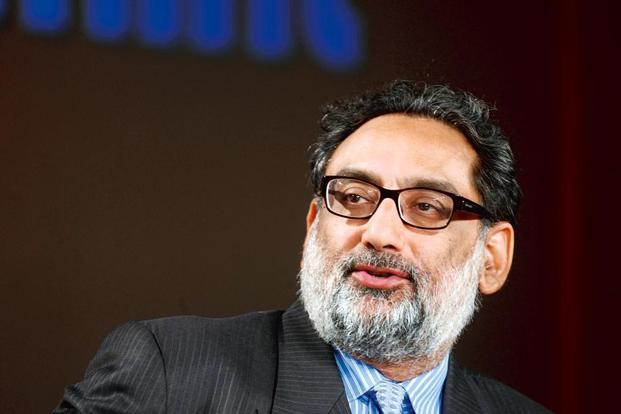
(An economist and an editor, the author was Jammu and Kashmir state’s last finance minister.)