Kashmir is witnessing unprecedented February warmth in 2026, with temperatures 9–10°C above normal, early tree blooming, drought, reduced snowfall, and rising concerns for apple orchards, agriculture, water supply, and winter tourism, reports Babra Wani
Sara Beghum, 80, a resident of Anantnag, often recalls her childhood stories to her grandchildren. One of the fondest memories she shares is about snow.
“We used to sing when it snowed. Sheene peatow peatow, maame yitow yitow,” Sara recalled, “and it used to snow very heavily, sometimes even in March. Now is different, even February this year feels like summer.”
She is correct. The data confirms that February 2026 registered significantly elevated temperatures. The winter chill receded sharply across Kashmir as Srinagar recorded its highest-ever February daytime temperature on February 21, 2026, with the mercury rising to 21.0°C, a full 10°C above the seasonal norm.
According to independent weather forecaster Faizan Arif, the previous all-time February record for Srinagar was 20.6°C, which was recorded on February 24, 2016. The reading has officially made it the warmest February day ever recorded in the city.
What has particularly alarmed meteorologists is the magnitude of the anomaly. At +10°C above the seasonal average, the deviation is exceptional for late winter in the Kashmir region. The prevailing conditions are more characteristic of mid-April than February, underscoring the unusual nature of the current spell.
“This never happened before,” Sara lamented, “I have seen Kashmir’s 80 summers and 80 winters, but none of the winters has been this hot. Even though the winters have been dry before as well, but not this warm.”
A General Phenomenon
Sara is not alone in holding this view about the winters; it is a sentiment echoed by a large number of Kashmiris, many of whom share the same perception. They were not so unhappy over the intense cold in a dry summer as they are over sunny April days in February.
“I have started unpacking summer clothing because wearing a sweater now feels like a burden. All the coats and jackets and pherans are useless now,” said Saba, a resident of Srinagar. “What I am more worried about is the summers now. Given that we had dry and warm winters, I feel like the summers are going to be harsh.”
The unusual warmth is not confined to Srinagar alone. Several stations across the Kashmir division reported maximum temperatures 9 to 10 degrees above normal earlier this week.
Qazigund recorded a maximum of 21.0°C against a normal of 10. 1°C. Pahalgam registered 16.5°C compared to the normal 7.5°C, while Kupwara settled at 19.8°C against 10.1°C normal. The ski resort of Gulmarg recorded 11.6°C, nearly 9.6°C above normal for this time of year.
In the Jammu division, Jammu recorded a maximum of 26.2°C against the normal 22.3°C. Kathua registered 26.0°C against 22.5°C normal, while Bhaderwah recorded 19.0°C compared to 14.2°C normal.
Night temperatures, too, have remained above average at most locations. In Srinagar, the minimum settled at 1.8°C, slightly above the normal of 1.5°C, while Pahalgam recorded a low of minus 2.0°C. Jammu city registered a minimum of 12.1°C, compared to the normal 11.1°C.
March Forecasts
The outlook for the first week of March indicates generally cloudy weather from March 1 to 3, with light rain or snow over higher reaches at isolated to scattered places. From March 4 to 7, the weather is expected to remain partly cloudy.
The MeT office has advised farmers to continue farm operations, noting that a further rise in both minimum and maximum temperatures is likely over the next six days. No major weather warning has been issued for the coming week.
“I am worried about summers. It is but natural that the water level will decrease and our day-to-day life will get affected,” said an orchardist from Kulgam. “Last year, the climate was not that favourable. This time as well, the indications are the same.”
“With a lack of snow and precipitation, there is a lack of soil moisture, which cannot provide water for the trees to grow well. Lack of this moisture during February, which is flowering time for the trees, will reduce the fruit size and overall yield for the farmers,” he added.
Early Blooming
Warmer winters can disrupt flowering cycles, increase pest activity and reduce yields. Farmers have reported early blooming of almond trees, a phenomenon usually seen in early March.
Early dry season will result in early blooming of flowers, which can result in a mismatch with pollination, which is harmful for quality. Moreover, apple trees under a lack of water from the soil are more susceptible to pests and diseases. These things, in turn, can result in bad fruit quality and lower yield.
Pertinently, early blooming has begun in a lot of places already.
“The flowers in our garden have already started blooming,” a resident of Pulwama said, “usually it happens after March, but this year we are witnessing an early bloom.”
“It is our bad luck and misfortune that there is premature flowering this season. It will result in a lot of loss. These flowers will not yield any good crop,” an almond orchard owner from Pulwama said. “Usually February sees minus temperatures, but now it is 20°C. It is very alarming, to be honest. We never saw any such warm temperatures before.”
The unseasonal warmth comes amid a staggering precipitation deficit of over 55 per cent during the peak winter months. The absence of significant Western Disturbances, moisture-laden systems that typically bring snow and rain to the Himalayas, has left the region dry.
The Meteorological Department has forecast generally dry weather across Jammu and Kashmir until the end of February.
Cascading Impact
Climate experts warn that sustained high temperatures following a weak winter snowfall could have cascading ecological and economic consequences.
According to Faizan Arif, the current weather pattern is indicating that Kashmir is under a dry heat spell. “Even though Jammu is witnessing the same as well, in Kashmir especially, the temperatures are 10 to 12°C above normal temperatures, especially during the daytime.”
This phenomenon, he explained, is very unusual and rare to see at this time of the year. “Although a few days of February are still left, it is possible that this may turn out to be one of the warmest Februarys on record, or at least among the warmest in recent times.”
On the rainfall pattern, he said, there were some light spells during the first week of the month in Kashmir. Apart from that, there has been no significant precipitation. This has resulted in a huge deficit for the month. In fact, there has been a substantial deficit from November onwards.
“January was the only month when rainfall was close to normal. In the remaining months, precipitation and snowfall were quite below normal. Because of this, the overall deficit is significant, making this one of the driest Februarys on record. This is the current climate situation.”
Ill-Timed Discharge
Commenting on the impact of the prevailing weather pattern on life in Kashmir, he said that an initial spike in river and stream discharge may be observed. “In the early phase, flows can appear relatively high. However, by late spring, summer, and autumn, discharge levels are likely to turn deficient due to below-normal winter precipitation. Consequently, water availability in rivers and streams will decline substantially in the latter part of the year, which could adversely affect agriculture and horticulture.”
He further noted that the unusual temperature profile may also alter crop cycles. “Apple orchards, in particular, could be impacted because the trees require a specific duration of chilling hours. This year, that requirement was not met owing to above-normal temperatures. As a result, productivity and fruit quality may suffer.”
He identified early blooming in trees as another emerging concern. Early bloom in itself is not inherently problematic, he explained. “The risk arises if, by mid-March or April, we experience a strong western disturbance or a windstorm. In that event, the prematurely emerged blossoms can be damaged,” he said, adding that such exposure could once again deal a blow to the horticulture sector.
He further cautioned that the impact may extend beyond orchards. Drinking water supplies are also likely to come under stress later in the year, particularly during the autumn months, when reduced river discharge begins to manifest more sharply.
“Otherwise, if we assess the average conditions from November onwards, cold spells were fewer this year. Sub-zero temperatures were not frequent, and the number of severe weather days was also lower,” Faizan observed with concern.
Apple Crisis
For the agriculture and horticulture sectors, the backbone of Kashmir’s economy, the early onset of warmth has become a source of mounting concern. Apple cultivation, the mainstay of the Valley’s horticultural landscape, depends on sustained winter chill to fulfil its critical chilling-hour requirements, which directly influence flowering, fruit set and yield.
“The apple industry has suffered greatly over the past few years,” said an orchard owner from Bijbehara. “Losses have become recurring.”
Growers and traders described 2025 as the toughest and “most disastrous” year in recent memory for Jammu and Kashmir’s fruit industry. They estimated cumulative losses of nearly Rs 2,000 crore, attributing the setback to prolonged highway closures, erratic weather conditions, weak market demand, “exorbitant” freight charges and the absence of any government compensation.
Valued at approximately Rs 15,000 crore annually, the apple industry in Kashmir directly or indirectly sustains nearly 3.5 million residents. It remains the Valley’s most significant horticultural sector and a central pillar of the regional economy. With nearly 1.72 lakh hectares under orchards, sustained improvements in fruit quality and productivity over the years have substantially strengthened rural incomes and household livelihoods.
Kashmir currently produces around 21 lakh metric tonnes (MT) of apples annually. Of this, nearly 8 lakh MT are graded as A-grade, about 7 lakh MT as B-grade, and roughly 6 lakh MT as C-grade, reflecting the scale and stratification of output across quality categories.
Skiing Under Sun
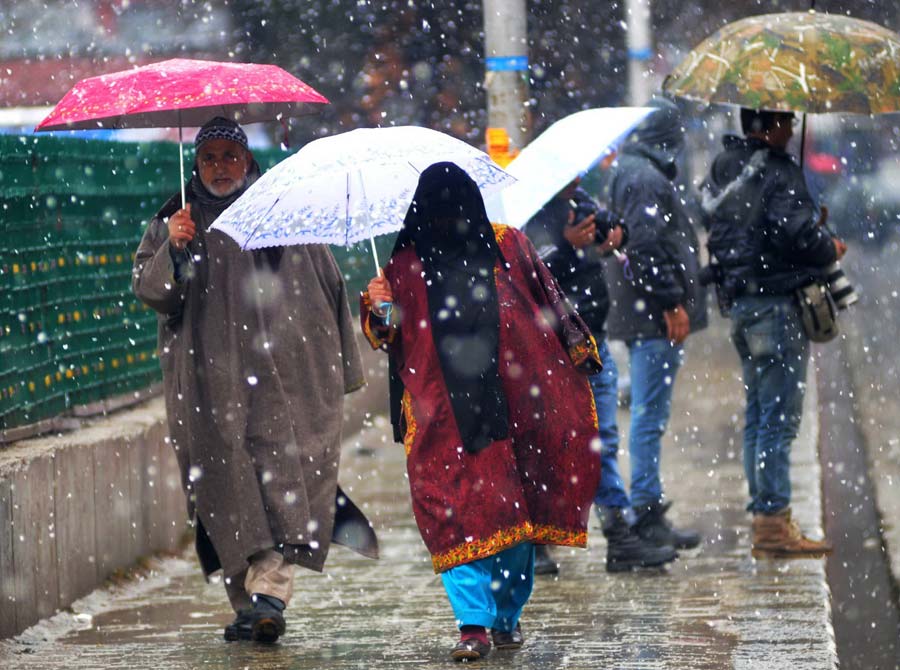
The lack of snowfall, a homestay owner in Gulmarg lamented, has left the business very low. “We suffered a lot because of the lack of snowfall this year,” he said. “We have a very small number of tourists. Because non-Kashmiri tourists come here to see snow, but there was very little this winter. Most of the tourists were left disappointed.”
Tourism stakeholders are equally concerned. Gulmarg, widely known as India’s winter sports capital, hosted the sixth edition of the Khelo India Winter Games from February 23 to 26. However, reduced snow cover and rising temperatures could shorten the winter sports season and affect visitor inflow. It actually landed Chief Minister Omar Abdullah in a sort of controversy when he suggested that the meadow, which is Kashmir’s winter wonderland, should have artificial snow for the game.
Senior meteorologists have termed the trend “worrying,” cautioning that in the absence of a substantial wet spell, temperatures could rise further in the coming days.
With February 2026 already rewriting temperature records and dry conditions continuing unabated, Kashmir appears to be witnessing what many residents describe as “April in February”, an unsettling signal of shifting climatic patterns across the Himalayan region.