Legal proceedings before the National Green Tribunal, triggered by three years of illegal riverbed mining, could force restoration of Kashmir’s iconic Sukhnag trout stream and fix accountability, writes Dr Raja Muzaffar Bhat
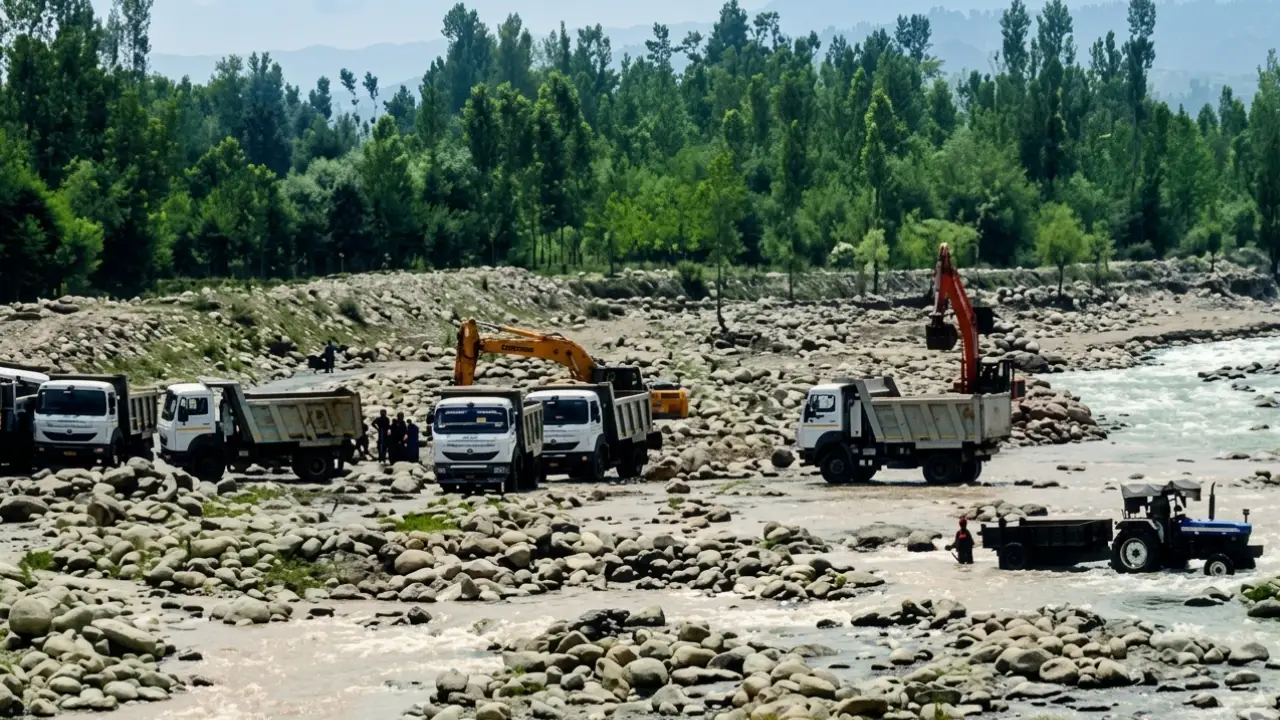
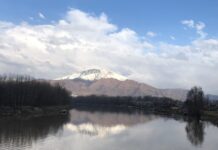
One of Kashmir’s most celebrated trout streams, Sukhnag, has long been more than a water body. Flowing through the verdant Beerwah landscape in Budgam, it has historically sustained local livelihoods, nourished a rich aquatic ecosystem, and served as a benchmark of the valley’s environmental health.
Over the past three years, however, it became the site of one of the most brazen episodes of riverbed plunder in the region’s recent memory, a devastation that only intensified after the political and administrative transformation of Jammu and Kashmir in August 2019, when the state’s special status was revoked, and it was reorganised into two centrally administered Union Territories. The systemic safeguards that had long governed natural resource extraction were weakened in that transition, and Sukhnag paid a heavy price.
From June 2022 to January 2025, approximately 200 heavy trucks operated daily along the banks of Sukhnag, extracting sand, gravel and boulders from its riverbed in Sail and surrounding villages before transporting their loads some 30 kilometres to Gudsathoo in Budgam. On a conservative estimate, material worth between Rs 15 and Rs 20 lakh was removed every single day. Over nearly three years, that adds up to thousands of crores of rupees in mineral wealth. Yet government records placed before the National Green Tribunal show that total royalty recovered by authorities amounted to barely Rs 1.30 crore, a figure that raises serious questions about collusion, negligence, and the capture of state machinery by mining interests.
A Vital Water Body
The Sukhnag is a roughly 54-kilometre tributary of the Jhelum, draining a large part of Budgam district through the heart of central Kashmir. It rises in the Tosa Maidan area of the Pir Panjal Range, fed by the Ashtar spring and the Shin Mahnew glacier, before descending through forested valleys onto the Karewa plains. From there, it passes through Arizal, Zanigam, Sail, Beerwah, Rathsun, Makhama, Kawoosa and Narbal, ultimately joining the Jhelum in the lower valley after skirting the marshy lowlands west of the Hokersar Wetland.
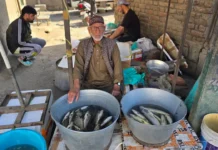
Beyond its role in the broader Indus basin hydrology, the Sukhnag is the economic lifeline of the communities along its banks. The Ahji and Lar canals draw from it to irrigate and water agricultural and horticultural lands across Budgam, while its cold, fast-flowing reaches have historically sustained productive fisheries, especially trout, and provided freshwater to rural settlements throughout its course. It is, in short, far more than a water body: it is the ecological and economic spine of central Kashmir’s most densely farmed district
The Road to the Tribunal
This writer, an environmental activist and independent researcher, raised the alarm through social media, newspaper columns and formal written complaints to offices in the Civil Secretariat and at the district level from as early as 2022. The pleas met with silence. With every administrative avenue exhausted, a formal application was filed before the National Green Tribunal in October 2024, supported by noted environmental lawyer Advocate Saurabh Sharma, whose marshalling of facts and figures proved decisive in the proceedings that followed.

At its very first hearing, the NGT’s Principal Bench, headed by Justice Prakash Srivastava, Chairman of the Tribunal, constituted a Joint Committee comprising representatives from the Central Pollution Control Board, the Ministry of Environment, Forest and Climate Change, and the Jammu and Kashmir government. The committee was tasked with verifying the facts on the ground. Its findings, delivered in January 2025, after a site visit on December 26, 2024, were unambiguous: illegal riverbed mining had devastated Sukhnag. The NGT’s three-member Principal Bench, comprising Justice Srivastava, Justice Sudhir Aggarwal and Expert Member Dr Senthil Veil, thereupon issued a complete ban on mining in the stream.
A Stream Condemned
The DC Budgam’s seven-member committee, constituted in August 2025 following a reprimand from the NGT’s Principal Bench, submitted its findings earlier this year. Its membership was broad-based: the Sub-Divisional Magistrate of Beerwah served as chairperson, joined by the DFO Budgam, Executive Engineer of the Flood Spill Channel at Narbal, the District Fisheries Officer, District Pollution Control Officer, District Mining Officer, the BDO of Sukhnag and several other officials.
The report confirmed large-scale destruction of the designated trout stream’s habitat and riverbed structure. It recommended filling the deep excavation trenches gouged by mining machinery, levelling the damaged riverbed, and constructing gabion and crate check-dams fitted with fish ladders and toe walls to restore stream flow. It further recommended the creation of artificial fish pools for trout breeding, since the natural spawning habitat of the fish had been effectively obliterated.
The NGT had simultaneously constituted a higher-level supervisory and expert committee to oversee the district committee’s work. This body included the Member Secretary of the Jammu and Kashmir Pollution Control Committee, the Regional Officer of the MoEF&CC in Chandigarh, and a nominee from the GB Pant National Institute of Himalayan Environment in Uttarakhand. At a virtual meeting held on February 24, 2026, Dr Sandipan Mukherjee, Scientist E at the Institute, stressed that because the district committee’s report was qualitative in nature, an actual site visit was essential to arrive at a proper quantitative assessment of the damage. Dr Khurshid Alam Khan, Deputy Director at the Ministry, echoed the need for more time, noting that the report had only been received on February 23, 2026 and required detailed examination.
The Human Cost
While legal arguments proceeded in New Delhi, the consequences on the ground were being borne by ordinary people with no recourse. One of the most documented cases is that of Peerzada Rayees, a trout farmer from Sail, Beerwah, whose farm is registered with the Department of Fisheries. When illegal mining operations choked the water supply channel feeding his farm, all 2,000 fish in his ponds perished. No First Information Report was filed. No compensation was assessed.
In the NGT’s order dated February 26, 2026, the Tribunal specifically directed the expert committee, during its forthcoming site visit, to visit Peerzada Rayees’s farm, examine annexure-8 of the application, a communication from the Director of Fisheries, Jammu and Kashmir, and quantify the losses he suffered. This is a small but significant step: placing a human face on an environmental disaster and ensuring that individual victims are not swallowed by the abstraction of regulatory proceedings.
The Company behind the Damage
The principal operator identified in the case is NKC Projects Pvt Ltd, a construction company awarded the contract for the Srinagar Ring Road project. The company extracted material from Sukhnag without the stream ever having been formally auctioned for riverbed mining and without any environmental clearance being obtained. Its operations relied on short-term permits issued by the DC Budgam, instruments that the Supreme Court of India had already declared illegal in its 2024 judgment in the Noble M Paikada versus Union of India case. The NGT cited that ruling when halting the mining in January 2025. NKC’s failure to pay even one per cent of the mineral cost to the Geology and Mining Department points to a pattern of conduct that warrants investigation by a central agency.
Crucially, this is not the company’s first encounter with environmental oversight. In 2022, this writer challenged the environmental clearance granted to NKC for excavating riverbed material from the Shaliganga stream in Panzan, Chadoora, and the NGT halted those operations in September of that year. Following that setback, the company simply shifted its operations to Sukhnag, 30 kilometres away, where no clearance had been granted and no auction had been conducted.
NKC challenged the Shaliganga NGT order in the Supreme Court, hiring a top-flight legal team, but lost that case too. The Supreme Court’s August 2025 judgment in that matter broke important new ground: it mandated that District Survey Reports for riverbed mining must incorporate empirical replenishment data, so that extraction does not outpace the river’s natural capacity to restore its own bed material.
What Comes Next
When the case was listed before the NGT Principal Bench on February 26, 2026, all parties were heard. The supervisory committee expressed its intention to carry out a ground inspection of Sukhnag, and the Tribunal’s order formally recorded this commitment. The committee members agreed to visit the site and assess the quantitative damage; examine violations of Standard Operating Procedures for mining issued by the MoEF&CC on August 8, 2022 and August 21, 2023, and fix responsibility for the destruction. The next hearing is scheduled for March 26, 2026. It is expected that by then the site visit will have been completed, the expert report will have been submitted, and the Tribunal will be in a position to pass a substantive order on restoration, accountability, and compensation.
The significance of this case extends well beyond Sukhnag. It is a test of whether environmental oversight mechanisms, weakened as they were in the altered governance landscape post-2019, can be rebuilt and made effective through judicial intervention. It is also a test of whether the communities most dependent on Kashmir’s rivers and streams will be heard, and whether those who plundered those rivers for three years will finally be held to account.
Sukhnag has been wounded, but it has not been written off. The convergence of a persistent legal challenge, the Tribunal’s active oversight, an independent expert committee, and the Supreme Court’s evolving jurisprudence on riverbed mining creates a genuine possibility of meaningful restoration. The stream that once sustained trout farms, nourished local ecosystems, and marked the rhythm of life in Beerwah may yet recover, if the accountability that has long been denied is finally delivered.
(The author is a Kashmir-based environmental activist, writer and independent researcher. He is the Founder of the Jammu and Kashmir RTI Movement and heads the JK Climate Action Group. Ideas are personal.)