Kashmir’s brown trout revival blends science, ecology and economics, settling extinction debates while reshaping angling tourism and cold-water conservation efforts, reports Syed Shadab Ali Gillani
Recently, brown trout have become more visible in Kashmir’s water bodies, sparking a controversy. Terming it sort of a ‘return from extinction’, Jammu and Kashmir’s Fisheries Department attributes it to the outcome of its strenuous efforts. However, the experts who have been researching the subject for decades believe the fish had never gone away, but have definitely increased in number in recent days.
“It was always found in the upper reaches of most of the tributaries of the Jhelum, like Lidder, Sindran, Branghi, Erin, Madhumati, Doodganga, although it is not available downstream areas due to low water levels,” said Farooz Ahmed Bhat, Dean, Department of Fisheries, SKUAST-K. “Downstream pollution and other anthropogenic activities were also adding to their absence. However, the intervention by the department will definitely help to increase its numbers and add to the species’ long-term sustainability.”
Recent media reports have suggested that brown trout have returned to Kashmir’s cold-water streams after 125 years, signalling the first major effort since 1900 to restore the species and strengthen the region’s fragile river ecosystems. About three lakh eyed brown trout ova imported from Denmark have been successfully reared and released into more than 40 streams and 12 lakes across Kashmir, officials of the Fisheries Department said. The project was aimed at restoring aquatic biodiversity and reviving angling tourism in the region.
The Danish Legacy
Native to Europe and Scandinavian nations, the brown trout was introduced to Jammu and Kashmir by the British around 1900. Known for its strength, speed, and fighting ability, the species quickly became a prized catch among anglers.
In contrast, rainbow trout introduced during the same period adapted easily to artificial feed and controlled farming systems. It has become the backbone of Kashmir’s trout farming industry, supported by public and private hatcheries, as well as government schemes like the Pradhan Mantri Matsya Sampada Yojana (PMMSY).
“The idea of revival was already in my mind because I have spent my career in this department,” Director of Fisheries, Abdul Majeed Tak, said. “The Brown Trout was originally introduced here approximately 100 years ago during the Maharaja’s time. Over the last century, due to repeated inbreeding and lack of genetic renewal, we saw ‘genetic fatigue.’ This resulted in low survival rates and a poor Food Conversion Ratio (FCR). It was our job to replenish this stock to maintain Kashmir’s reputation as a famous angling destination.”
In a bid to break the ‘genetic fatigue’, Tak explained the answers were in Europe, the place wherefrom the species was initially sourced. “Last year, we imported a genetically improved strain of Brown Trout from Denmark,” he said. “We imported them at the egg stage and utilised our hatchery in Kulgam. Once they attained a weight of approximately 20 grams, they were ready for the wild. The results have been excellent. We produced around three lakh fingerlings with a survival rate of 90 per cent.”
Technical Precision
Under the revival project, the Danish ova were incubated at the Chancer hatchery in Kulgam, where they underwent a nine-month rearing cycle from January to October. The stock was later transferred to the Kokernag hatchery in Anantnag, one of Asia’s largest trout hatcheries. The ova were developed through selective breeding into F1-generation fingerlings.
Following the scientific assessments, about 2.50 lakh fingerlings, each weighing between 5 and 15 grams, were approved for release into suitable cold-water streams. Stocking sites include Lidder, Brengi, and Kapran (Anantnag); Aharbal (Kulgam); Heerpora (Shopian); Lam and Laristan (Tral); Dachigam stream in Srinagar; Doodhganga ( Budgam); Sindh (Ganderbal); Ferozepora ( Baramulla) and Mawar ( Kupwara). High-altitude alpine lakes were also selected due to their cold temperatures.
Dietary Challenges
Brown trout is known for its natural life cycle and ability to mature independently of human intervention, often migrating before spawning and surviving in diverse freshwater environments. Unlike the more docile rainbow trout, the brown trout maintains a fierce predatory nature.
“The Brown Trout is a highly carnivorous fish as compared to rainbow trout, which is more domicile,” Prof Farooz Ahmed Bhat elaborates on the feeding habits. “In its natural habitat, it feeds on insects, larvae, and beetles. This predatory nature is exactly what makes it such a prized game fish. When an angler casts a hook, the trout mistakes the lure for an insect moving with the water current and strikes.”
This character makes intensive farming difficult. “Unlike Rainbow Trout, which adapts easily to artificial feed, Brown Trout has not adapted yet 100 per cent to commercial pellets,” he said. “They survive for a while, but their mortality rate is higher because the technology and feeding concepts for intensive farming are not yet fully developed.”
Ecological Balance
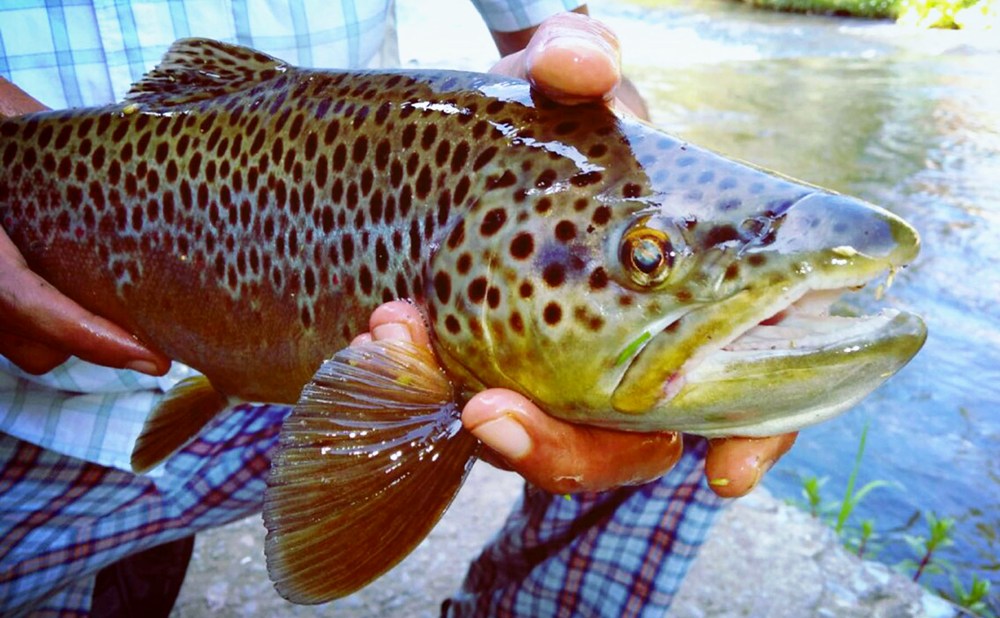
The introduction of an exotic species often raises alarms regarding native biodiversity. However, experts suggest that a century of presence has allowed for a natural equilibrium. The brown trout typically grows 15 to 22 inches long and weighs between 1 and 5 pounds, occupying a specific niche in the water column.
The two varieties of the Trout have interesting behavioural differences. “Brown Trout is the premier sport fish, but its behaviour is distinct. It is a ‘shy’ fish and a bottom feeder, meaning it stays in the lower depths of the water column,” Farooz said. “In contrast, the Rainbow Trout is much more active and visible. Both species are carnivorous. This predatory nature means we cannot easily introduce other fish alongside them in high densities, as there is always a ‘struggle for existence’.”
Though not completely endemic, the Snow Trout (Schizothorax) is a Kashmir native. “There is a natural separation in our water bodies,” Tak explained. “Our native fish, the Snow Trout, generally inhabit the lower strata or different patches of the river. The Brown Trout prefers the upper reaches where the water current is stronger. Because of this habitat preference, they do not migrate down much, and the native fish don’t go up much, minimising direct conflict.”
Farooz concurs that the “invasive” threat is largely a thing of the past. “Over the last 100 years, nature has taken its course. Through natural selection and habitat suitability, both the Brown Trout and the indigenous species have adapted to coexist,” he said, based on his studies on the ground. “The prey-predator dynamics have stabilised. While invasive species are generally not good for indigenous populations, the Brown Trout has become naturalised in our waters.”
Environmental Guardianship
The success of the “ranching” programme, where fish are reared to a certain stage and then released to the wild, depends entirely on the health of the Kashmir rivers. Officials said brown trout have also been stocked in virgin streams such as Panzath in Qazigund. “Protecting clean, cold and fast-flowing streams is key to their survival,” Farooz said.
While the upper reaches remain pristine, the lower regions face severe threats. “Comparatively, the upper reaches of Kashmir’s waters are still safe,” Tak said. “They are not as polluted as water bodies in other regions. However, in the lower areas, like Dal Lake, we are seeing challenges. We see mortality in livestock and fish due to oxygen depletion and increased pollution.”
Farooz highlighted why Kashmir is a suitable home for this project. “Kashmir offers the perfect environment for Brown Trout, mirroring its European origins,” he said. “These fish require specific water parameters: temperate climate, pure oxygenated water, and snow-fed streams. Kashmir possesses all these qualities naturally.”
The Fish Economy
The revival is not merely a scientific endeavour but an economic strategy. The Fisheries Department is involving fishermen and local communities through government schemes and linking brown trout conservation with eco-tourism initiatives.
“When people are involved, conservation becomes sustainable,” Farooz said. “This will definitely increase anglers’ catch and support sustainable tourism development.”
The introduction of the “genetically improved” seeds is the cornerstone of this future. “The intervention we are making involves seeds that are genetically improved,” Farooz explained. “These quality seeds are specifically modified to be disease-resistant. This intervention is crucial because while the fish exists in the upper regions, their numbers are low. This quality seed will help significantly in increasing their population density.”
Beyond the sport, the nutritional value of the wild-ranched brown trout offers a premium product for the region. When comparing the nutritional quality, Brown Trout is comparatively better than many other fish, according to Farooz. “Because it is highly carnivorous and feeds on natural prey in the wild quality of its meat is superior. Its taste profile is distinct and often considered better than herbivorous or omnivorous fish due to this high-protein, natural diet.”
Whether the fish came back from extinction or was encouraged enough to have adequate numbers, the larger reality is that the brown trout marks a full circle in Kashmir’s history. From its arrival via the British to its modern genetic renewal via Denmark, the species remains a symbol of Kashmir’s cold, rushing waters. With 2.50 lakh fingerlings now navigating the Lidder, Sindh, and high-altitude lakes, the “angler’s paradise” prepares for a new chapter of biodiversity and economic growth.
At the same time, the government under the HADP is planning to have nearly 900 trout farming units in the private sector in the next five years. Officials said 561 are already in place by November 2025. Of them, 198 units have started adding 561 metric tonnes of fish to the market in a year. “We are chasing of target of adding 4000 MTs of Trout a year to the market,” a senior officer at the policy level said. “By March 2026, we will have a claim that we have already added 2950 MTs.” He said a lot of resources have been invested in the sector within and outside the public infrastructure to take the fisheries to the next level.