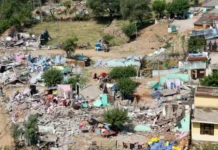
Mechanised riverbed mining is dismantling the biological processes that sustain Kashmir’s fish populations, disrupting spawning, breeding and habitat at a physiological level. The vanishing catch that fishermen describe is not a parallel crisis but the visible outcome of that intervention, Asrar Syeed reports
Riverbed mining across Kashmir has gone on for decades, but it was always carried out through manual excavation. Small communities living on the riverbanks usually did this as a generational occupation. Post-2019, the shift to heavy machinery, hydraulic excavators, backhoe loaders, wheel loaders, dumpers, and tipper trucks has dramatically escalated the damage to waterbodies.
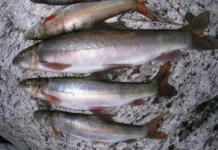
“In Kashmir, heavy mechanised sand, boulder and gravel extraction along the Jhelum River and its tributaries like the Rambiarah, Veshaw, Sindh, Lidder, Romshi, Sukhnag and Doodh Ganga has severely degraded critical fish spawning grounds,” Dr Tasaduq A Shah, Head of the Division of Fisheries Resource Management at the Faculty of Fisheries, SKUAST-Kashmir, Rangil, Ganderbal, explained. “This habitat destruction directly threatens native snow trout (Schizothorax) species as well as introduced brown and rainbow trout in protected trout reserves like the Sindh and Lidder streams. Consequently, egg survival rates are plummeting, pushing several indigenous fish species like Schizothorax and Triplophysa towards extinction and endangering the region’s fish biodiversity.”
The mechanism is specific, not incidental. “Mining severely impairs fish reproduction by physically scooping up gravel nests, covering eggs in suffocating silt, and disrupting chemical mating signals that fish rely on to recognize species, find mates, and synchronize spawning,” explained Dr Syed Talia Mushtaq, Assistant Professor at SKUAST’s Division of Fisheries Resource Management.
There is also a dimension of the crisis that has drawn almost no research attention: the physiological stress the mining itself induces in fish, driven by the persistent noise of heavy machinery, tippers, and dumpers. Tasaduq pointed to this directly. “This in turn triggers chronic elevated cortisol (stress hormone) levels in fish, suppressing immune function and diverting metabolic energy away from growth and reproduction toward stress responses,” he said. “Constant structural vibrations frequently trigger avoidance behaviours, forcing local fish to abandon otherwise suitable micro-habitats and move to unfavourable and inhospitable areas, ultimately leading to lower survival rates, reduced reproductive success, and population decline.”
In other words: before a single fisherman notices an empty net, the intervention has already worked its way through nesting grounds, mating signals, egg survival, and stress physiology. The empty net is the last link in that chain, not the first.
Diminishing Returns
That chain is now visible in the catch itself. For Abdul Gani, catching fish in Wullar Lake was once a ‘royal trade’. Over the past seven years, however, the fish catch has dropped by a huge margin. He describes the current situation as being “on the verge of extinction.” The loss of livelihood caused by this collapse in fish population has forced many families, for whom catching fish had been a generational calling, to look for other ways to survive.
“I have grown up watching first my grandfather waking up early in the morning, and then my father used to follow the same schedule,” Ganie recalled. “In the evening, while I was playing in the courtyard of our house, they returned with boats full of fish. They used to catch almost 20-25 Kgs of fish daily. But today even catching one kilo of fish seems like a dream.”
Jammu and Kashmir has almost 93,000 people dependent on fisheries. Beyond the numbers, the sector occupies an important place in the socio-economic fabric of the region, having been a key source of earnings and livelihood for decades. The region is blessed with a vast network of perennial rivers, lakes, reservoirs, ponds, and about 250 high-altitude lakes spread over an area of 40 thousand hectares.
Yet fishermen complain of a steady reduction in fish production, entire days spent without catching even a single kilogram. This has upended their lives, ruining a source of livelihood built over generations and forcing many to think about leaving the trade altogether.
Mohammad Shafi, a resident of Srinagar’s Rainawari, has been catching fish on the outskirts of Nigeen and Dal Lake since he was just 21. Every Sunday, he would wind through the narrow lanes of the two lakes, locating the fish. That routine has changed.
“I recall those good old days when an entire Sunday in these lakes meant almost 5-10 Kg of fish. But for the past few years, as fish population has dropped significantly, I have not been visiting regularly,” he said. “Why would I spend an entire day in scorching heat or harsh cold winters just to catch one Kg of fish? These waterbodies have been damaged beyond any repair.”
Gani, 70, worked as a fisherman until 2023, when he finally gave it up because of the collapse in fish catch. He is careful, though, to draw a distinction: it is not necessarily that the fish population itself has vanished, but that the catch has suffered because of unregulated mining.
“Fish population has declined by some margin over the years, but the main damage has been done to the fish catch by this unregulated mining. If I talk about 12-14 years back, spending an entire day in a waterbody would have got you a good amount of catch. But now, even an entire day sometimes leaves you with disappointment,” he said.
Kashmir ecology activist Raja Muzaffar Bhat has worked extensively against illegal riverbed mining. He took the case of Sukhnag, the Trout fish rivulet, to the NGT, and the fish massacre was one of the established outcomes of the riverbed mining. “It has impacted aquatic populations to a great extent, especially various species of fish,” he said.
Habib Ullah Kundh, a fisherman in Anchar Lake with many decades of experience, recalled days when children playing at the banks used to be given “Free Fish”, something that is not possible now.
“Over the years, almost 90% of fish have disappeared from the lake. How can fish exist when the lake itself has disappeared, polluted heavily?” Kundh added, pointing towards the continuous sewage that has been directly going into the lake. “How can you expect a lake to have fish inside it, when sewage is flowing inside it?”
Bashir Ahmed, a local fisherman in Bandipora, alleges that riverbed mining has only increased over the years. “The use of heavy machinery and continuous riverbed mining has led to a vast change in lake water.” He argues that over the years, the continuing extraction done beyond the permissible levels has created an “Uneven surface” inside the lake.
Heavy machinery removes large quantities of sand, gravel, and boulders much faster and deeper than manual extraction. As the riverbed is lowered, the water table across the nearby areas declines quickly because groundwater naturally follows the level of the river. Bashir seeks an immediate halt to this unregulated mining “If it’s not done within the next few years, finding fish would be a very difficult task”.
Deep pits created by mechanised mining can trap water, and due to the removal of natural sediments, it reduces the river’s ability to spread across its floodplain during high flows.
The Intervention Scale
The growth of urbanisation, infrastructure, and economic development across Jammu and Kashmir in recent decades has driven up demand for riverbed material used in construction. This demand has resulted in unsystematic and unscientific mining in in-stream areas, floodplains, and agricultural stretches of river basins, causing severe damage: altered channel morphology, degraded water quality, loss of both aquatic and terrestrial biodiversity, soil erosion, and the loss of agricultural land.
A paper published by the Central University of Kashmir, titled Illegal Sand Mining in River Jhelum in Jammu and Kashmir: Environmental Law and Governance Challenges, documents a sharp rise in mineral extraction from the Jhelum through riverbed mining within just a couple of years, from 0.47 million extracts in 2021 to 1.14 million in 2023. The same article notes that groundwater tables in areas near riverbed mining sites had dropped by 15-20 per cent, creating fresh problems for residents living nearby.
Between 2021 and 2023, multiple mining rules were moulded, leading to significant changes in river morphology, changes that have triggered flash floods, reduced fish catches, destroyed livelihoods, and dried up irrigation channels.
Muzaffar Bhat has taken the exploitative mining of various Kashmir water bodies to the NGT, and interventions have started. Now the Tribunal is monitoring the mining across various water bodies such as Dhoodh Ganga, Mamath Koul, and Sukhnag stream. In October 2023, a fine of Rs 35 crore was imposed on the government.
Using e-auction, the government auctioned 238 riverbed mining blocks between 2020-21 and 2025-26,, with 204 leases actually granted so far. Data shows that from 2022-23 until September 2025, the Jammu and Kashmir Mining and Geology Department collected over Rs 462.14 cr in revenue from riverbed mining. In 2022–23, revenue stood at Rs 101.17 cr. It rose to Rs 175.47 crore in 2023-24. In fiscal 2024-25, collections stood at Rs 128 cr. By September of fiscal 2025-26, the figure had reached Rs 57.67 cr.
The revenue curve tracks the scale of the intervention. What it does not track is the ecological cost accumulating beneath it.
This kicked the traditional miners out of the job. Having no other options, they started retaining their involvement with the occupation and became violators of the law. Enforcement agencies would intercept them and penalise them. In 2022-23, the penalty amount stood at Rs 16.34 cr, rising to Rs 19.20 cr in 2023-24. By January 2025, Rs 14.71 cr had already been collected in penalties.
A Fading History
In 1838, ichthyologist Johann Jakob Heckel published a book titled Fische Aus Caschmir (Fish of Kashmir) recording the presence of 16 fish species in the region, 12 of which belonged to the local snow trout genus, Schizothorax. In the years since, that number has steadily fallen. Decades of environmental negligence have thinned out local fish species, with a few disappearing from Kashmir’s waterbodies altogether.
The sadness on the faces of Abdul Ganie and Mohammad Shafi tells its own story. Men who once hauled in dozens of kilograms of fish now spend most of their days sitting beside waterbodies in the scorching summer heat or the bitter cold of winter, wondering what went wrong, how these lakes turned into “dead” waters where catching even a single fish feels like a triumph.
“These fishes were once cherished,” Ganie said, his face serious. “These lakes used to be the source of livelihood for so many people. Now even looking at them makes me feel miserable.”