Away from Dal’s bustle, Nigeen Lake offers Srinagar’s tourists stillness, mirror-clear water, colonial history, and centuries-old lakeside neighbourhoods, writes Lilac Ali
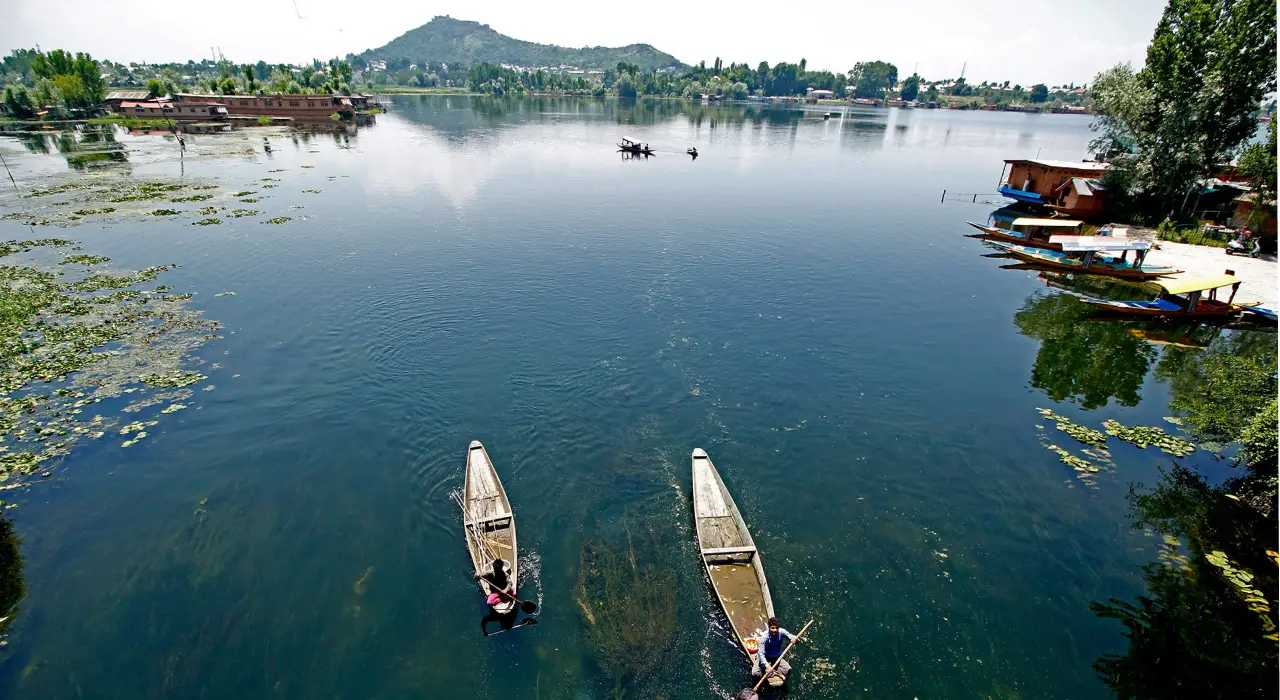
Dal Lake has long served as the high-traffic commercial centre of Srinagar’s water tourism. It draws shikaras, vendors, and visitors in numbers that have, over the decades, fundamentally altered the character of its water and its shores. The lake’s restless surface fills with noise and movement from the earliest hours of the morning until well after sunset, when the snow-laden ridges of the Pir Panchal range darken behind it.
Nigeen Lake occupies the quieter northern reaches of the city. It connects to Dal through narrow channels and causeways that thread between dense stands of marsh grass and old, mossy stone embankments. What Nigeen offers is something its larger neighbour has largely ceased to provide: the experience of being on a Kashmiri Lake in something close to its natural condition, unhurried and generous with its silences.
Historically, Nigeen Lake attracted high-end foreign tourists who wanted to escape the cacophony of urban centres. To accommodate this preference for secluded luxury, the western shoreline is lined with super deluxe houseboats. They cater to such clientele, providing an exclusive vantage point over the water’s most tranquil expanses.
The name itself comes from the Persian word Nageen, meaning the jewel set in a ring. The description is earned by the thick, unbroken collar of ancient willow and poplar trees that line the banks on every side. Their long, heavy, supple branches press down toward the water, keeping the lake feeling enclosed and intimate, even in the height of summer, when the valley is full of visitors, and the roads into the city are loud with traffic.
Like a Second Sky
The lake is fed by subterranean springs and cold mountain runoff. These keep lake waters clear and cool through most of the year. Its basin descends to depths of nearly six meters at its centre, making it significantly deeper than the silted, weed-choked expanses of Dal, which have grown shallow and turbid under decades of encroachment and neglect.
This depth gives Nigeen its most arresting quality: the stillness and translucence of its surface on a calm morning. The water becomes so smooth and unblemished that it seems less like a lake than a second sky laid flat upon the earth, holding within itself a depthless, trembling version of everything above it.
The Zabarwan mountains appear in it with unsettling exactness. Every dark ridge and forested slope is reproduced with the fidelity of antique glass. The peaks and treelines are rendered so faithfully below the surface that the lake seems less a body of water than a vast, silent archive of the landscape surrounding it.
In the evening, the wind drops entirely and the last shikara retreats to its mooring. The water deepens through successive registers of burnished amber and pale rose, finally settling into a blue so saturated and profound that the boundary between lake and sky becomes genuinely difficult to locate. The whole basin seems to hold a quiet distillation of the day’s vanishing light, surrendering it slowly to the descending dark.

A Club on The Shore
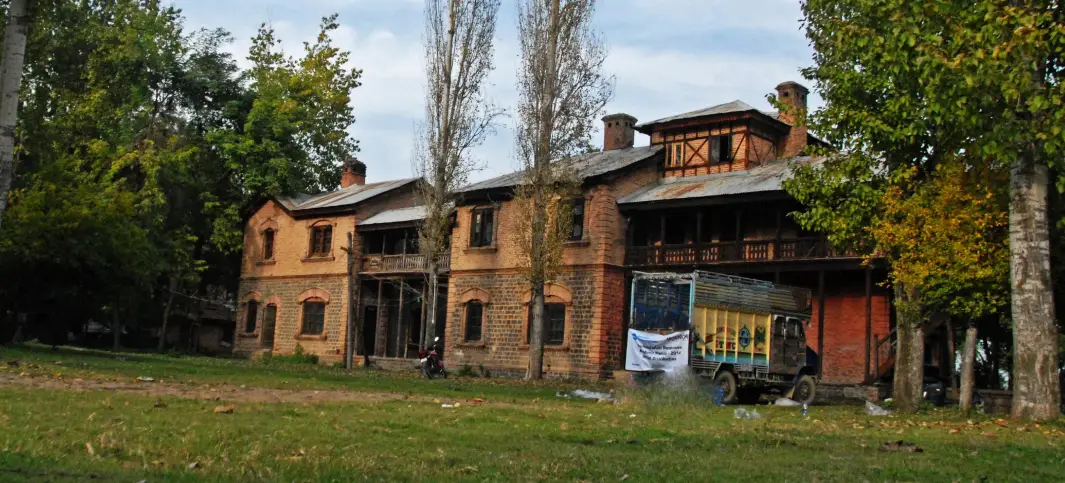
The eastern shore of the lake is home to the Nigeen Club, a gracious building with wide wooden verandas and large, generous windows looking out across the full breadth of the water. Its origins reach back to the particular administrative and social conditions of the British colonial period in the valley.
The reason the club came to exist on this shore at all was a legal one. The Maharaja of Kashmir prohibited foreign nationals from purchasing land anywhere in the valley. Unable to circumvent this restriction through ordinary means, the British community resolved it with characteristic ingenuity: they moved onto the water instead, commissioning elegant floating wooden homes along Nigeen’s quiet surface. The Nigeen Club eventually emerged on the eastern bank as a modern anchor for this unique, water-borne enclave, serving for decades as a place of formal recreation.
After independence, the Jammu and Kashmir government assumed stewardship of the property. It was gradually opened to a broader public, its airy halls and sprawling grounds converted into a venue for state functions and cultural events. The broad lawns surrounding the building have become, over the years, a place where people walk slowly in the evenings beneath the large, spreading Chinar trees, their broad leaves producing a soft, layered susurrus in even the lightest wind. The building itself has been renovated and expanded over the decades, acquiring a gymnasium, a restaurant, and various other practical additions. But it retains a quality of stillness and mild formality that distinguishes it from the more commercial establishments along Dal’s Boulevard.
The Communities of the Shore
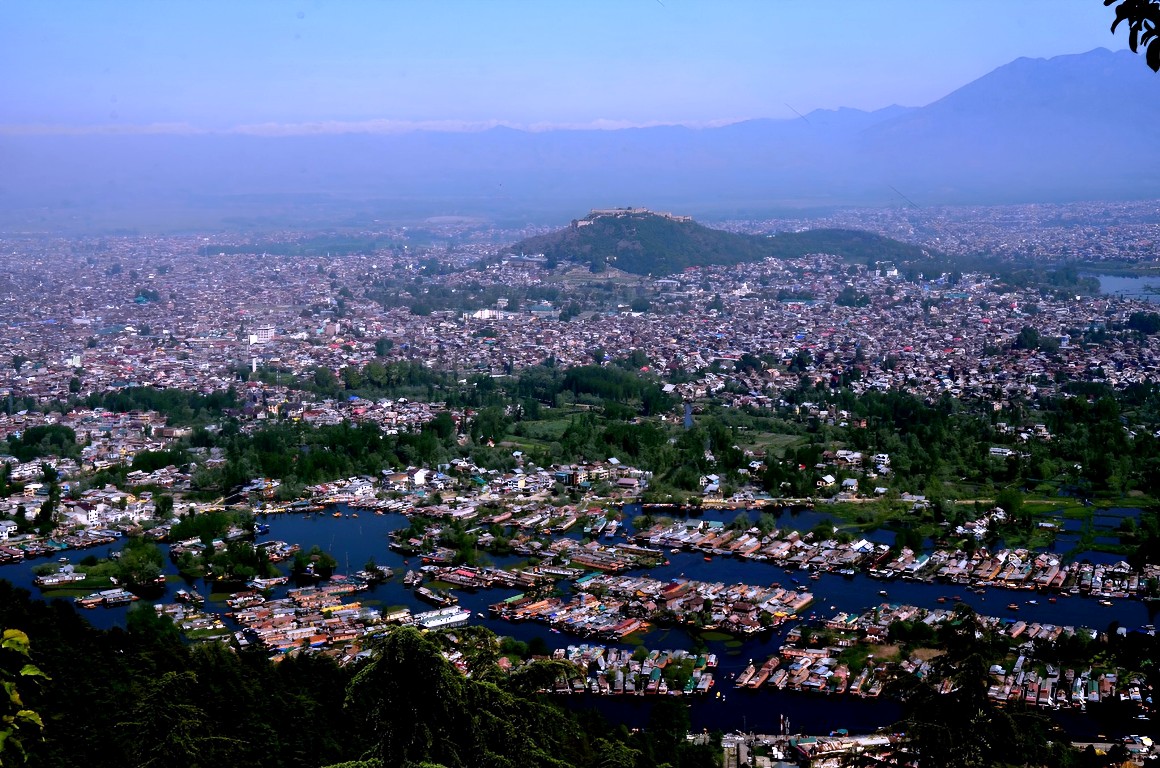
In contrast to the recreational spaces of the eastern side, the western bank of the lake is the most populous, with numerous old habitations. Not so long ago, this area was known for its vast almond orchards, fenced by bushy pomegranate trees that created a fragrant, blooming barrier between land and water. Now a populous area, it is called Bagwanpora for that reason, preserving in its name the memory of the market gardeners and orchardists who once defined its landscape.
The land was also known, in earlier times, for its white cumin, a rare and prized variety that grew here in a part of the valley where few other places could produce it. Wild rue, known locally as Isband, once grew freely across this shoreline too. The sharp-scented herb’s dried seeds have been burned in Kashmiri homes for centuries, as both a fragrance and a charm against misfortune. It is said that Isband retreats wherever human settlement advances.
The old neighbourhoods that press against Nigeen’s shores, principally Lal Bazar, Saida Kadal, and Baghwanpora, have sustained an intimate, centuries-old relationship with the lake. This shapes the rhythms of daily life in ways immediately visible from the water itself.
Every morning, before the city has fully woken, the lake is already alive with movement. Residents paddle out into the surrounding marshes and lush floating gardens to harvest lotus stems and fresh vegetables, loading their narrow shikaras in the cold, grey predawn light before making their unhurried way to the floating markets.
The area has a historical dimension too, stretching far back into the valley’s imperial past. The farthest tail of Bagwanpora is called Behrar, a corrupted form of Bahar Ara. It is said that Bahar Ara was a princess belonging to the Mughal nobility, who had built a small palace for herself at the place, seeking the same peace that draws visitors to the lakeside today. The locality was subsequently called Nawab Bagh, and the remnants of the palace are still there, standing as weathered stone witnesses to a bygone era.
The same area was later converted into a leprosy hospital under the Maharaja’s rule, manned by British doctors. The hospital still operates from the same place, serving the community from its historic lakeside grounds.
History books also mention that Emperor Jahangir used to take boat rides to Behrar from Shalimar on full moon nights, to watch the bright moon’s silent grace reflected in the Nigeen waters. To better observe this celestial display, it is said that he had a minar built, atop which he would enjoy the moon, looking out over the glassy midnight waters. The minar is no longer there, leaving only the literary record of the emperor’s nocturnal voyages.
Lake’s Future
The rapid expansion of housing in these localities over the past several decades has placed considerable pressure on the lake’s water quality. Inadequate sewerage infrastructure has allowed a steady inflow of domestic effluent into the clear basin. This has encouraged the aggressive proliferation of weeds and algae, depleting the oxygen levels the native fish population depends upon.
The Lake Conservation and Management Authority has responded by installing sewerage lines along the houseboat moorings and constructing modern treatment facilities in the vicinity. The restoration work is ongoing, and the results are uneven. But the sustained effort reflects a shared recognition, among authorities and residents alike, that the lake’s ecological health and the livelihoods it sustains are so thoroughly intertwined that the deterioration of one inevitably hastens the diminishment of the other.
What makes the ecological stakes feel particularly acute is the extraordinary quality of light and landscape Nigeen offers at its best. Anyone who has spent unhurried time on the water at dawn or dusk will understand this without needing it explained. The lake catches the early morning sun, transforming its pellucid surface into something close to luminous. The still water is suffused with a pale, golden glow, while the surrounding poplars and ancient willows remain in deep, velvety shadow, their dark reflections lying motionless below. The whole scene feels held inside a profound quietude, less the absence of sound than a palpable presence in itself, something the generous valley produces in the early hours before the world reasserts its ordinary clamour.
In the evening, the light softens, and the wind dies, and the glassy lake goes entirely still. The water becomes so clear and deep in its faithful reflections that to look into it is to feel, briefly and inexplicably, that the wide sky is below you and the ancient mountains are beneath your feet. For that fleeting moment, the valley seems to gather itself into something very close to perfect.
The Houseboats and the Garden
The approach to several of the houseboats along Nigeen’s shore leads first through Bagh-e-Shagoofa, a small, well-kept lakeside garden whose name translates as the garden of blossoms. It sits between the residential lanes of the surrounding neighbourhood and the water’s edge, in a way that makes it feel like a natural pause between two different worlds.
It is modest in scale but deliberate in character, a tended corridor of flowering shrubs and shaded pathways. It opens onto the lake with a suddenness that catches most first-time visitors off guard, the noise and compression of the city giving way to the wide, open stillness of the water. For the houseboats it serves, the garden functions as both entrance and threshold.
On mornings when the blossoms are full, and the cool air off the lake carries their scent landward, the walk through it is one of the quieter pleasures this part of Srinagar has to offer.
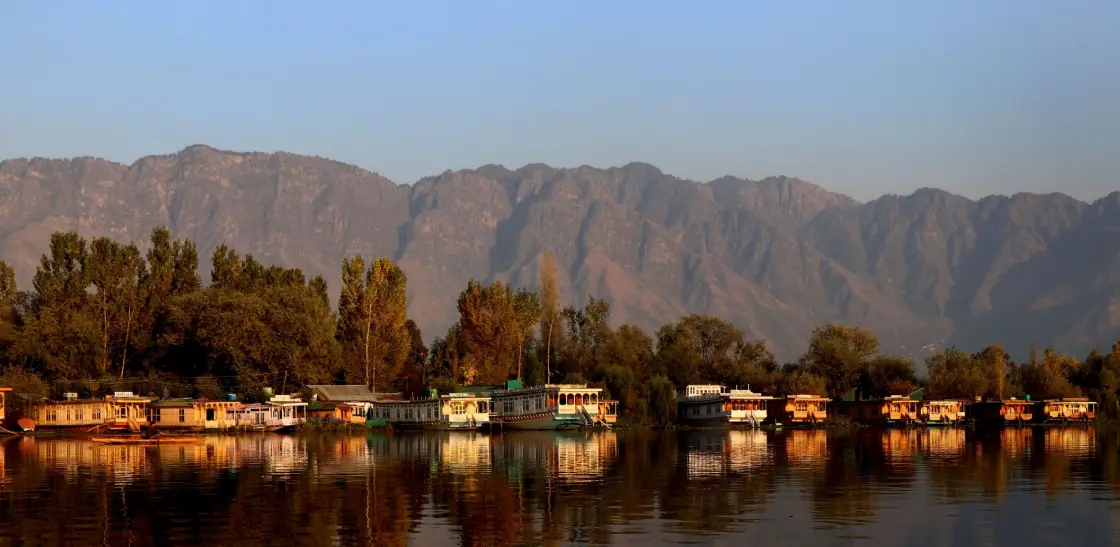
The houseboats moored along Nigeen’s sheltered shores are spaced generously apart from one another. They are built from fragrant cedar and richly grained walnut wood by craftsmen who have worked with timber on water for generations. They attract visitors who come to Srinagar in search of something quieter and more considered than the busy experience of Dal’s crowded Boulevard.
As evening comes, the amber lights of the houseboats begin to reflect in the darkening lake. The basin settles into the deep, enclosed stillness that is, for most people who have spent time here, its most lasting and characteristic quality. The surrounding trees hold the light a little while longer before the mountains above the city fade into the night and the water goes dark and quiet beneath them.