by Asrar Syeed
Near Dachigam, Harwan Garden blends ancient Buddhist ruins, Mughal-era history, and centuries-old Chinars into a tranquil public park.
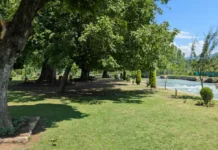
Harwan Garden is located almost 15 kilometres from the heart of Kashmir’s capital, Srinagar city, in the foothills of the Zabarwan mountain range, close to Dachigam National Park. Inside the park, the serene mountain range surrounds decades-old Chinar trees, which are often the favourite spots for people seeking shade during the scorching heat of summer.
The garden holds great significance in the Buddhist history of Kashmir. According to historians, the 4th Buddhist council of Mahayana Buddhism was held in Harwan. The council, called by Emperor Kanishka, was an attempt at “reconciliation,” meant to address the crisis of different sects emerging out of Buddhism at the time. The attempt was not successful. But the council saw the participation of almost 500 monks, who later travelled to Central Asia and China.
This garden does not follow the pattern observed across other Mughal gardens in Kashmir, with their large marble fountains, terraces, and carefully engineered cascades. Instead, the garden is famous for its vast lawns, which provide a spacious area for people visiting for some respite from the chaos of the city, or for tourists visiting from different parts of the country. The noise of birds resting on the branches of the Chinar trees, combined with the water stream flowing through the middle of the garden, creates nature’s own lullaby.
Historical Significance
In 1920, pioneering archaeologist Pandit Ram Chandra Kak, while on an afternoon survey of the place, discovered the ruins of an ancient Buddhist monastery complex. The ruins are believed to belong to the Kushan period, particularly between the 1st and 3rd centuries CE. This discovery transformed Harwan into one of the most historically significant Buddhist archaeological sites in Kashmir. Until then, the Buddhist history and significance of the place were unknown to the common masses of the then princely state of Jammu and Kashmir. The most notable findings were terracotta tiles, which had been used to decorate the pavements and floors of the monastery structures.
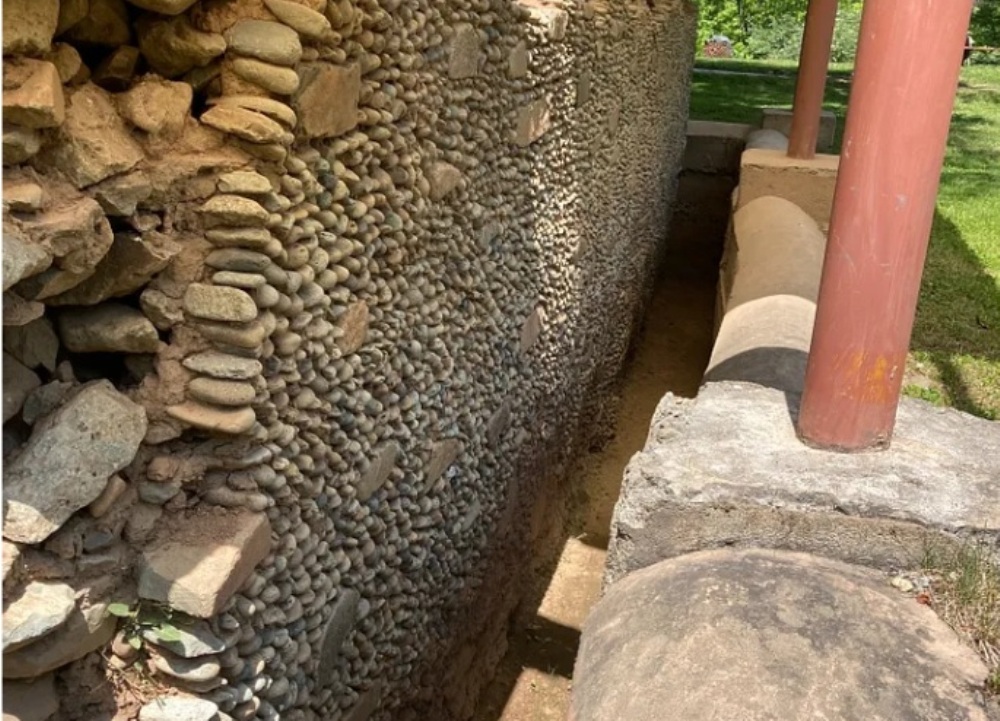
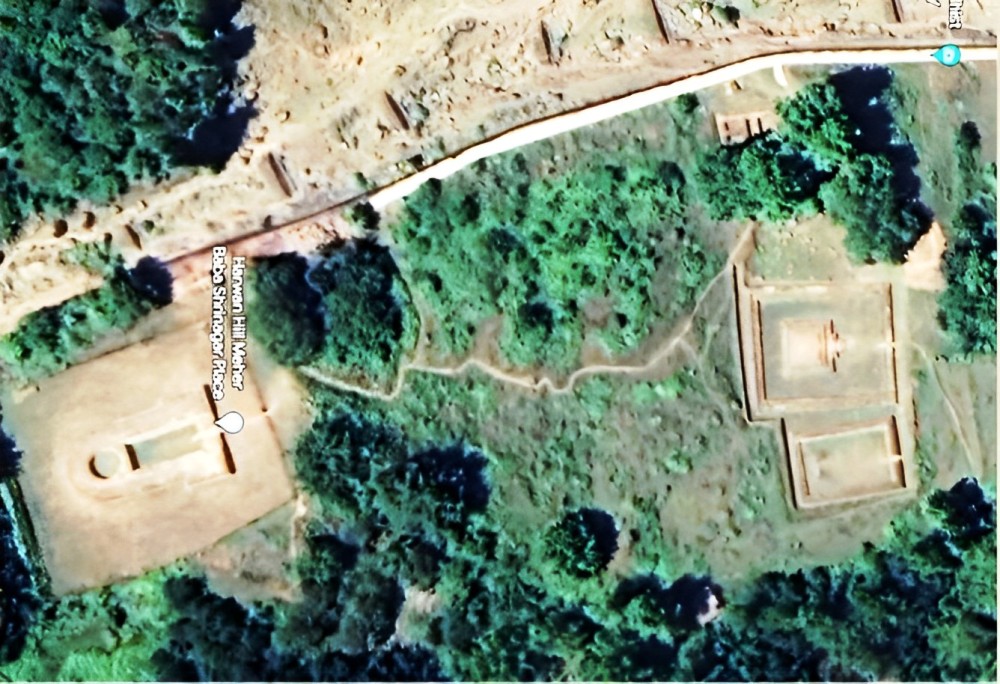
This discovery revealed how the place held great importance in Kashmir’s Buddhist history. Harwan is believed to be the home of Buddhist master Nagarjuna (150–250 CE), who gave the theory of “Sunyata,” or “Emptiness.” This theory completely changed the Buddhist way of thinking. Kak’s discovery helped the park gain attention, resulting in more focused excavations. These uncovered further structures, including a few walls, the base of a medium-sized stupa, and several rooms that might have been used for residential purposes at the time.
Harwan has been mentioned in Pandit Kalhana’s work, Rajatarangini, where he describes how Nagarjuna resided here: “A Bodhisattva lived then in this country as the sole lord of the land, namely the glorious Nagarjuna, who resided at Sadarhadvana.” Noted historians like Aurel Stein have identified Sadarhadvana with the Harwan monastery. Today, Harwan Garden has been renovated and turned into a modern green park by the Government of Jammu and Kashmir. But amid the decades-old Chinar trees and the newly constructed structures inside the park lies a brief account of Kashmir’s past.
Transition to a Public Park
During the later period of Dogra rule, the Harwan site was turned into a public park. History shows that the plan to develop and preserve the park was hugely impacted by Pandit Ram Chandra Kak’s excavations. Until then, Harwan had remained a quiet village in the foothills of the Zabarwan range. Authorities and the ruling regime realised the significance of the place, prompting them to develop and preserve this historical site, which had once served Buddhist ideology in navigating its challenges and changing its course.
The renovations advanced further during the 1960s and 1970s, when Kashmir’s tourism infrastructure was being expanded by the regime of the time. The beautification of Harwan Park was carried out based on modern tourism patterns, giving the site a new shape. During this period, Kashmir saw a major upgrade of public parks. Harwan, however, remained different from other parks in the valley, drawing far smaller crowds.
What makes Harwan different from other public gardens in Kashmir is its nature-oriented character. One of the defining features of the park is the water canal flowing in from the nearby Dachigam stream. During this period, authorities planted more Chinar trees, along with flowerbeds of different colours, decorated near the stream flowing through the middle of the garden. A long pathway was also constructed, which has, over the years, become one of the park’s important features. People who visit often spend time walking along it, enjoying the natural serenity of the park.
The Present State of the Park
Since the initial renovations of the later Dogra period, and again in the 1960s and 1970s, the garden has been renovated further in recent years. More flowerbeds have been added, the pathway has been redesigned, and small wooden huts with benches have been built inside the park. A wooden cafeteria has also been constructed in recent times. Keeping in view the importance of protecting the park’s natural serenity, a large number of dustbins have also been placed inside.
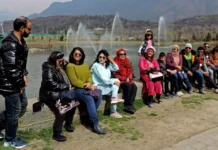
Today, the park is visited by a large number of local families for excursions. Tourists visit as part of their itinerary, and the place also serves as the first stop for trekkers scaling the mighty Zabarwan mountain range. The Chinar trees inside the park have grown old, with some said to be more than 200 years old, spreading over a large area and providing nature’s own roof against the scorching heat and rain.
Apart from serving as a base point for adventure tourism, the park has, in recent times, become a common destination for birdwatching, nature walks, photography, and other leisure activities. During autumn, the park is painted in the brown shades of its Chinar trees, following the pattern of other gardens in Kashmir. Across all these parks, the mighty Chinar trees remain the most common natural, scenic thread.
(This is a web-specific feature)