A once-thriving wetland at the heart of Srinagar’s ecosystem is dying quietly, suffocated by sewage, encroachment, and decades of collective neglect, reports Afreen Ashraf
Zooni is 80 years old. She still rows her small wooden boat through the narrow channels of Anchar Lake each morning, moving carefully through water that has grown darker and shallower with every passing year. She is looking for fish. She rarely finds many.
“As children, we would spend entire days on the water,” she said, pausing her oars for a moment. “There were fish everywhere.”
She did not say this with anger. She said it the way people speak about something they have accepted losing, quietly, with a kind of grief that has had decades to settle.
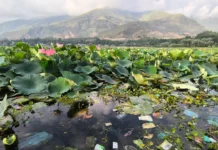
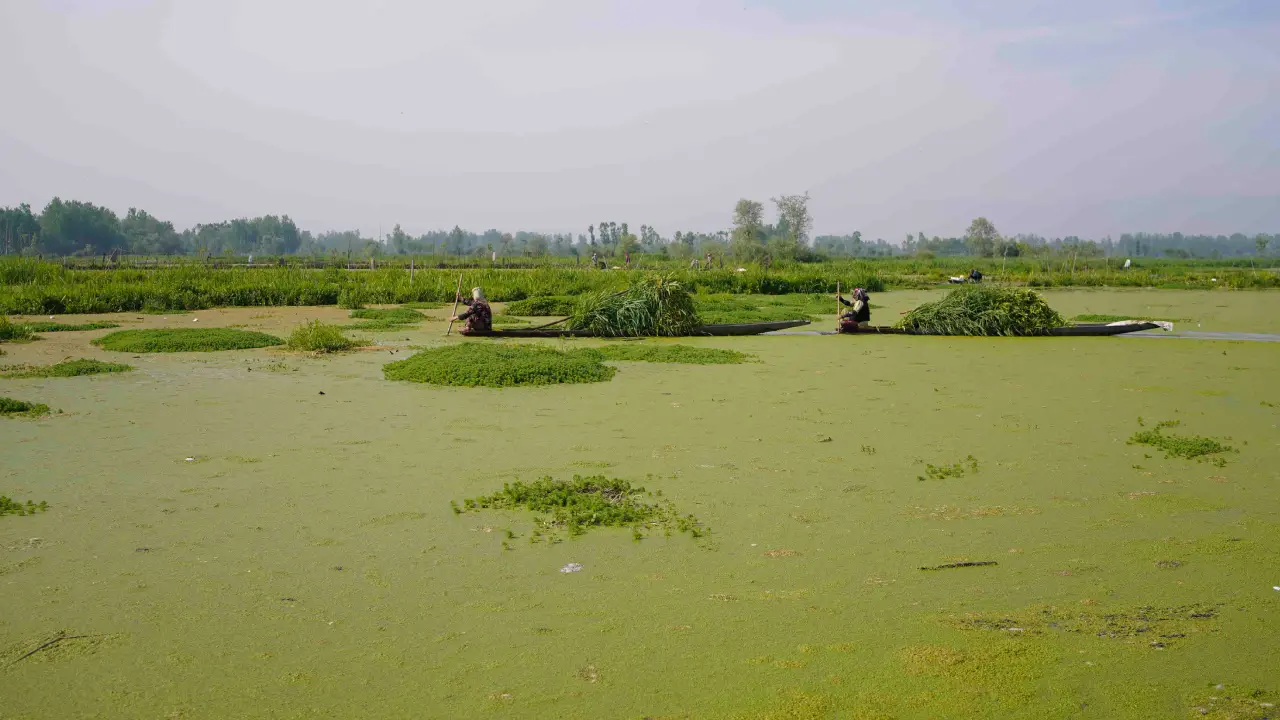
Around her, the water tells its own story. Green algae have spread across the surface in thick patches. Floating plastic and polythene cling to the banks. The pathways between weed beds have grown so tight that her boat barely passes through. And beneath it all, a foul smell rises from the water, not overpowering in winter, but unmistakable, and worse as the months warm.
This is Anchar Lake in 2025. A wetland that once stretched across nearly 19 sq km on the north-western edge of Srinagar that once sustained over a thousand families drew migratory birds from Central Asia and Siberia each autumn. It is now reduced to a fraction of its former self, choking slowly on sewage, silt, and decades of neglect.
Zooni remembers Anchar when it was alive. When fishermen would return with heavy nets. When Lotus flowers bloomed across wide stretches of open water. Then the lake was noisy with birds in winter. That world has not merely changed. It has disappeared.
Vanishing Waters
To understand what has been lost, it is basic to understand what Anchar once was.
Hydrologically, the lake is connected to Dal Lake via Nallah Amir Khan, passing through Khushal Sar and Gilsar, a network of interconnected lakes and marshes formed over centuries as part of Kashmir’s natural floodplain system, linked to the Jhelum basin. Anchar served not merely as a scenic body of water but as a critical ecological regulator: absorbing excess water during heavy rainfall, recharging groundwater, and maintaining the broader environmental balance of the region. It had a catchment area of nearly 66 sq kms.
For generations, the lake was the economic and cultural centre of life for the communities surrounding it. Close to 600 families once earned their livelihoods solely through the cultivation of nadru, lotus stems, a prized ingredient in Kashmiri cuisine and a vital source of household income. Another 1,000 families depended on fishing, agriculture, and trade directly tied to the lake’s ecosystem. Families harvested reeds for traditional wagov-mat making. The lake fed people, clothed them, and gave them purpose.
During autumn and winter, Anchar transformed further still. Migratory birds, among them the Great Crested Grebe and the Indian Cormorant, arrived in large numbers, turning the wetland into a vibrant seasonal habitat. Their arrival each year marked the changing of seasons and reflected a richness that no longer exists in the same measure.
The Shrinking Lake
The numbers alone tell a grim story.
A century ago, Anchar spread across 19.54 sq kms. According to official data and independent research, it has now shrunk to approximately 4.26 sq kms. Of what remains, nearly 3.6 sqkms has already turned into marshland.
A study from Kashmir University documented that the lake lost approximately 93 hectares of natural wetland area from 1980 alone, with losses driven by encroachments, unplanned settlements, and unchecked developmental activity. Research conducted between 2014 and 2016 found that encroachment was occurring at a rate of roughly 0.142 sq kms every year. That figure has not meaningfully changed.
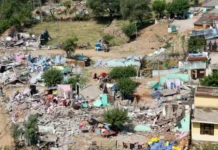
The transformation is visible without the need for satellite imagery. Roads have been laid across former water. Houses and small constructions have risen on reclaimed parts of the lake. Residents point to specific spots, places where water was once deep enough for boats and fishing, that are now filled with soil, garbage, and construction debris.
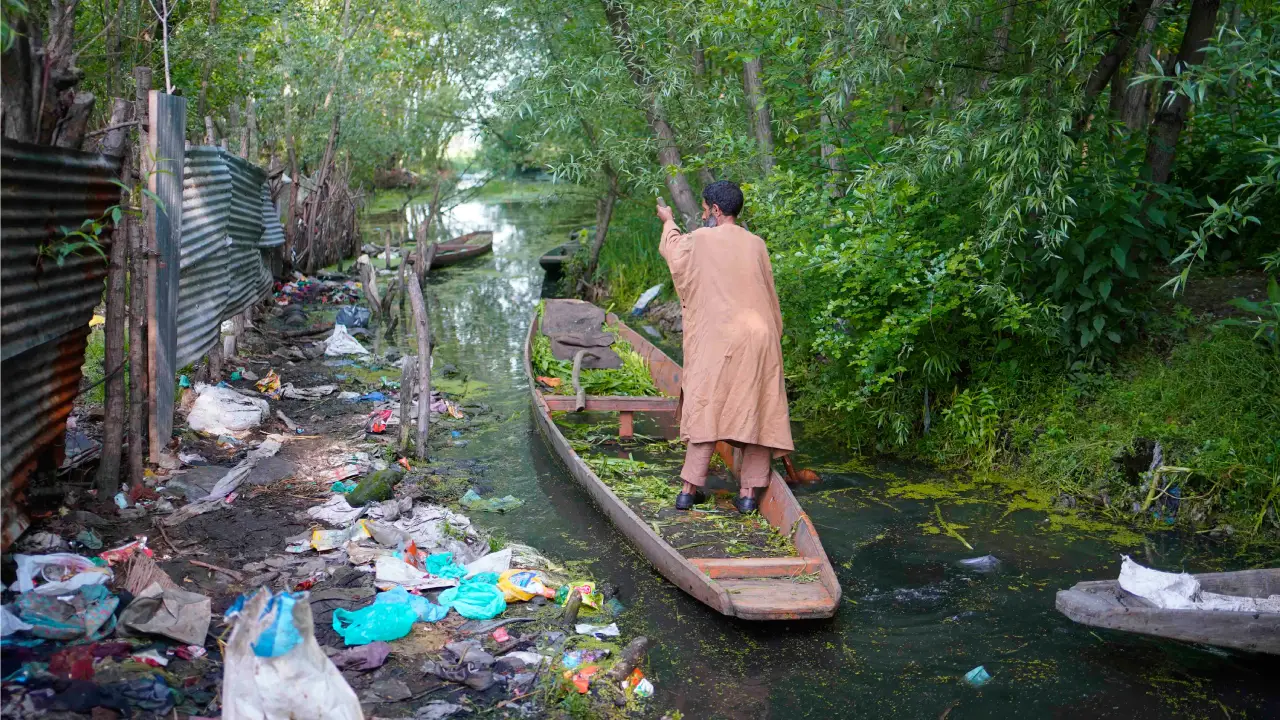
“Every year the lake becomes smaller,” said Asif, who grew up beside Anchar and remembers stopping to look at it on his way to school. “People kept filling parts of it slowly, and nobody stopped it.” He pauses. “I remember when the water was so clear.” Today, he said, he would not dare put his hand into it. He is certain it would give him a skin allergy.
Ecological Collapse
The shrinking of the lake is only part of the crisis. The water itself has changed.
Decades of unchecked sewage from surrounding localities have poured directly into Anchar. Domestic waste, agricultural runoff, and the pressures of rapid urban expansion have compounded the damage year after year.
Studies have identified the lake as having reached a hyper-eutrophic state, excessive nutrients from sewage and organic waste trigger uncontrolled algae growth, which strips the water of oxygen and makes survival increasingly difficult for aquatic life.
Sedimentation has reshaped the lake’s character further. Its maximum depth now stands at roughly 2.2 metres, while the average has fallen to approximately 1.3 metres. In many stretches, the water is so shallow that weeds grow densely from bank to bank. In the 1990s, six-foot pipes were laid under the Mearplan road to improve water circulation between Dal Lake and the Anchar system. The pipes became clogged with waste and debris, worsening stagnation rather than relieving it.
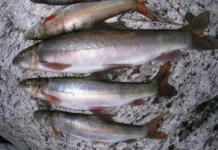
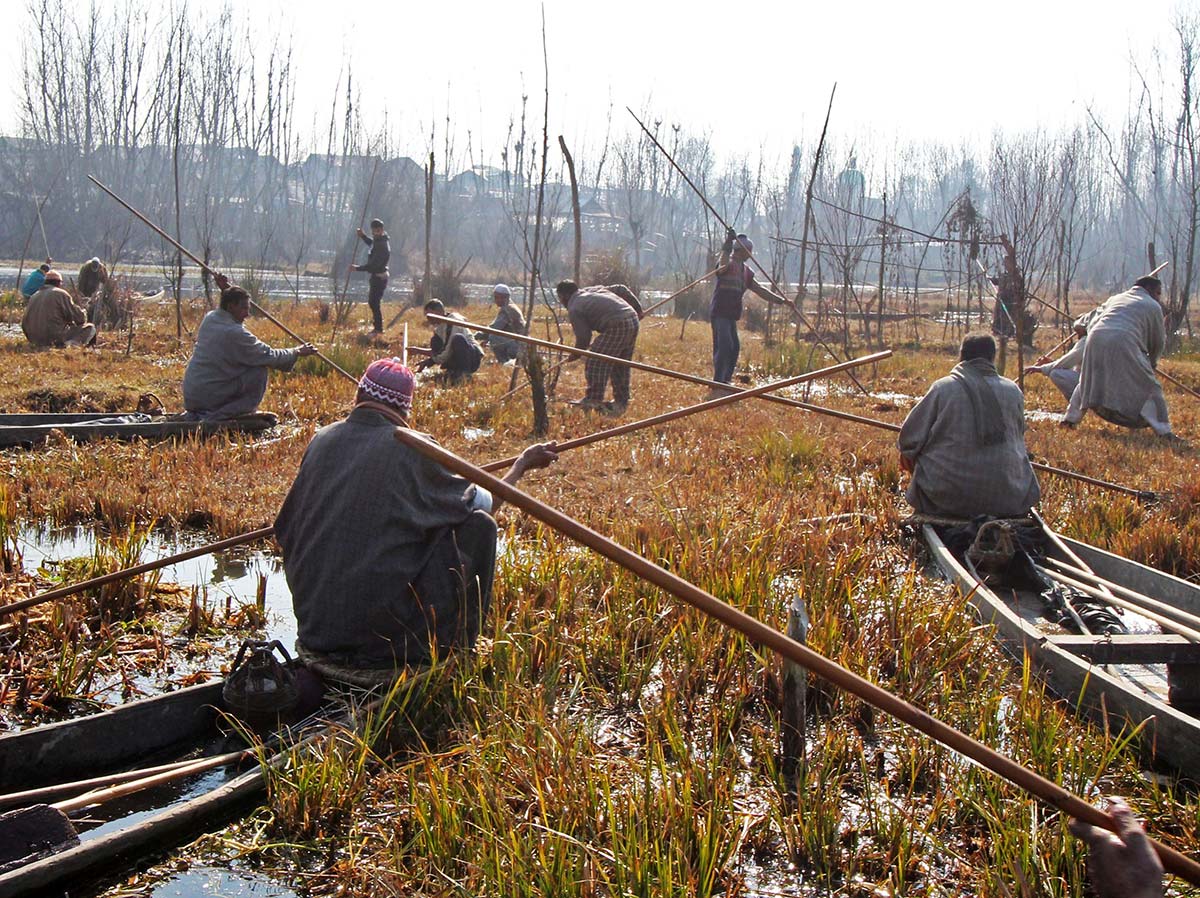
The consequences for aquatic life have been severe. Fish populations have declined sharply. Species once common are now rarely seen. Fishermen who once supported entire households from a single day’s catch now return with almost nothing. One elderly man, still tending a nadru field at Anchar, put the collapse plainly: “Earlier, if even one member of the family came to the lake, he could support a household of ten people. But now, even if ten members come, they still cannot meet their needs.”
His sons, he added quietly, have started working as labourers.
Memory and Loss
Manzoor Ahmed is 38. He no longer lives beside the lake, but he grew up there, and the Anchar of his childhood is vivid in his memory: wooden boats moving freely across open water, people living full lives around it, a landscape that felt alive. He wishes his daughter could see Anchar the way he once did. He knows she cannot.
Older residents speak of Tchai Gaad, shadow fishing, a traditional winter practice once common on Anchar. Fishermen would conceal themselves beneath blankets or straw covers in their boats, casting shadows on the surface to draw fish close before striking with a harpoon. It was skilled, patient work, belonging to a particular relationship with the water that has been lost.
For the Hanji community and the residents, whose identities have been shaped by Kashmir’s lakes and waterways across generations, Anchar was never simply a resource. It was home. And it is disappearing. Younger people in the surrounding communities no longer look to the lake for survival or identity. Many have already left, seeking work elsewhere. The sons of fishermen now work in real estate and construction sector as labourers. The daughters of harvesters have grown up without ever wading into the water.
Shared Accountability
The decline of Anchar is not a simple story of official failure. It is a more uncomfortable story of shared responsibility.
Local residents have raised complaints repeatedly about encroachments and illegal construction. Habibullah Kondu, a resident, said complaints to the authorities have gone largely unanswered. Another resident, having noticed fresh construction along the shoreline in an area designated as a protected green belt, filed a complaint and saw action taken, but pointed out that reactive intervention is no substitute for consistent enforcement. Officials, he argued, should conduct regular inspections rather than waiting for residents to report violations.
At the same time, a significant portion of the lake’s pollution originates from the daily habits of the very communities living around it. Untreated sewage, household waste, and plastic are still being dumped into the water from nearby settlements. Garbage is thrown openly along the banks and washed into the lake by rain and runoff. Residents also raise concerns about effluents from nearby medical infrastructure contributing to contamination, though the sources of pollution are multiple and overlapping.
Authorities failed to intervene with sufficient consistency to prevent encroachments from accelerating. Communities continued practices that added cumulatively to the lake’s deterioration. Anchar was never protected with the urgency its ecological significance demanded. Both failures are real. Both matter.
Final Chance
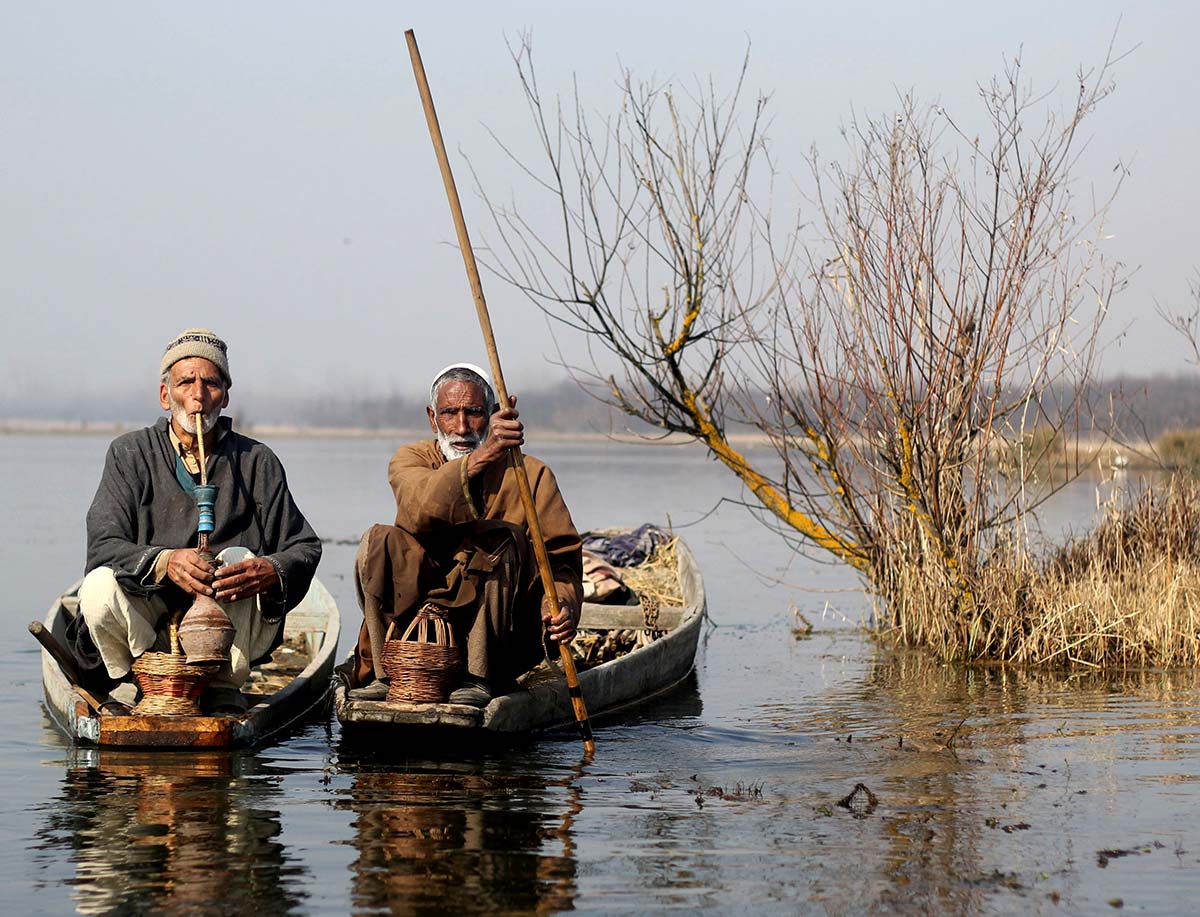
Wooden boats are still tied along the lake’s narrow channels. Nadru harvesters still step into the cold water each winter. Fishermen still cast their nets, though the catches grow thinner with each passing season. Life around Anchar has not ceased, but the ecosystem that once sustained it is approaching a point from which recovery becomes impossible.
Asif, who swam in these waters as a child and now will not touch them, believes restoration is still possible, but only if action comes soon and is taken seriously. Sewage entering the lake must be controlled at source. Illegal encroachments must be removed and prevented from returning. Waste disposal around the wetland must be monitored consistently. “If things continue like this,” he warne, “nothing will remain for the next generation.”
Zooni still rows out each morning. The channels are narrower than they were last year. The fish are harder to find. But she goes anyway, moving her small boat carefully through the weeds and the algae and the dark, still water, carrying in her the memory of everything Anchar once was. And perhaps everything the lake could still be, if the decision to save it is made before it is too late.