As a mutton trade standoff threatens supplies ahead of the wedding season, Kashmir’s traditional staple, fish, could be staging a comeback, reports Babra Wani
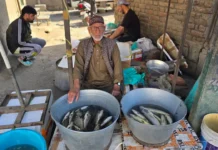
For the past 15 years, Shakeel Ahmad Dar has sold fish at a market in Chattabal, almost every day. The Punjab Gaad, also known as Golden Carp, he said has remained the most sought-after variety among his customers. The price of fish, he explained, is generally determined by its size rather than the species itself, with larger fish fetching higher prices in the market.
Having made his living this way, Shakeel has come to understand the rhythms of his customers’ appetites. Most of them are resident families buying for household consumption, not restaurants or commercial kitchens. Comparing today’s demand with that of a decade and a half ago, he said both fish sales and customer numbers have risen considerably.
On an average day during the warmer months, he receives around 50 to 60 customers; in winter, the peak season for fish consumption in Kashmir, footfall can reach approximately 200 people a day. Many of his regulars, he added, have stayed loyal for years, returning to a trusted vendor to ensure freshness and quality.
His observations reflect a broader trend, one shaped by changing dietary preferences, growing awareness of nutritional benefits, and the enduring cultural pull of fish in Kashmiri cuisine. For most Kashmiri families, gaade-batteh, fish and rice, remains one of the great comfort meals, a dish around which households still gather for both lunch and dinner.
“I receive a lot of orders for homemade fish and rice,” a home cook said. “Mostly in the winters, people want radish and fish, known as mujeh-gaade, or gaade-haakh (fish with collard greens). Some people also order fish koftas.”
“I have always loved fish,” said Ahmad Mir, a resident of South Kashmir. “I used to go angling with my friends, catch fish from the Lidder river, then come back and ask my mother to prepare it and relish it. After she passed away, my wife carried forward the tradition. Whenever someone even in our extended family cooks fish, they know who to invite first,” he added, laughing. “Savouring fish is a different kind of kick altogether. We make sure we cook fish four or five times throughout the year.”
For Mehr, 28, fish defined the iftaars of her childhood. “As a child my father always bought fish in the holy month of Ramzan, and then my mother used to grill it and serve it for iftaar,” she said. “That tradition has continued. When I got married last year, my family invited me and my in-laws for a gaade-saal, every dish prepared that day was made of fish. It was a happy feast, and part of our family tradition.”
A Gaadeh Past
That cultural memory runs deeper than any one household. Hasarat Gadda, a cultural activist and writer in his nineties, recalls a Kashmir in which mutton and chevon (goat meat) were occasional luxuries rather than everyday fare. In his childhood, he said, fresh fish pulled from the valley’s own rivers and lakes was the more regular protein on most tables, prized precisely because it was local, abundant, and did not need to travel far to reach a plate. Mutton, by his account, was reserved for rarer occasions.
That earlier hierarchy has, over the decades, inverted. Mutton and chevon, fuelled in part by the spread of Wazwan culture into everyday celebration, and a meat-trade infrastructure built around livestock imported from outside the valley, became the meats of status and feast. The fish, despite never disappearing from the Kashmiri table, slipped into the role of a seasonal favourite rather than a daily staple.
Gadda’s recollection is a reminder that this was not always the order of things, and that the valley’s own waters once fed it more directly than supply chains running through the plains.
Turning Back
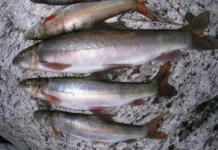
According to Faris Punjoo, founder of Al Wadi Fish Farm in Srinagar, fish consumption in Kashmir has been rising steadily year on year. Involved in the sector since 2022, he attributes much of the increase to growing public awareness of fish’s health benefits. “Traditionally, the most commonly consumed fish in Kashmir were Schizothorax, locally known as Kashir Gaad, and various carp species such as Common Carp and Grass Carp, often referred to as Punjab Fish,” he said. Consumer preference, he noted, has gradually shifted toward Rainbow Trout, prized for its high Omega-3 content, even as carp remains the winter favourite in traditional preparations with haakh and nadru.
Punjoo could not offer precise consumption figures, but said the upward trend is unmistakable. He also pushed back on a long-held belief that fish should be eaten only in winter and avoided in summer, calling it misplaced: fresh, live fish, he said, can be safely consumed year-round.
The growing demand has drawn young entrepreneurs into fish farming and retail, he said, though local production still falls short of what the valley consumes, leaving a gap filled by frozen fish imported from outside. That imported fish remains popular chiefly because it is cheaper, Punjoo said, though he believes consumer habits are shifting toward fresh and live fish as people grow more wary of quality concerns around imported meat and fish generally.
His own farm, operational since 2022, is, he said, the only one in Kashmir producing both carp and trout, with a retail outlet for fresh fish and a small on-site seating area where customers can eat freshly prepared meals.
Official figures bear out the sector’s growth: Jammu and Kashmir’s fisheries recorded a production of 29.40 thousand metric tonnes in 2024-25, with a further 20.68 thousand metric tonnes produced up to November 2025, government data shows, with trout farming contributing significantly to that output. The Ministry of Fisheries’ Annual Report 2024-25 lists Jammu and Kashmir among India’s key cold-water fisheries regions, with notable potential for high-value species such as rainbow trout, brown trout, snow trout, and mahaseer.
A 2024 study, Fish Consumption in India: Patterns and Trends, conducted jointly by the Indian Council of Agricultural Research (ICAR) and WorldFish India, found that Jammu and Kashmir recorded the highest growth in fish consumption anywhere in the country over the past 15 years, with the proportion of fish consumers rising from 60.7 per cent in 2005-06 to 81.6 per cent in 2019-21, a jump of 20.9 percentage points. The same study found that 34.15 per cent of the population eats fish weekly and almost 46 per cent occasionally, with consumption notably higher among men (89.8 per cent) than women (73.4 per cent).
Doctors point to nutrition as part of the explanation. “Fish is among the most nutrient-rich foods and an excellent source of high-quality protein, omega-3 fatty acids, vitamin D and vitamin B12, among other minerals that are really important for human consumption,” a consultant physician said. “It is good for the heart, liver, and so on, but it is very important to consume it in good quantity, and avoid consumption in extreme conditions. Otherwise, fish is one of the best foods, and everyone should consume it, even women and children.”
Mutton Shortage
That nutritional case for fish may be about to find an unlikely economic ally: a fresh crisis in the mutton trade. Livestock traders have suspended fresh imports of sheep and goats, and the Kashmir Mutton Dealers Association (KMDA) has said no new livestock-laden vehicles will be dispatched until the government intervenes on long-pending transit concerns.
KMDA General Secretary Mehraj-ud-Din told the media that traders bringing livestock from markets in Delhi, Ambala, Rajasthan and other parts of northern India have faced mounting transit charges and repeated stoppages while passing through Punjab. Per-truck charges during transit, he said, now run “between Rs 20,000 and Rs 30,000,” a burden he said traders have raised with authorities multiple times without resolution. He described livestock carriers being held for two to four hours at checkpoints in temperatures above 40°C, conditions he said raise animal mortality and losses borne by traders. The association said it has approached both the Jammu and Kashmir administration and Punjab authorities repeatedly, without a fix.
Mehraj-ud-Din warned that if the deadlock persists, mutton availability in Kashmir could be hit after Muharram. The traders cannot guarantee supply through the peak marriage season if fresh consignments remain stalled, he said.
The timing is pointed: any squeeze on mutton lands directly on Wazwan, the seven-course feast built almost entirely around mutton and chevon. During the wedding season, Wazwan is most in demand. If costs and uncertainty persist, hosts may find the centrepiece of the traditional feast harder and more expensive to secure, a contemporary echo of the world Hasarat Gadda remembers, one in which the meat of celebration was not always cheap or easily available, and fish from the valley’s own waters filled the gap left behind.
The Water Livelihoods
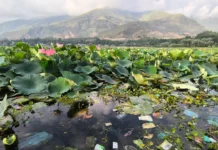
Whether or not that history repeats itself, those who depend on fish for a living warn that the sector’s future rests on the health of Kashmir’s water bodies, the same waters that once made fish, in Gadda’s telling, the valley’s everyday protein. Punjoo and other fish farmers say aquatic life is increasingly suffering due to sewage discharge into water bodies including Dal Lake, with direct consequences for those who depend on fisheries and related work.
Punjoo said he has personally suffered substantial financial losses because of the lake’s worsening condition and has repeatedly approached authorities for intervention, with little result. He said he hopes greater public awareness will eventually translate into stronger conservation efforts and renewed commitment to protecting Kashmir’s fragile aquatic ecosystems.
Fishermen who depend on the lake for their livelihood echoed that concern. “The pollution is severely affecting the water bodies, and that is making it very difficult for us,” one said.
For now, the valley’s appetite for fish keeps growing on its own momentum, driven by nutrition, nostalgia, and habit. Whether a stalled mutton trade pushes more Kashmiri tables back toward gaade-batte, as they once were, may become clearer once the wedding season truly begins.