Kashmir’s endemic freshwater fish, once abundant across the Dal, the Wular and the Jhelum, are disappearing, not into extinction, scientists say, but into a silence just as alarming, reports Babra Wani
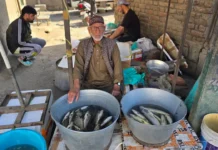
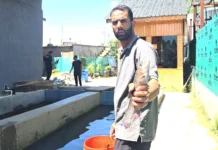
Hilal was ten years old when he first followed his father out onto Dal Lake before dawn, watching the nets come up full. It was a life handed down without ceremony, his father a fisherman, and so he became one too. For 20 years now, the water has been his work, his rhythm, his livelihood. The fish he has chased all his adult life is the Kaeshir Gaad, the indigenous Kashmiri fish that has sustained families like his for generations.
He still leaves home at 5 am. The hour has not changed. But the nets tell a different story now.
“Earlier if I used to catch a quintal (100 kgs) of fish, now I catch less than that,” he said. He is not a man given to despair, he is quick to add that Allah has put barakah in this work, and he means it. But the numbers do not lie. Of the roughly 20 fishermen who work the same waters, he estimates that out of the entire year, there are only ten to fifteen days on which they actually catch fish.
His trader, Shakeel Ahmad, who has sold fish in the local market for 15 years, has watched the same arc of decline from the other end of the transaction. The supply that once came in at one or two quintals has dropped by nearly fifty kilograms. “The numbers vary because of climatic changes,” he said, the rainy days yield less than the sunny ones, and weather patterns shift what comes up in the net. But he is careful to add that the fish itself has not disappeared. The catch has.
Imtiyaz Ahmad, another fisherman from Srinagar, remembers what 20 years ago felt like in the body. Every day he left his home and came back satisfied. There was enough. The Kaeshir Gaad was always in demand, and the water delivered it. “Now the numbers have decreased and there are many factors to it,” he said. “Kaeshir Gaad is always so much in demand, the livelihood of so many people depends on it, but unfortunately we are witnessing a decline right now.”
This distinction, between the absence of fish and the absence of fish here, is one that scientists are insistent upon.
What Has Gone, and Where
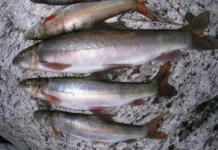
“The indigenous Kashmiri fish species, particularly Schizothorax, locally known as Kaeshir Gaad, have not vanished,” said Dr Farooz A Bhat, Dean of the Faculty of Fisheries at Sher-e-Kashmir University of Agricultural Sciences and Technology (SKUAST-K). “What has happened is a decline in their numbers across different water bodies. When the population declines, naturally the fish catch also declines. The issue is not extinction, but reduction in abundance caused by environmental pressures.”
Three or four decades ago, the water quality of Dal Lake was markedly better, and fish populations were comparatively high. Now, the numbers have not reached zero, but they have clearly, measurably fallen.
The story of the Kaeshir Gaad, however, is not the only one being told. There was once another fish, Botia species, locally called Ramgurun, that was very abundant in Dal Lake. It is now rarely found there at all.
“This decline happened because the habitat and ecology of the lake have changed, mainly due to pollution,” Dr Farooz explained. “If you look back to the 1940s and 1950s, the foreshore areas of Dal Lake had stones and sand along the banks. Today, that natural structure is largely gone.”
The Ramgurun depended on sandy substrates, burying its snout into the sand to pick insect larvae for food. That sand has disappeared, and with it, the feeding ground. “If a species cannot find its habitat, it cannot survive there.”
Sensitive Species
The damage runs deeper than any single species. Schizothorax species are acutely sensitive to changes in water quality, when pollution crosses certain thresholds, their populations decline naturally. Some species feed by scraping algae from stones at the bottom of the lake. If those stones disappear, or if pollution alters the composition of the algae growing on them, their food source is gone.
Schizothorax isosceles, a carnivorous fish, feeds on aquatic insects and invertebrates. When pollution changes the insect population, this fish cannot sustain itself. In such cases, Dr Farooz explained, a species does not vanish from the earth, it becomes locally extinct, disappearing from that location while surviving elsewhere. The lake loses it. The river may hold it, for now.
Waters That Have Changed
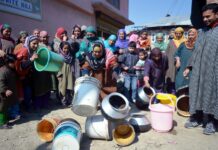
A fisherwoman who catches fish in Aanchar Lake points to the waste flowing in from SKIMS hospital and surrounding settlements. “That has resulted in the decrease of fish in the waterbody. We are not able to catch as many fish now as we used to.”
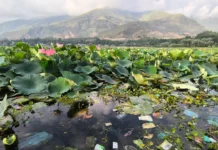
The pattern repeats across Kashmir’s water bodies. Wular Lake, if its area in the 1950s is compared to that of today’s, has significantly shrunk, large portions of open water converted into marsh by silt deposition. As open water reduces, so does fish habitat.
Species like Schizothorax niger, locally called Ale Gad, were once lacustrine fish, creatures of the lake. Now, pushed out by habitat change, they are increasingly found in the slow-flowing sections of rivers like the Jhelum. “This shift shows how species adapt when their natural habitats are degraded,” Dr Farooz explained. Adaptation, in this context, is not resilience. It is retreat.
Along the Jhelum itself, a fisherman who once easily caught ten kilograms in a day now considers two kilograms a good haul. And the composition of the catch has changed as much as the quantity. Where indigenous fish once made up sixty to seventy per cent of what came out of the water, the dominant catch today is common carp, Punjaeb Gad, a hardy, pollution-tolerant species that survives precisely because the native fish cannot.
The Forgotten Names
The scale of what has been lost becomes clearer when one reaches back into history. European travellers who frequented Kashmir in the nineteenth and early twentieth centuries recorded in their journals a freshwater world of extraordinary variety.
The Jhelum and its connected lakes held fish known by names that few people recognise today: Charri Gad, Sattar Gad, Krout Gad, Pikut Gad, Chash Gad, Harj, Ramah Gad, Unyour, Tet Gad, Dras, Ait Gad. Each had its own season. The Charri Gad came in October and November. The Sattar Gad was plentiful year-round. The Chash Gad, with its pointed head and soft scaleless skin, was a winter fish, caught from December until March. The Ramah Gad moved between the Jhelum and the lakes as the water turned cold.
The travellers wrote of fishermen working long lines stretching over a thousand yards, hooks placed at intervals of less than a yard, each weighted with a small stone or pebble, the same sandy beds that indigenous fish would later depend on for breeding, and that sand mining is now destroying. They wrote of the fish in the sacred pools at Vernag and Mattan, tame fish with no generic name, called only Nageh Gadeh. They wrote of the mulberry season drawing fishermen away from the Jhelum and up to the cold, fish-rich waters of the Sind river at Ganderbal.
That world had a density and a variety to it that the present cannot match. Of the 15 Schizothorax species once recorded in Kashmir, many are in decline. The list of what existed is, in some ways, a measure of what is being lost.
Why Stocking Is Not Enough
Research institutions across the region continue to produce fish for stocking, sometimes releasing lakhs of fish into water bodies. But Dr Farooz is unambiguous about the limits of this approach.
“Unless the environment is healthy, these fish will not survive. Indigenous species like Schizothorax are not as easily culturable as trout, so conservation must focus on habitat protection.”
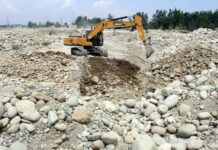
Pollution, he asserted, remains the primary driver of decline. Habitat destruction, siltation, and ecological disturbance follow close behind. Climate change plays a role, but a secondary one. And sand mining , which destroys the pebble and sandy beds to which indigenous fish migrate in winter to breed, has made natural regeneration nearly impossible. “If breeding success drops, even if thousands of fish migrate, only a very small percentage survives.”
Even as trout production has increased and is often held up as a conservation success, the population of indigenous fish continues to fall, and with it, the daily catch that families like Hilal’s depend on.
Dr Khurshid A Salman, who has tracked these pressures through an environmental lens, calls for urgent and coordinated action: strengthening sewage treatment, regulating sand mining, protecting breeding habitats, restoring degraded wetlands, and improving scientific monitoring. Rapid urban expansion around Dal and Wular has reduced wetland buffers and increased pollution loads, while weak monitoring of waste discharge and illegal mining has allowed the damage to accumulate unchecked. “Meaningful recovery will require coordinated efforts from policymakers, agencies, and local communities,” he said.
Without that, he warned, the consequences will compound, loss of biodiversity, disruption of aquatic food chains, and the growing dominance of invasive species that further crowd out what little remains of native fish populations.
For Hilal, standing at Dalgate at 5 am with his net, the science and the policy feel distant. What is immediate is the water, how it looks, how it smells, and what, if anything, comes up in the net by 9 am. For Imtiyaz, 20 years of memory make the present harder to accept. He knows what this lake once gave. He knows what it no longer does.
“The pollution in Dal Lake has degraded the water quality and that is affecting everyone,” Hilal put it simply. He goes out every day. Most days, there is nothing