From Ganderbal to Shopian, Kashmir’s sacred springs and trout canals are witnessing mass fish die-offs, a crisis born of blocked outlets, sewage, algal blooms, and decades of official neglect threatening both ecology and livelihoods, reports Babra Wani
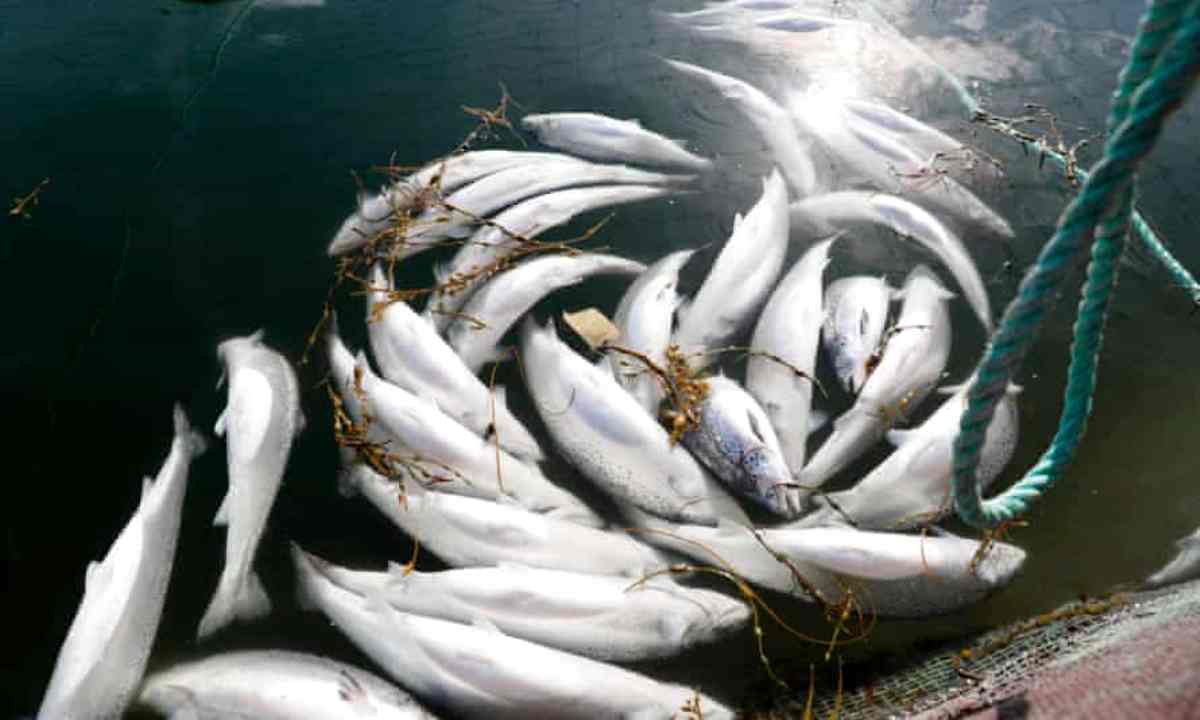
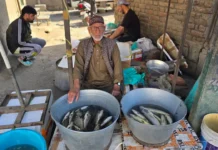
Mohammed Yusuf has fished the Baba-Wayil canal in Kangan for over two decades. Trout, he will tell you, are proud fish; they stay deep, fight the current, and never beg. In March, when he saw them surfacing in slow, desperate circles, mouths gulping at the air, he knew something had broken.
“They were coming up on their own,” he said. “We did not even need nets. We just picked them up from the banks.”
The canal that had sustained his family through the lean winters had turned against its own. Yusuf is not alone in this predicament.
What Yusuf witnessed was not a local oddity. Across Kashmir’s springs, wetlands, and freshwater canals, fish are dying in their hundreds and thousands. The phenomenon is called a fish kill. It is accelerating. It is hitting the valley’s fisheries at the worst possible moment, when yields are already falling, indigenous species are disappearing, and the communities that depend on these waters have no more room to absorb the losses.
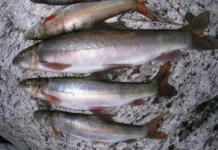
Several cold-water species have already vanished. The schizothorax and the brown trout that made Kashmir famous among anglers are now confined to shrinking pockets of clean water. Each kill event shrinks those pockets further.
A Spring Closed
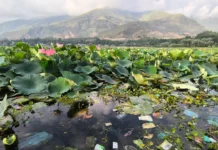
In the Beehama area of Ganderbal, a spring near the Jamia Masjid has long been a place of quiet devotion. Faithful from across Kashmir would visit to feed the fish. It was an act of good deed as much as leisure.
Bilal Bhat, a local activist, remembered visiting during his college years. “It always brought joy to the onlooker,” he said. “The fish were thriving, playing with each other.”
This spring, the fish were dead.
Large numbers of carcasses were found floating on the surface earlier in April 2026. Bilal received the call mid-assignment. He arrived as quickly as he could. What he found shook him. Fifty young men stood on the bank. They watched the dead fish drift. Not one of them entered the water.
That paralysis struck him as emblematic of something larger. Springs like this one exist at the intersection of faith and ecology in Kashmir. They are tended by community belief as much as by formal governance. When both fail simultaneously, the results are visible and, perhaps, irreversible.
“Without any second thought, I jumped in and started collecting the carcasses,” Bilal said. “There was a possibility the water was poisoned. It could have harmed me. But I did not care.”
The cause, he believes, is plain. The spring’s outlet had been closed by its managing committee. They feared the fish might escape. The stagnant water bred algae. The algae consumed the oxygen. The fish suffocated.
“The plan backfired,” Bilal said. “The outlet was closed to protect the fish. It killed them instead.”
He also identified a longer pattern of neglect. The spring had gone without regular cleaning for years. “Nobody paid any heed. I cannot blame anyone else, but even I am responsible,” he admitted, even though he was not part of the decision-making. It, however, points to a shared failure that no single department can fully own.
The fisheries department has collected water samples and is analysing the findings. Bilal is not waiting. “The reasons are quite visible,” he said.
A Valley-Wide Pattern
Beehama is not alone. In the Zainapora area of Shopian, fish were found dead in Vurnag Spring earlier in April. Carcasses floated across the surface. Locals appealed to the government to investigate and prevent further damage.
Before that, hundreds of fish were found dead in Sherbagh spring in Anantnag, one of the coolest places in the south Kashmir town, to which millions of memories belong of residents, students, men and women.
A fisheries department team visited and concluded the deaths were likely caused by chemical contamination. Officials pointed to wastewater entering the spring from nearby facilities, washing discharge, soapy water, and used detergent. Detergents reduce dissolved oxygen sharply. They also introduce toxins that freshwater fish cannot survive.
In the Baba-Wayil canal in Kangan, trout were showing the distress signs that precede a kill. They rose to the surface. They came ashore. They became easy to catch. Residents said the canal had recently become a dumping ground for dirty diapers and household waste.
Javid, a resident, had never seen anything like it. “This is the first time we witnessed such a phenomenon,” he said. It was not just the fish. The insects on which the trout feed had also begun appearing on the surface. The disruption had already reached the lower layers of the food web.
The recent incidents sit within a long and worsening record. In 2025, Wullar Lake and the river Jhelum both reported mass fish deaths from electric fishing and chemicals. In 2023, Dal Lake saw a major die-off from acute oxygen depletion. That same year, the Fashkoori wetland in Pulwama recorded a mass mortality linked to high levels of phosphate and ammoniacal nitrate.
A 2025 study published in Just Agriculture, titled Death in the Valley’s Waters, catalogued the drivers carefully. Chemical contamination was identified as a primary trigger. The study cited a 2018 case in Langate, Kupwara. Over 14,000 trout died after an unknown chemical entered the Mawar Nallah, the farm’s main water source. The study also traced fish mortality to agricultural runoff. Water flowing from orchards into fishponds carried residue from cleaning equipment. Growers may not have known what they were releasing. The harm happened without intention. It kept happening without accountability.
The Science of a Silent Death
Dr Syed Masood ul Hassan Balkhi is the longest-serving Dean of Fisheries at SKUAST-K. He has spent his career studying what happens when water turns against fish.
“Fish kill refers to the sudden and often mass mortality of fish within a water body,” he explained. “This may involve only a few species or, in severe cases, entire fish populations.”
The primary driver in most cases is oxygen depletion. When dissolved oxygen levels fall below critical thresholds, fish cannot breathe. They suffocate. The depletion is most often caused by decomposing organic matter or excessive nutrient loading. Nitrogen and phosphorus from agricultural runoff feed algal blooms. When those blooms die, bacteria decompose them. The bacteria consume whatever oxygen remains. The fish have nowhere left to breathe.
Industrial waste, sewage, and pesticides cause further damage. They destroy the gill tissue, which fish use to extract oxygen from water. Rising temperatures lower the oxygen that water can hold. Lake overturn, when deep, oxygen-poor water rises and mixes with the surface, can trigger sudden mass death in water bodies that appeared healthy just days before.
What makes Kashmir’s situation distinctive is the layering of these pressures. A spring might face nutrient loading from agriculture, receive untreated sewage from a nearby settlement, lose its natural flow from a blocked outlet, and warm slightly through seasonal shifts. Each factor might be manageable alone. Together, they are lethal. Dr Balkhi describes this as a compounding crisis, environmental stress accumulating silently until it crosses a threshold that announces itself only in death.
Kashmir’s most vulnerable species are also its most valuable. “In Himalayan regions, fish like trout require high dissolved oxygen levels,” Dr Balkhi said. “When oxygen drops, they move to the surface or near shorelines, gulping at air where oxygen concentration is relatively higher.”
The surfacing trout that Yusuf described at the Kangan canal was not a curiosity. It was a distress signal, one that arrived too late.
“Such events can lead to the complete collapse of fish populations in affected water bodies,” Dr Balkhi warned. “Sensitive species such as trout and snow trout in Jammu and Kashmir are particularly at risk.”
Cascading Losses
The deaths do not stay in the water. Fish occupy a structural role in aquatic ecosystems. They regulate the populations below them and nourish those above. When they die in mass, the disruption radiates outward. Biodiversity collapses. Water quality deteriorates. Every organism that depended on them loses a critical link.
For Kashmir, the economic toll is direct. Trout farming, concentrated in the Himalayan belt, is especially exposed. A single contamination event can erase months of investment, feeding costs, maintenance, and labour in a matter of days. Small-scale farmers have no insurance. No institutional buffer. They absorb the loss quietly and carry it into the next season, if they survive long enough to reach it.
There is also a reputational loss that compounds over time. Kashmir once drew fly fishermen from across India and beyond. Angling on the banks of clean rivers and having wild trout. That reputation was built over generations. It is not easily rebuilt once a water body becomes associated with death. Angling tourism, already diminished, faces further erosion as rivers and springs continue to deteriorate.
Then there is what cannot be measured. The grief of men like Bilal Bhat, who once watched fish play in a spring and now collects their bodies from it. “God will take away from what He has bestowed us with if we do not take care of these things,” he said.
What Must Be Done
Dr Balkhi was measured but direct. Sewage treatment plants must be built around vulnerable water bodies. Catchment areas need afforestation to control soil erosion and reduce runoff. Agricultural discharge carrying fertilisers must be regulated, not left to chance.
When a kill occurs, speed matters. Oxygen-depleted water can be partially restored through aeration, pumps and diffusers introduced into the affected body. Dead fish must be removed immediately. Left to decompose, they worsen the very oxygen crisis that killed them. Bioremediation and wetland restoration offer longer-term solutions as natural filtration systems for chronically stressed water bodies.
Community understanding matters as much as infrastructure. The managing committee that blocked Beehama’s outlet acted without grasping the consequences. That ignorance was not malicious but proved lethal. Basic education around water body maintenance, outlet management, algae monitoring, and early warning signs could prevent a significant share of kills that are currently treated as mysterious or unpreventable.
None of this is technically difficult. What is required is the will to treat Kashmir’s springs, wetlands, and rivers as foundations, not backdrops. The valley’s ecology and its economy rest on the same water.
Back in Beehama, Bilal Bhat stood at the spring he had pulled dead fish from. He offered no comfort. “This situation is very alarming,” he said. A spring that once brought peace now brought dread. And the question that followed him home: who, exactly, is watching over the waters that remain?