In Jammu and Kashmir, daily wagers’ insecurity, stalled regularisation, skewed reservations, 77,099 vacancies and rising unemployment deepen youth despair, even as credit schemes like Mission YUVA offer limited relief, reports Babra Wani
In the not-so-distant past, Mushtaq Ahmad, a resident of a South Kashmir village, was attending to urgent work at a local hospital in Srinagar. As he passed through the corridor, a woman ran towards him.
“Is anyone here who can recite Azaan to our baby?” she questioned. Without a second thought, Mushtaq leapt forward, “Yes, I do.”
The woman was all excited and was about to as kto accompany him to the newborn to recite azaan when the second sentence that Mushtaq said blew off her excitement. “But I am a daily wager,” Mushtaq had told her, matter-of-factly.
He remembers the unknown woman’s face colours changing and her soft expression stiffening. “No, no, not you,” she reacted, as if being forced. “Not a daily wager at all. Her father is one too. We do not want her to have the same fate.”
Even though Mushtaq recalls the incident with a tinge of humour to make other people laugh, daily wagers like him say that they have been suffering for a long time. “I do laugh about the incident, but it shows the state and the status of the daily wagers in Kashmir,” Mushtaq said.
It is not Mushtaq alone. This is the story of around 100501 daily wagers serving 27 departments of the Jammu and Kashmir government. They work on the hope of becoming formal employees one day, and in this hope, many of them have died or been electrocuted.
A Protest
Earlier last week, the members of the Jammu and Kashmir Government Employees Joint Action Committee said that their key demands include the regularisation of daily wagers.
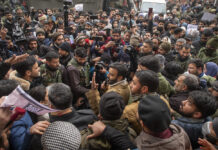
Frustrated, hundreds of daily wage workers accompanied their families to register their protests demanding regularisation. Their placards read, “OMAR SAHIB We Dream Too Please Don’t Ignore Us.” Jannat, daughter of a humble daily wager, pleaded for her father’s regularisation, her dreams hanging by a thread, “regularisation policy ko waazah karo.”
Irfan Ahmad Kawa, Chairman of the All J&K PDL-TDL Electric Employee Union, said that there are almost 7000 Permanent Daily Labourers and Temporary Daily Labourers employed with the power department in Kashmir. “Our only demand is that we be regularised. Until that happens, the Minimum Wages Act must be implemented for all.”
Irfan lamented that nearly 500 need-based workers have not been paid, and “their salaries must be released. The wages of the next of kin have also been withheld since 2019, merely because the government claims they were engaged after March 17, 2015.”
In The Budget
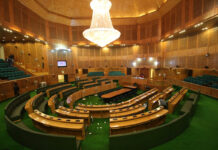
When Omar Abdullah presented the budget, the opposition criticised it, calling it National Conference-centric and not people-centric. The daily wagers apart, various lawmakers from non-NC parties highlighted that the expenditure strategy has not taken care of the youth, the next generation of Jammu and Kashmir.
The youth are already frustrated. Reservation is one major crisis they are facing.
Sahil Parray, Open Merit Students Association of Jammu and Kashmir, leader, said the excessive reservation coupled with rising unemployment has become the “deadliest combination” for Gen Next. “It has completely broken the backbone of meritorious students. We are living through extremely painful and uncertain times,” he regretted.
Thousands of aspirants are silently slipping into anxiety and severe depression because their hard work is no longer enough. In Jammu and Kashmir, employment opportunities outside the government sector remain scarce, and when even public jobs seem out of reach, a deep sense of helplessness sets in among young aspirants. Years of preparation, personal sacrifice and family expectations weigh heavily on them, with their futures hanging in uncertainty. Many are crossing the upper age limit while waiting for recruitment processes to move forward, watching their aspirations slowly slip away.
What compounds the distress, Parray said, is administrative inaction. “The government continues to play office-to-office with the reservation file while the most productive years of youth are being lost. Recruitments come and go, but general category meritorious candidates feel increasingly sidelined, left with frustration, despair and a growing sense of injustice,” he lamented.
Fresh data tabled in the Assembly reveal the fact that Kashmir is facing music as Jammu division accounts for nearly 86 per cent of the 11.81 lakh certificates issued across seven categories, compared to just 14 per cent in Kashmir division. Of the 7.49 lakh ST certificates, over 92 per cent were issued in Jammu, while more than 98 per cent of SC certificates went to the region. Border-linked categories show a similar trend, with over 93 per cent of ALC certificates and all International Border certificates concentrated in Jammu. Even under the Economically Weaker Sections category, Jammu received more than 91 per cent of the benefits. Only the Reserved Backward Area category reflected near parity between the two regions
Despite this, the files are not moving. “A notification issued in 2020 led to an examination only in 2025, and even in 2026, the selected candidates are yet to be declared,” Nasir, a 26-year-old scholar from Kulgam, said.

Rs 48 Cr Fees
It shocked the assembly last week when the government admitted to Waheed Para that the two major recruiters, the JKPSC and SSB, have realised Rs 48,88,39,650 (JKPSC Rs 17,90,38,100 and JKSSB Rs 30,98,01,550) from candidates during the financial years 2023-24 and 2024-25 as fees for examinations.
“Jammu and Kashmir has 70 per cent of the population below the age of 35. It is a young sate and in this age group, 32 per cent are desperate to have a job,” Parras said, while talking on the budget. “The mental hospital said they had 200 thousand patients this year, and it is a shock.”
Parra said the people understand that the government may not be able to give a job, but at least it can return Rs 50 crore to the youth who paid it as a fee. “Why cannot you do it?” he asked. “Your budget is not human development or youth-focused, and it is very problematic for Jammu and Kashmir’s youth who look towards this house.”
Jammu and Kashmir has, in recent time,s experienced an increase in the number of unemployed youth. Jammu and Kashmir’s unemployment rate stands at 6.7 per cent, well above the national average of 3.5 per cent, according to the data shared in the Legislative Assembly.
Vacancies
With Jammu and Kashmir Police taken over by the Ministry of Home Affairs, Omar Abdullah now heads a small government with a historic low number of employees on its rolls.
At the same time, however, the government admitted in the assembly that it has 77,099 vacancies across its departments: Direct Quota accounts for 3,808 Gazetted, 24,507 Non-Gazetted and 12,351 Multi-Tasking Staff (MTS) posts, while the Promotion Quota includes 6,409 Gazetted, 24,451 Non-Gazetted and 5,573 MTS posts. In his budget, Omar gave an idea about the number of vacancies his government anticipates filling in the next year.
Mission Yuva
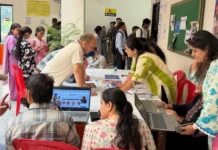
On the employment front, the Jammu and Kashmir government offered a set of credit-linked employment schemes with Mission YUVA topping the list.
Since its launch on June 28, 2025, Mission YUVA (Yuva Udyami Vikas Abhiyan), the government said, has rapidly evolved from a policy rollout into a large-scale entrepreneurship drive, drawing over 1.71 lakh youth registrations and translating interest into tangible financial uptake, with bank sanctions nearing Rs 1,000 crore and more than rs 700 crore already disbursed to new ventures.
Conceived as a five-year employment strategy, the programme aims to establish 1.37 lakh enterprises and generate about 4.25 lakh jobs, backed by a baseline survey of 24 lakh households and 1.1 crore individuals that identified 5.5 lakh potential entrepreneurs. The pipeline shows steady conversion: nearly 70,000 enterprise applications have been filed, DPRs prepared for 52,875 candidates, 47,816 proposals approved at the district level, 16,141 receiving bank sanctions and around 15,000 more at advanced appraisal stages. Financial incentives include a 25 per cent capital subsidy and 5 per cent interest subvention for nano enterprises with investments of Rs 5–6 lakh, and 6 per cent interest subvention for MSMEs in priority sectors.
Not Helpful
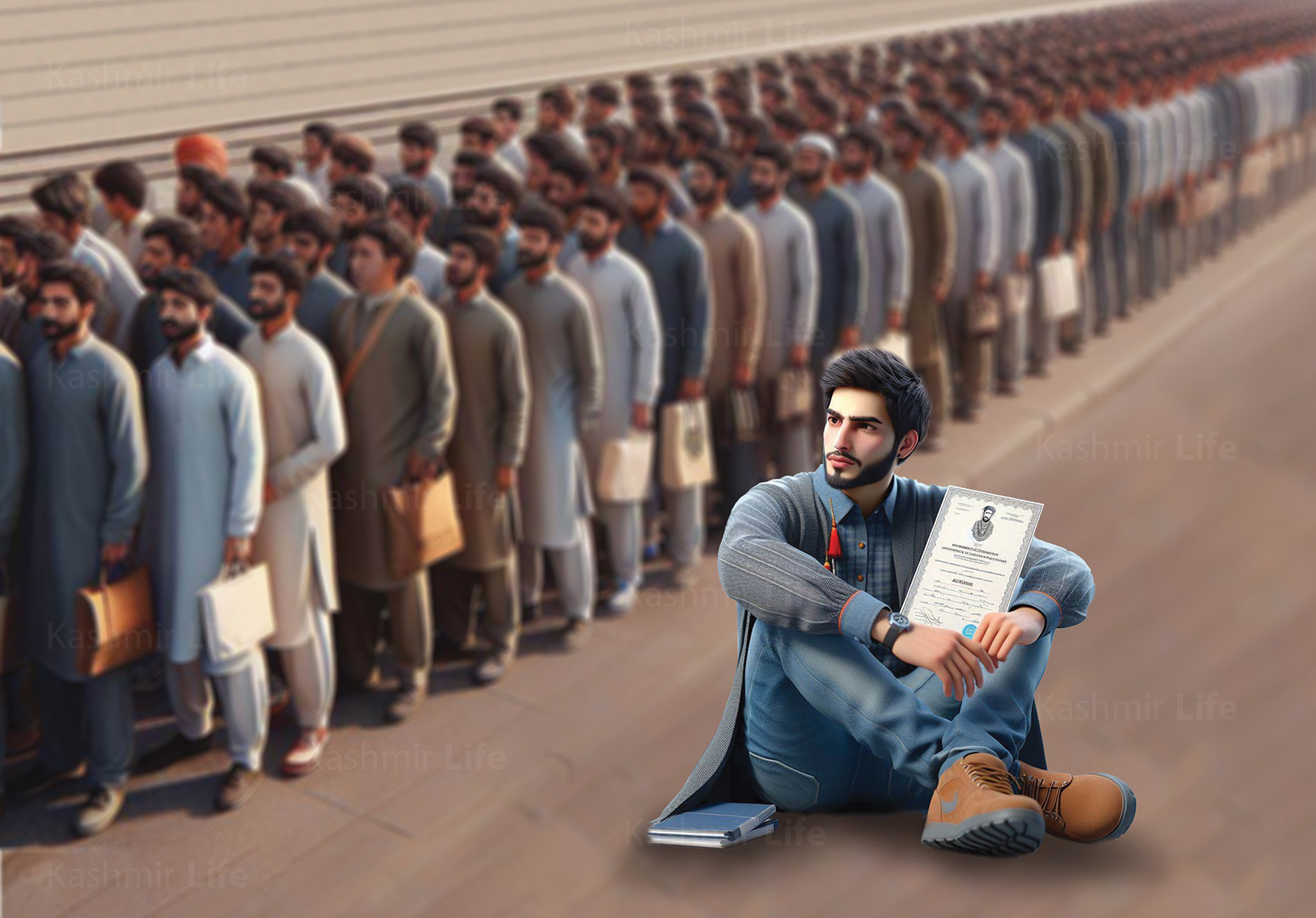
The self-employment schemes and jobs are two parallel things to the same mess, but notthe sole solution. Last week, JKNC MP, Aga Syed Ruhullah Mehdi, remarked in Lok Sabha that after the abrogation of 370, Kashmir has seen a decline in the employment rate.
Even the BJP, which has ruled Jammu and Kashmir indirectly between 2018 and 2024, is unhappy that youth are not being treated well. BJP leader in the House, Sunil Sharma, alleged that promises made to unemployed youth had not been fulfilled.
“Twenty-four thousand jobs were given to a company without any formal interviews. This is a totally anti-public budget,” Sharma alleged, adding that no concrete capital expenditure had been outlined.
Even the PDP highlighted the same concern. “Twenty-four thousand posts were outsourced, 15,000 vacancies remain unfilled, while nearly six lakh labourers from outside are working here. Our people are unemployed, hopeless, depressed and stressed,” he said.
Parra alleged that there was no industrial policy in place for the past year and said the budget made no mention of policies for handloom and handicrafts. “There has been no incentive policy for the last one and a half years. This is a vague repackaging of centrally sponsored schemes,” he claimed.