Kashmir’s students face a widening gap between personal ambition and systemic pressure, reports Lilac Ali

Sayim walked into university with unshakable clarity of purpose. He wanted to study neuroscience, specifically that charged intersection where philosophy meets the brain, where questions about consciousness become questions about what it means to be human. Two years later, he is majoring in economics. “I like what I am doing now; it opens a lot of doors,” he said. “Our generation is confused because we are more self-aware.”
“I like what I am doing now; it opens a lot of doors,” he said. “Our generation is confused because we are more self-aware.”
Sayim is not an exception. Kashmiri students are navigating a widening gap between what they set out to study and where they eventually land. They are caught between personal ambition and external pressure, between what they want and what the world appears to reward. What looks like individual indecision is, on closer examination, something far more systemic.
Borrowed Dreams
The most common story Ajaz Ul Qayoom hears is not a student’s story. It is a parent’s.
Qayoom, a Srinagar career counsellor, has spent years sitting across from young people navigating one of the most consequential decisions of their lives. The single biggest cause of confusion he has witnessed, he said, is career imposition by parents. “Parents wish for their children to pursue their failed ambitions without acknowledging the skill set and uniqueness of the child.”
One incident stays with him. A doctor brought his son into the consultancy, determined to push the boy toward sitting for NEET a second time. The student listened patiently, then broke down in tears. He confessed he did not understand physics at all. A psychometric test, a standardised tool that measures aptitude, personality and behavioural tendencies, revealed that his interests lay in entirely different fields.
Qayoom has watched the same story unfold in different forms, with different families, more times than he can count.
Most students who come to him fall into the “confused” category on the psychometric scale, which classifies young people across four stages of career readiness: unaware, confused, exploring and future-ready. Qayoom attributes this overwhelmingly to parental imposition and systemic ignorance. He noted that there are 34 recognised career clusters globally, many of them entirely unknown in Kashmir, leaving students to choose from a map they have never been shown.
His proposed solution is early intervention. “The best way to avoid this confusion is to introduce psychometric tests in middle school, enabling students to explore their passions before the pressure of high-stakes choices arrives.”
The Paradox
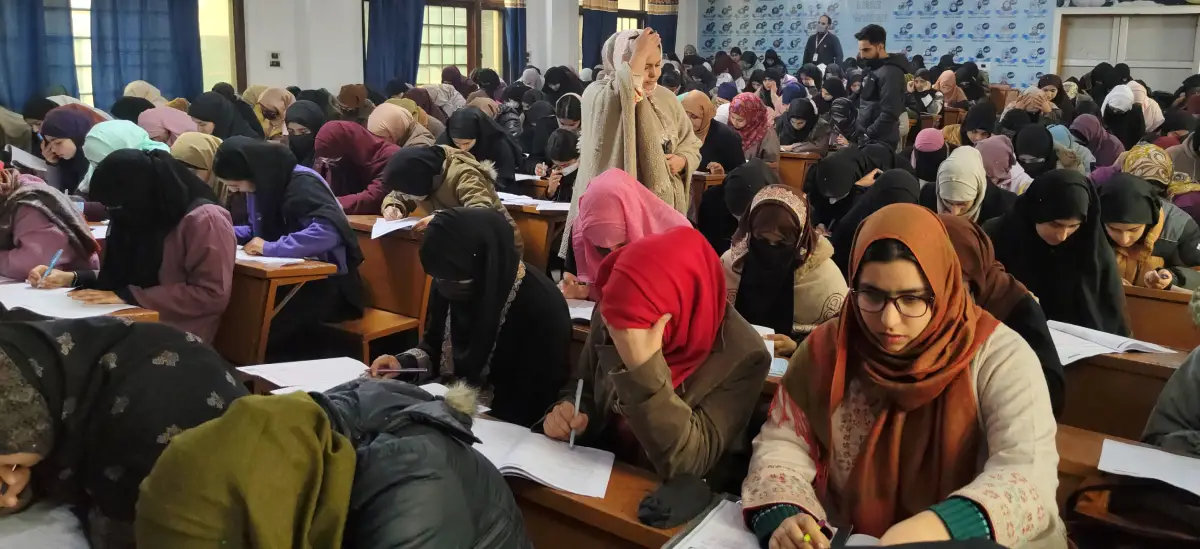
Yet parental pressure does not account for everything. There are students in Kashmir who face no such imposition, whose parents have stepped back, left the decision entirely to them, and who find themselves no less lost.
Zara, a 12th grader, articulates the tension with precision. The confusion, she said, is not between a good option and a bad one. It is between entirely different definitions of a good life. One version is inherited from family and society: stable careers, professional degrees, financial security, and a reliable future. The other is personal and uncertain, shaped by passion, meaning, and the desire to pursue something that feels genuinely one’s own, even without guarantees. Purpose versus stability. Meaning versus money.
This is a shape of confusion particular to this generation: not a shortage of options but an overwhelming excess of them, each pulling in a different direction. A teenager in Srinagar can watch a filmmaker in Mumbai, a startup founder in California, a policy researcher in London, and a fashion creator in Paris within the span of a single scroll. Every profession seems attainable. Every path seems urgent. The internet delivers advice in infinite quantities but very little certainty.
A Strange World
Taiba, 21, frames the stakes plainly. “We know what kind of world we are entering, a world with its mouth open. Automation and job saturation at their peak. We have to think it through”.
The anxiety she describes is not abstract. As of early 2026, Jammu and Kashmir’s unemployment rate stands at 6.7 percent, nearly double the national average. Behind that figure are over 4.73 lakh individuals between the ages of 18 and 60, willing to work and currently without it, a number exceeding the entire population of Iceland. For a young person standing at the threshold of a career decision in the Valley, these are not statistics. They are the landscape.
The New Education Policy 2020 mandates systematic career guidance from as early as Class 8. On paper, the framework exists. In practice, Qayoom said, the number of schools in Kashmir with a dedicated career counsellor is so negligible he can count them on one hand.
Accidents, Not Systems
Research confirms that this generation’s expectations are genuinely different. According to a Deloitte survey, 70 per cent of Gen Z and millennials prioritise purpose in their work, yet fewer than one in four can see a clear path toward it. They want meaningful work, financial stability and personal wellbeing simultaneously. In any job market, that trifecta is difficult to find. In Kashmir, it is exceedingly rare.
Back in his economics lecture, Sayim is not unhappy. The doors remain open. The choices are still available. But the neuroscience dream sits quietly on a shelf he has not returned to.
There are exceptions. But they are outcomes of accidents, not systems. They depend on the right person being in the right room at the right moment, and choosing to look closely. In Kashmir’s classrooms, packed and under-resourced, that moment arrives for some and never comes for others.