A government-mandated textbook monopoly has lowered costs but triggered concerns over academic quality, editorial standards and learning outcomes, forcing many families to rely on costly supplementary books and private coaching, reports Lilac Ali

In the 2025 winter, a tenth-grade student in Srinagar was studying for her social science board exams. Turning to the first aid chapter of her Disaster Management and Road Safety Education textbook, she hit a sentence that brought her studies to a bewildered halt. “Unconsciousness or fainting,” the text solemnly informed her, “is a UT of the human body.” A few lines down came a grimmer warning: “This UT can lead to the death of the victim if no immediate first aid is provided.”
The baffling sentences were not a printing error. They were the result of a hasty, automated find-and-replace command run across the manuscript by the Jammu and Kashmir Board of School Education (JKBOSE). Following the reorganisation of Jammu and Kashmir state that required downgrading the term “state” to the “Union Territory,” the board’s textbook division used a computer algorithm to replace the words. Without human editors to check the context, the software blindly replaced every instance of the word indiscriminately.
In seconds, everyday descriptions of bodily conditions or mental states were transformed into bureaucratic acronyms, leaving students to read about the “UT of mind” and the “UT of affairs”. Interestingly, the officials who started reporting to the offices exactly at 10 am after the UT administration enforced the “discipline’ skipped even proof-reading the altered text that a generation of federally governed region had to study.
This is the material reality of the textbooks that currently shape the minds of young students in Jammu and Kashmir. If this were an isolated editorial blooper, it might be laughed off as an embarrassing mishap. But the stakes are incomparably higher: these exact textbooks are now the only texts available to all, regardless of the fact that where you are enrolled.
Over the last few academic cycles, a relentless government campaign has systematically forced private educational institutions to abandon independent, learning materials from mainstream national and international publishers. Private schools are now legally barred from prescribing anything other than these official, state-sanctioned volumes.

The Monopoly
The enforcement mechanism that led to this monopoly was forged through a sequence of sharp administrative orders and prolonged legal battles. The push began in earnest with a series of JKBOSE notifications issued in late 2022 and early 2023, which targeted the middle school tier from classes six to eight.
Privately run schools were warned that recommending any “unauthorised supplementary” text would invite fines of up to Rs 50,000 and the outright cancellation of their school affiliations. Private school collectives, represented by the Jammu and Kashmir Private Schools United Front, took the matter to court. They argued that the blanket mandate restricted their freedom to choose advanced, rigorous textbooks that better prepared students for national competitive exams.
The legal struggle reached its climax in early June 2026, when a Division Bench of the High Court of Jammu and Kashmir and Ladakh upheld the government’s textbook policy. The court dismissed the final appeals filed by the private school unions. It ruled that since private academies voluntarily sought affiliation with the JKBOSE to register students for public examinations, they were legally bound to comply with its regulatory framework. The court emphasised that regulating education to enforce uniformity and prevent commercial exploitation was a reasonable restriction in the broader public interest.
Conceptually, the government’s stance is built on a valid point. For years, the private school ecosystem across Kashmir operated as an unregulated sphere of commercial activity. Elite school managements frequently entered into exclusive agreements with niche private publishers to supply textbook sets that were intentionally unavailable in the open market. Families were subjected to a coercive retail chain, forced to purchase books at hyper-inflated prices, often running between Rs 6,000 and Rs10,000 at designated retail outlets.
By implementing a singular, state-mandated curriculum, the government successfully smashed this ‘cartel’, replacing expensive commercial sets with government texts priced at a bare fraction of their cost.
Schools in the Middle and Secondary level were already being taught the NCERT and the new order hit the primary level, the most crucial learning level in the education ladder. Almost 1.1 million kids in the primary level were impacted. Also impacted were nearly 1100 booksellers who had cumulative turnover of Rs 140 crore in supplying the text books for the initial five classes. Some of them have closed the shutters and have changed their line of activity. A small section of schools understood the cost it will inflict upon the students and they quickly shifted to CBSE where such restrictions do not exist.
The Content Deficit
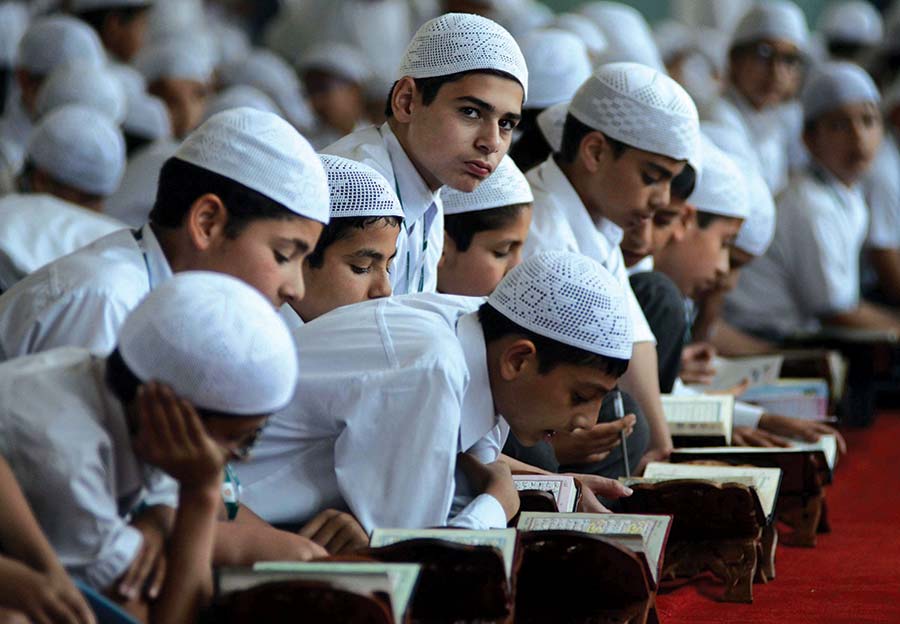
The actual experience of families tells a far more complicated story. When parents and local educators analyse the actual content of the BOSE-prescribed books, the initial satisfaction over financial savings turns into deep anxiety.
“The textbooks may be inexpensive, but their academic standard is incredibly poor,” said Asifa, a parent whose children attend a reputed private school in Srinagar. “While the policy has protected the parent’s wallet from institutional greed, it has simultaneously tied private education to a state publishing apparatus that is structurally and pedagogically compromised.”
The overarching criticism is that the BOSE has achieved economic equity by lowering the curriculum of private schools to an unchallenging, basic baseline instead of elevating education standards to match premium national benchmarks.
The word that comes up constantly when one asked parents about these books is “ridiculous.” Aijaz, a banker, whose son studies in the fourth grade at a local private school, recalls the profound shock of opening his child’s bag at the start of the academic year when the school shifted to government-prescribed textbooks. “When we shifted to these textbooks,”Aijaz said with frustration, “It felt like my fourth-grader son was back in UKG (Upper Kindergarten). The drop in standard was immediate, visual, and devastating.”
Aijaz’s complaint makes perfect sense when one looks at the text. The first chapter of the fourth-grade mathematics textbook published by JKBOSE, titled Merry Math, is called Building with Bricks. A critical examination of its layout reveals a pedagogical framework that is shockingly basic for a nine year old child. The entire opening phase of the textbook asks students to read about bricks and shapes. The exercises do not challenge a child’s analytical faculties; instead, they instruct students to find the circular pattern, identify the simple two-dimensional drawing of a brick, colour in blocks, and guess the size of a chimney from an illustration.
The only real math that exists in the entire introductory chapter is lazily labelled as “mental math” in a tiny sidebar. It features a “lousy” division problem: if 1,000 bricks cost Rs 6,000, how much do 500 bricks cost?. “This is not even math for a fourth-grader,” Aijaz pointed out, “This is basic spatial awareness and kindergarten colour-matching.”
“They are insulating children from real problem-solving under the guise of making learning fun,” said Insha, a private school teacher. “Teaching at this remedial pace will inevitably leave students severely unequipped for future high-stakes academic and professional pursuits.”
Contrast this regressive approach with the fourth grade curriculum from independent publishers like the Oxford University Press. In those textbooks, the very first chapters introduce students to a high level of arithmetic. The students under that curriculum are expected to master long division with remainders, advanced multiplication, fractions, and real life problem solving involving the four core operations. By flattening the difficulty curve in the early years, the state board’s material insulates students from rigorous analytical challenges during crucial periods of cognitive development. This creates an accumulation of academic deficits that remains hidden until the child encounters high-stakes competitive environments later in life.
This content deficit deepens as students’ progress into higher classes. The state board’s materials simply do not suffice because of their “awful” content, forcing a heavy reliance on additional reference books. While the central government’s NCERT textbooks used in higher secondary tiers across the country are often praised for their academic rigour and conceptual clarity, the localised textbooks produced for lower classes by the regional board lack that sophisticated editorial touch. The content is presented as dry, static summaries rather than engaging, inquiry-based lessons that encourage independent critical thought.
Another parent pointed out the clear discrepancy in the state’s execution. “This uniformity would have been great had the books been of good quality as well, like the NCERT books used in higher secondary, which are far better,” he said. “Why couldn’t JKBOSE replicate that standard instead of giving our children low-effort text?” The general consensus among educators is that if uniformity was truly about equity and raising standards, the administration would have adopted the national standard wholesale rather than legally enforcing the use of sub-par local adaptations.
The consequences of this content deficit are felt acutely by the students themselves as they attempt to bridge the gap for rigorous national examinations, international academic benchmarks, and global higher education pursuits.
Laila, a Class 12 student, has spent her entire teenage years navigating this exact deficit. “I have used reference books since 7th grade because the JKBOSE books never had any extra content for knowledge,” she said. “It has been very limiting.” Her experience reflects a structural reality where the state-mandated textbook is treated by students not as a comprehensive source of learning, but as a chore to be completed solely to pass the annual regional examinations. To acquire actual foundational concepts in science and mathematics, families must buy external reference manuals published outside the region, which parents note are highly expensive.
The Hidden Deficit
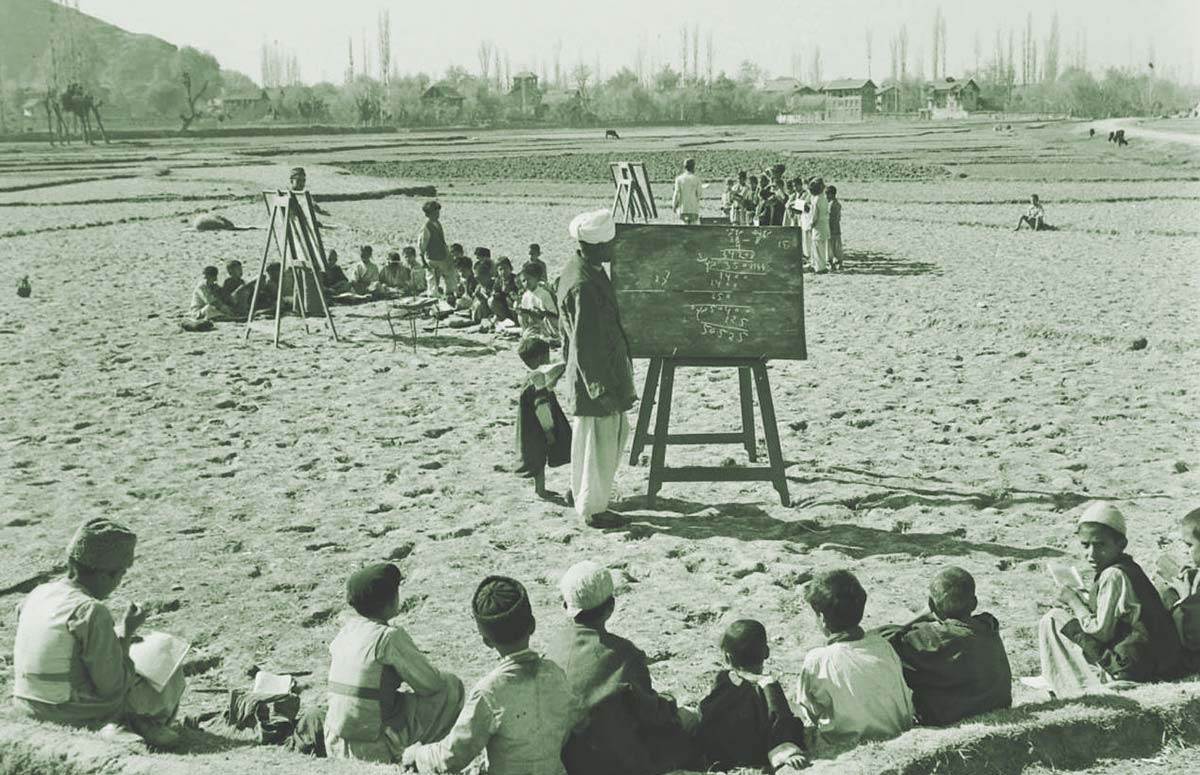
This content deficit is further compounded by the physical degradation of the textbooks themselves. Operating under severe financial constraints, the board’s textbook division runs an annual deficit of roughly Rs 12 crore, a shortfall driven by rising production costs colliding with price caps mandated by public welfare policies.
Under the central Samagra Shiksha scheme, the funding model is structurally strained. The government allocates a fixed budget to JKBOSE per student set, providing roughly Rs 250 for primary books and Rs 400 for middle school tiers, even though the actual manufacturing costs of paper, printing, and distribution hover closer to Rs 450 and rs 750 respectively. Because the board must provide these books completely free of cost to thousands of government school students, JKBOSE is forced to absorb a massive deficit on every single child.
To survive this financial haemorrhage, the state used its regulatory framework to turn private schools into a commercial bailout vector. By legally forcing thousands of fee-paying private school students into their ecosystem, the board sought to scale up market volume and use private parental money to offset its institutional losses. To keep printing costs strictly below the rigid central budget ceilings, JKBOSE aggressively squeezes profit margins through open-tender printing contracts. The final consequence of this economic strain is a product that feels noticeably substandard to the touch.
“Until the fifth grade, I studied from durable, national-level books that lasted for years,” said Tufail, a Class 11 student. “With these books, the paper is so fragile that the very first thing I have to do at the start of every academic year is send them to a bookbinder. If I do not bind them immediately, they would not even last the year without losing half their pages.”
The books are routinely printed on low-grade, thin recycled paper that allows ink from a student’s pen or highlighter to bleed heavily through the page, obscuring the text on the reverse side. High-velocity press runs without adequate quality control result in smeared typography, inverted pages, and ink blots that compromise the readability of entire chapters.
“The editorial quality matches the physical print,” said Minha, a high school student. “Basic grammatical mistakes, typographical glitches, and spelling errors are incredibly common throughout these pages. You constantly find yourself questioning if what you are reading is actually correct.”
Critically, complex scientific diagrams and geographical maps are often reduced to muddy, low-resolution grayscale reproductions. In a biology module, a student attempting to study the fine structures of an animal cell or the pathways of the human circulatory system is forced to squint at an indistinguishable blur of grey tones where individual labels overlap and bleed into the background. This physical low quality actively hinders the visual learning process, turning what should be an inviting study session into an exhausting exercise in deciphering a poorly printed document.
Shifting the Costs
This displacement of expenses highlights what parents and educational analysts describe as the central irony of the mandate. The government enforced this policy to eliminate the financial exploitation of parents by private educational set up. Yet by forcing an absolute monopoly on a flawed, un-engaging product, the administration has merely shifted the financial burden from textbook purchases to alternative sectors of the educational marketplace.
A parent who wants to ensure that their child receives a quality education and better content explanation in an engaging manner will inevitably buy supplementary books. Parents find themselves spending substantial sums of money on thick, comprehensive supplementary guides and question banks produced by national educational publishers. These reference books, which contain the detailed explanations, accurate diagrams, and challenging problem sets missing from the official texts, have effectively replaced the mandated books as the true primary source of learning.
For families with greater financial means, this text deficit is countered by enrolling children in private tuition centres and preparatory academies early in their school lives. The financial liability that the state sought to eradicate has effectively migrated from the private school booklist to the retail bookstore counter and the coaching centre invoice. The policy operates on a superficial definition of affordability, protecting the family’s finances at one specific point of sale while forcing them to privatise the cost of quality instruction elsewhere.
This also creates a secondary inequality, where children from wealthy backgrounds can bypass the limitations of the state-mandated textbook through private supplements, while children from poorer families are left entirely dependent on a compromised material foundation.
Opportunity for Equity
The June 2026 High Court decision effectively cleared the legal decks, allowing the administration to enforce its authority. On paper, the metrics look pristine: private school set up have been reined in, textbook costs have plummeted, and the policy masquerades as a triumph for equity.
However, true educational equity requires something more substantial than reducing curriculum quality to the lowest common denominator for the sake of affordability. Reducing the foundational literature of a generation to a low-cost bureaucratic exercise, where automated errors can turn human anatomy into administrative acronyms, does not democratise education. It merely standardises mediocrity, sacrificing quality and intellectual rigour in the name of uniformity and efficiency.
The true cost of this mandate, critics argue, will ultimately materialise a decade from now, when these same students sit for fierce national competitions and global interviews alongside peers who were trained to think using dynamic, world-class material.
For many families, the state’s rush to protect the parent’s wallet from private exploitation has ultimately left them struggling to protect the child’s mind from what they characterise as standardised mediocrity. Until the physical and academic quality of the print matches the weight of the mandate, they argue, the price of uniformity will remain tragically high.
“If my child has to study the same text book that BOSE offers, why should I send my kid to a private school,” argues a young father, whose kids is in third primary. “And if this is the norm, why the same norm does not operate in Delhi or in Jammu?”
Is there something that is not written in the orders linked to the crucial decision-making for a unified school text?