Students in Tulail travel up to 35 kilometres daily for college, facing costly transport, unfinished hostels, absent teachers and no medical facilities, reports Babra Wani

Every day Haseeb, 20, leaves home at 6 am to reach his college. Sometimes he walks 35 to 40 kilometres. Other days he pays Rs 200 for transport. As the son of a daily labourer, he mostly prefers walking. He is not alone. Most of his friends travel long distances to reach the only college in their area.
A former student recalled classmates travelling nearly 30 to 35 kilometres to attend college. “Some had to leave home as early as 6 am, relying on private vehicles and Sumo services to cover the distance. The journey could cost several hundred rupees a day, an expense that becomes particularly difficult for families dependent on daily wage work,” he said. “For some students, distance is not simply an inconvenience. It determines whether they can afford to remain in education.”
The college owns a bus, but students said it has had no driver for more than five months. A facility meant to ease their commute has offered little relief.
The return journey is equally uncertain. Shared vehicles stop running after a certain hour, leaving students with few options if delayed.
For Saima, the biggest obstacle is not ambition but the cost of reaching the classroom. She travels 15 to 16 kilometres and may leave home at 6 am to find transport. A one way trip can cost about Rs 150. Her father, like many others, is a labourer.
Cost Burden
For families on limited incomes, Rs 300 a day in commuting costs is significant. It can mean choosing between education and household needs. “Many families just earn 600 a day out of which 300 to 400 is spent on the bus fare of their children, and then there is nothing remaining for the rest of the family,” Saima said.
Girls face a greater burden, she said. Some of her female classmates travel nearly 30 kilometres, with transport costing a fortune. Saima has heard of girls who could not take admission because they lived too far away. “There are girls who give up studies because they cannot afford it,” she said.
Continuing her BA is, for her, an act of persistence. Her next ambition is postgraduate study, but that depends on whether the road to education stays financially possible.
A further challenge awaits inside the college: the lack of separate washrooms. “We have a common washroom there, where both male and female students go. Sometimes it is very problematic. You know girls’ issues are different and we need a separate washroom,” Saima said.
College Gaps
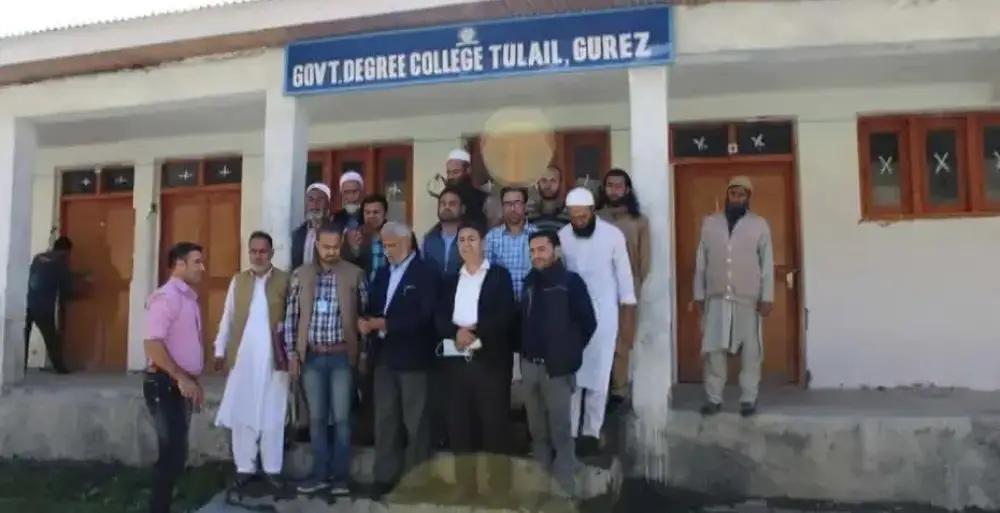
A former student pointed to several issues at the college, particularly the shortage of classrooms, since the new building remains under construction. Students currently attend classes in the quarters. The playground has not been properly developed.
He said the college has good teachers, both contractual and regular senior professors. There is a computer lab, “but no teacher available to teach the students.”
The absence of staff is undermining infrastructure that already exists. “The library has no librarian, leaving students to access and use it on their own. Even though there are thousands of books there. We just have some employees who help us,” he said.
The computer lab has around 30 to 35 computers, but no instructor to train students, leaving it largely unused despite the equipment. Around 80 to 85 students enrolled in the 2026 batch.
The college hostel remains incomplete despite years of construction. “Even our building has been under construction for around five to six years, with two floors built but the interiors still unfinished,” said Abdal, a former student.
He said students have repeatedly raised concerns with successive principals and visiting officials, but the problems remain unresolved.
Staff Shortage
Recalling his own experience, Abdal said that when he joined the college in the 2023 batch as a Political Science major, he had no Political Science teacher until 2025. A contractual teacher, also a local resident, was then appointed. That teacher has since moved to a government post in the higher secondary sector, leaving the college without a Political Science teacher again.
The college has only two or three contractual teachers, alongside around five regular professors covering the major subjects. Students say teachers are reluctant to take up postings in the remote area.
Uncertainty around appointments is another major problem, he said. Students “often do not know when teachers are posted to the college or when they are transferred out, making it difficult to understand the staffing situation.”
Despite lacking a teacher for his subject, Abdal managed through online classes, help from friends and occasional guidance from a contractual teacher he already knew. Students said mobile network reached the area only in the past five or six years, making online learning expensive and difficult. Graduates and senior students still try to support others by sharing knowledge and language skills.
Around 30 to 35 of the college’s current students are female, with male students in the majority. Students attribute the gender gap partly to the cost and difficulty of travelling long distances, saying many families cannot afford daily transport of Rs 100 to 200.
Adnan, recalling his graduation years, described a sharp decline in numbers. “My 2023 batch initially had around 52 students, including 15 to 16 girls. By the time we appeared for our final year examinations, only 18 students remained, of whom only two were girls.”
Other facilities, including the gym and sports infrastructure, remain incomplete. “Equipment and installations are still pending, leaving facilities such as the gym and cricket related infrastructure unused,” Adnan said.
He identified transport and hostel facilities as the biggest factors behind students leaving. A functioning bus service could prevent dropouts, he said, while an operational hostel could house students who live too far to commute daily. The bus has been standing in one place for five months.
The college has no dispensary or on campus medical facility. “In case of illness or an injury, students have to travel to a facility located around a kilometre away, as there is no medical centre within the college.”
Village Struggles
Residents of Tulail said that for any minor surgery, people must travel to Dawar. “However, there are no surgical facilities available at the hospital in Dawar either, forcing them to travel further to Bandipora for treatment.”
In areas without proper road connectivity, they said, people have been carried on someone’s shoulders or transported on horses, a major difficulty for residents.
Medical services lack continuity even when doctors are available. “One doctor is posted for around 15 days and then another doctor would come for the next fortnight.”
There is neither X-ray facility in Tulail nor blood diagnostics. “There are no testing facilities in Tulail at all, forcing people to travel to Dawar whenever they needed diagnostic tests.”
None of Tulail’s many villages has a Jammu Kashmir Bank ATM, which residents describe as another major problem. One ration depot serves five to six villages. “It is a major problem for people to travel four to five kilometres from one place to another to access ration,” a resident added.
The Agriculture Department is based in Dawar, with limited presence in Tulail. “Because of this we are unable to benefit properly from government schemes.” Residents say they often lack information about subsidy details even when benefits reach them.
“Almost everything related to agriculture is difficult for people in Tulail. Even obtaining seeds and pesticides is extremely difficult for us,” said Mohammad Afzal, a local resident. Dawar is around 30 kilometres from some parts of Tulail and about 10 kilometres from others, he said.
On education, residents said it was impossible to teach children of different classes separately in schools with only one room. There is also a shortage of teaching staff across almost every school, and some primary schools operate from old buildings with no proper government structure, forcing children to be taught in rented houses.
Residents also raised a public transport problem. A bus service ran between Tulail and Gurez until 2010. Tata Sumos and pickup vehicles now operate in the area, “because these are the main available modes of transport and poor people are being forced to pay higher fares.”
“The fare used to be around Rs 20 but had now increased to around Rs 100. The JKSRTC bus service that used to operate between Bandipora and Dawar is not running this year.”
Tulail also lacks firefighting centres, with a fire brigade stationed at only one location. Mohammad Afzal raised concern over wooden houses in Badugam. “God forbid, if a fire broke out more than 10 kilometres away from the fire station, the fire brigade would take time to reach the location. By the time it arrived considerable damage could already have occurred.”
Official Response
MLA Nazir Ahmad Khan Gurezi said he had been repeatedly approached about problems at the college, including the absence of a driver for its vehicle. No driver post is currently sanctioned, making the vehicle difficult to operate. He said he was exploring arranging a temporary driver through his Constituency Development Fund (CDF).
“I had proposed providing bicycles to students from these villages, but the Finance Department did not approve the proposal as it did not fall within permissible CDF guidelines,” he said.
Gurezi acknowledged transport was a particular concern for female students, who face higher dropout rates. The Tulail degree college, he said, was established to make higher education accessible to students from the remote area, where many families cannot afford to send children to Srinagar or Dawar and pay for accommodation.
On the lack of separate toilets, Gurezi said the issue had not previously been brought to his attention. He called it a basic requirement that could be addressed quickly and said he would raise it with college authorities. He would also enquire about reports of a sanctioned health facility without a functional medical team, and said the college building and hostel were expected to be completed. He added that he would visit the site.
Gurezi also highlighted wider employment challenges, saying many educated youth, including PhD holders, struggle to find work.
Most residents in Tulail work as army porters. Afzal, a local resident working as a porter to fund his postgraduate education because his labourer father cannot afford university fees, said even someone with two master’s degrees works as a salesman in Srinagar.
Gurezi said he is building a hostel for Gurez students in Srinagar, “especially for the ones who want to pursue higher education and employment.”