Jammu and Kashmir’s unbundled energy infrastructure has evolved its logic for load shedding while briefing the new government about the challenges it is fighting to keep the switches on, writes Syed Shadab Ali Gillani
After the decades-long hunt for a reason why one locality should get power supply and the other grope in the dark at the peak of energy-scarce Kashmir winters, the engineers managing the challenging energy sector of water-abundant Jammu Kashmir have finally discovered the logic – the returns. If a consumer falls in an area which fetches the entire billed sum and has no complaints of energy loss, there is the possibility of a better supply, at least on paper. The AT&C (Aggregate Technical and Commercial) loss is the new parameter that is running Kashmir’s load-shedding systems. This parameter that succeeded the T&D (transmission and distribution) loss offers a cumulative quantum of the loss from technical, billing, recovery and energy theft sides.
Insiders in the department said they have grouped 1236 feeders in five broad groupings – based on AT&C losses. Areas lacking any loss or energy pilferages are as good as the essential service where there is going to be no load-shedding, plans suggest. As many as 242 feeders (20 per cent) fall in this category comprising all the essential services, defence areas and consumers having smart metering and ABC (Aerial Bunching cable).
The Second Group comprises 30 feeders having a mix of smart and conventional meters but reporting 15-20 per cent ATC loss. They will have a two-hour cut in 24 hours cycle.
The third Grouping comprises 99 feeders reporting a loss of up to 40 per cent. These areas having conventional meters are planned to have load-shedding of 4.5 hours every day.
As many as 142 feeders make the fourth consumer group where losses are above 40 per cent. These areas having conventional meters will have an energy supply halt for six hours.
The fifth group is too bulky – it comprises 723 feeders – 58 per cent of the entire feeder strength, which will have a maximum load shedding of eight to nine hours. These are flat power tariff areas lacking any meters where energy managers insist the losses are too much.
Interventions
It is the ATC that is now the main parameter of the systemic and systematic efficiency in the entire energy distribution set-up. At one point in time, Jammu and Kashmir would top the AT&C loss chart in India. To bring the losses down, several centrally sponsored schemes were floated and a speedy implementation has started showing results. Official sources suggest that the losses were reduced to 58 per cent in 2021-22, to 51 per cent in 2022-23 and 40 per cent in fiscal 2023-24. The target is to bring them down to 31 per cent in the current fiscal and 25 per cent in 2025-26. In the fiscal 2023-24, the AT&C losses for Jammu Power Distribution Corporation (JPDCL) were at 35 per cent and 45 per cent in the case of Kashmir Power Distribution Corporation Limited (KPDCL).
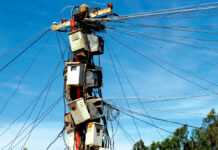
Jammu and Kashmir’s AT&C losses were primarily because of the run-down distribution system and the conventional style metering, which are now being taken care of through twin centrally sponsored schemes – PMDP and RDSS. So far, 627 thousand smart meters have been installed in Srinagar and Jammu cities and 50,000 more are being installed by the end of 2024. Under the Revamped Distribution Sector Scheme (RDSS), Jammu and Kashmir’s energy sector intends to install another 1407 thousand smart meters to cumulatively reduce AT&C losses to the sub-15 per cent level. Besides, part of the PMDP is funding the ABC and so far 2251.56 chain km have been completed.
This, planners say, will automatically improve the gap between average cost of supply (ACS) and average revenue realized (ARR). The ACS-ARR gap has already been reduced from Rs 3.11 kWh in 2021-22 to Rs 2.44 in 2022-23 and Rs 2.18 in 2023-24. The plan is to take it to Rs 0.58 in 2025-26.
Energy Availability
The load shedding in Kashmir winters and Jammu summers is the outcome of a surge in consumption against a fixed availability. It goes too low during winters when the water table touches the riverbeds in Jhelum and partly in Chenab, the two main power-producing water resources.
Officials have reported a peak demand of 3000 MW against an availability of 1915 MW. Though Jammu and Kashmir has an allocation of 4384 MW from all sources – centrally owned projects (Northern Grid), Jammu and Kashmir’s fully owned State Power Development Corporation and the banking system devised by efficient Kashmir engineers over the years, the generation has gone down. Jammu and Kashmir would get 1064 MW from its own generation but currently, the state’s own projects are not producing beyond 150 MW, which depends upon the availability.
After the energy started getting traded in the open market, the auctions at peak hours reached a level which became unaffordable for loss-making utilities in Jammu and Kashmir. This is the key factor why rationing is emerging as the only way out.
Over the years the Kashmir engineers have made two innovations to manage their winter burden. One is the water harvest, which envisages closing small power projects during the day and halting the water flow midway so that enough water is stored. They open the projects when the demand peaks during the night and the water is used. This method has been in vogue for years now. The second innovation is that during summers when they can produce much more than the demand, instead of selling the excess, they bank it with a utility that can return the same during winters. This is how almost 200 MW of energy is getting into the energy pool of Jammu and Kashmir right now.
Kashmir Scene
Across Kashmir’s 10 districts, the KPDCL has to supply energy to 1221743 consumers of whom 305487 have smart meters, 225124 have conventional meters and the balance 691132 avail flat system. The cumulative demand is 1500 MW. Srinagar has historically remained the major consumer of energy. Of late, urbanisation has triggered a huge demand from peripheries too. Now Srinagar requires only 365 MW for its 254024 consumers.
With the energy managers making AT&C losses as the main criterion for load shedding and bulk of the consumers fall in the groups which will have six to nine hours of power cut in a 24-hour cycle. Given the fact that the losses are linked to the infrastructure – smart meters and ABC, the consumers are asserting why they are being targeted for the losses when the department is unable to install the same. Besides, the consumers falling in the top category are alleging that they are subjected to the load shedding despite them following every dictate of the energy department.
Massive Losses
Admitting these issues, insiders in the department assert that the sector’s long story is beyond extracting costs from the consumers. There are too many issues that need to be tackled, they believe.
Keeping the wheeling of energy going on into Jammu and Kashmir, they say, is a neck-wrecking exercise that requires decision-making on an hourly basis, especially in purchasing the additional requirement. Jammu and Kashmir is massively dependent on purchases and it has historically remained a major whole on public kitty.
Right now, officials said the power purchase liability of Jammu and Kashmir stands at Rs 4628 crore.
In 2021-22, officials said they had outstanding liability on power purchase at a staggering Rs 13145 crore. With energy being purchased for Rs 9886 crore in 2022-23, the liabilities simply reached an unaffordable level. This led the policymakers to avail a central scheme and lift a loan of Rs 20012 crore and brought the outstanding to a low of Rs 1554 crore.
“The ongoing year has not been very bad,” one insider, not authorised to talk formally, said. “We opened the year with a liability of Rs 4324 crore and purchased energy for Rs 4410 crore. During the year so far we made payments worth Rs 4106 crore leaving only Rs 4628 crore as the liability.” This, he said, will change as we have three more months to go.