As allopathic medicine embraces AI and advanced technologies to transform healthcare, Kashmir continues to preserve an age-old tradition of postpartum healing, where new mothers are given herbal baths believed to aid recovery after childbirth, Asrar Syeed reports
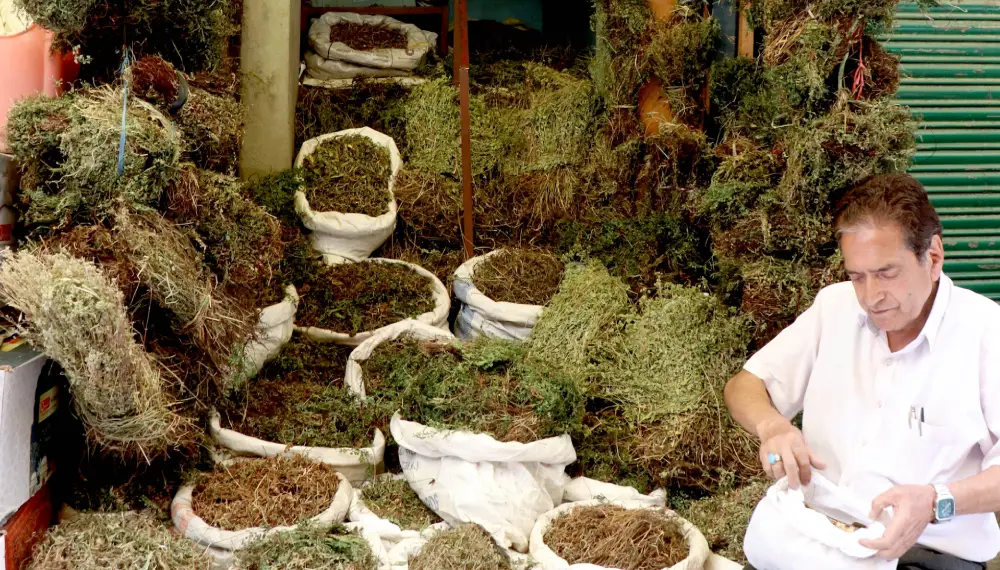
In the narrow lanes of Old Zaina Kadal sits the shop of Ghulam Rasool Wani & Sons. Squeezed into the limited space of the market, the 68-year-old arrives every day in neat, formal attire. This has been his routine since 1980, when he began working at his family’s generational shop, which has sold the traditional Losse Gasseh for four generations.
Loaseh Gasseh is a mix of traditional herbs grown in Kashmir, with a few ingredients sourced from the mainland. This herbal mix is used during a woman’s first few baths after giving birth.
Wrinkles now mark Rasool’s face, evidence of age, yet the daily ritual of opening his family’s shop keeps him going even through the difficulty of rising in the harsh winter months. ” I still remember the day clearly, the first time I maintained the sales in this shop,” he recalled. “My father had learned the art from his father. I don’t remember the exact date the shop first opened, but I can clearly say it is almost a century old. Women from different parts of Kashmir have visited our shop after learning about it from the elderly ladies in their families.”
Old Traditions
In Kashmir, a woman who gives birth to a child gets a temporary status of being a Loaseh, a mother who has just given birth. Gasseh means the grass. The herbs are procured from Bohris, traditional herb sellers, who also market aromatic and medicinal plants and their formulations. This herbal mix is boiled strongly in water in traditional copper vessels, the Deag or Degchi, a common utility in every Kashmiri household, rich or poor.
Postpartum women commonly face problems such as exhaustion, backache, pain in the lower uterine region, wounds, intimate health issues, haemorrhoids, bowel and urinary issues, and respiratory infections. Rasool argues that the herbal mix helps address many of these issues.
“Had this grass not been helpful, why would a woman travel all the way from Uri to buy it? It must be because of the benefits,” he said, when asked if it is effective. “People from different parts of Kashmir contact me in advance of their visit, so we can keep the herbal medicine ready.”
Among the ingredients used are Gyav Theer (Adiantum venustrum), Wan Babbar (Origanum vulgare), Maed Sath (Paenia emodi), Gul-e-Tesu (Tagetus eretus), Revand (Rheum emodi), Tejpatie (Cinnamomum tamala), Amla (Phyllanthus Emblica), Lyedar Gandr (Curcuma longa), and Ajwain (Thymus linearis). A study in the International Journal of Current Microbiology and Applied Sciences, titled Traditional Food and Health Practices during Post-Partum Period, found that women who bathed in water infused with the herbal grass reported considerable benefit; the water is first steeped for hours and then boiled before use.
Changing Times
Over recent decades, caesarean deliveries have risen sharply across Jammu and Kashmir. National Family Health Survey data shows the rate climbing from 5.7 per cent in NFHS-1 (1992-93) to 10.6 per cent in NFHS-2 (1998-99), 14.1 per cent in NFHS-3 (2005-06), and 33.1 per cent in NFHS-4 (2015-16). Normal deliveries, once the norm, spared women from complications such as increased blood loss, blood clots, anaesthesia reactions, and a longer six-to-eight-week recovery period.
Rasool recalled that buying Losse Gasseh was a priority for families expecting a birth. “During the period of 1980-90’s, buying this herbal mix figured on top of the family priorities. Sales were sufficient to afford a nice living.” He pauses to attend to a customer, then continues, recalling days when he served more than twenty customers daily.
Family Legacy
Over the last 40 years, the product has travelled beyond Kashmir, carried by women to different parts of the country and abroad. Rasool remembers one evening, years ago, when a woman insisted he unwrap and pack two bags of the herbal grass just before he shut his shop. She was carrying it to America, where her daughter was nearing the date of delivery. She wanted her daughter’s first postpartum bath to include the traditional Kashmiri herbs.
The business, Rasool said, has shifted from individual sales to a wholesale model. “Individual sales have declined as more women deliver through caesarean sections, but commercial sales have increased,” he said. “I now have more of a wholesale business, partly because of the benefits highlighted by medical professionals over the years.” His expression turns bittersweet as he recalls his old generational customers.

Lasting Hope
Both of Rasool’s sons run a wholesale cosmetics shop nearby, where he now stores his bulk orders due to limited space at his own shop. Yet one son has promised to keep his father’s shop running. “I was deeply worried about who would look after this business after me,” he said. “Apart from the health benefits, it is part of our Kashmiri tradition. I was overwhelmed when my son promised to keep it running.”
As the conversation winds down, a mother and daughter pass by, and the young girl asks about a packet. Rasool steps in to explain its uses. After they leave, he reflects: “See how this product has travelled through generations. It will never be taken off the market. Somewhere, there will always be a Loaseh Gasseh trader.”