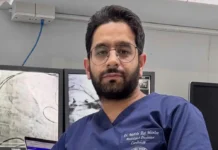
Dr Tariq Tramboo, interventional pain physician, explains why pain often has no visible cause, why delay turns it chronic, and how blocks and regenerative therapy now replace steroids. Wajeeha Hajirah brings out the key insights from Tramboo’s Doctors Lounge conversation with Raashid Andrabi
KASHMIR LIFE (KL): What actually is pain?
Dr TARIQ TRAMBOO (TT): The basic definition given by WHO and IASP is that pain is an unpleasant sensory and emotional response to an injury, or to a potential injury. Focus on the word emotional. Pain is not only physical.
That was the definition till date. There is now an addition, and people must understand it. Pain is not always caused by an underlying injury or a potential one. Pain can be nonspecific. Nothing underlying is found. The patient goes through investigation after investigation without a diagnosis.
The pain is always real. The patient does not lie about pain. If no underlying cause is found, it does not mean the patient has lost their senses and needs a psychiatrist. Yes, there is a component called psychogenic pain, but it is a very rare condition, and it carries associated symptoms.
KL: Back pain and knee pain are common here. People cannot tell whether to see an orthopaedic or a pain specialist.
TT: It is a grey line. There was a time when a radiologist’s work was limited to X-rays. Then MRI came. Today radiologists do interventional procedures. There is a subject called interventional radiology. Biopsy and brain coiling are now done mostly by radiologists, not neurosurgeons.
Similarly, anaesthesia has a sub-speciality called pain medicine, which further became interventional pain medicine. NMC guidelines make this subject mandatory. Every hospital should have a department of interventional pain medicine. I am one of the first people in India to do a fellowship in pain medicine. The research was brought in from the US, where I worked on many techniques. The subject was new even in Delhi. So this question is not only for Kashmir. It is asked across India.
Neurologists, orthopaedic surgeons and anaesthesiologists are all pain physicians. All of them have their limitations. They give medicine. The patient does not feel better, cannot tolerate the medicine, or the medicine carries a potential for addiction. If simply blocking the pain works, the patient is spared medication for a long period. Anaesthesiologists are certified to do these procedures because they are already trained. A neurologist or an orthopaedic surgeon who wants to do them needs formal training.
There is another aspect. If you keep tolerating pain, there is a huge chance it becomes chronic. A lot of chronic pain is irreversible and can stay lifelong. We then manage the pain, treat the pain, but many times it is no longer curable. There is a thing called central sensitisation. Like a cassette or a tape recorder that keeps running, it makes space in your head. The underlying cause is treated, but the pain sensation stays for a lifetime.
That is why pain should be addressed promptly, and I will use the term ruthlessly. A pain-free life is your human right. Life is bigger than pain. Do not spoil your life because of pain. This is an internationally recognised subject, and it is larger than we imagine.
KL: How is chronic back and neck pain actually treated? Is it medicine, and what are the side effects?
TT: Pain itself is a side effect. It influences you psychologically and emotionally.
Keep in mind that we are interventional pain physicians, and we deal with every type of chronic pain. Back and spine issues are a small percentage of what we treat. We treat neuropathic pain, head and neck pain, cancer pain, and chronic pain syndromes. Because back pain is so common, people think we are back pain physicians.
Since you asked about the back, most people attribute back pain to disks. This will puzzle you, but the majority of back pain is nonspecific. There is no underlying cause. The patient does an MRI. It may show disks or a degenerative spine, but the disk is not always the cause of pain. There are small joints in our back called facet joints, and arthritis of these joints can be a major cause. Infection can cause inflammation in the plates of the vertebra, which is another reason. Bursitis, tuberculosis and tumour can also be causes.
People will feel better hearing this. Of those in pain due to disc herniation, 80 per cent are better within two years, because the disc is naturally absorbed. In 10 to 15 per cent, there is no absorption, and some progress to complications, such as increasing neurological deficit, nerve suppression, numbness in the feet, or problems with excretion. Those are surgical emergencies. Three to four per cent go through this. But till the disc irritates, we have to step in.
Earlier, we only performed the transforaminal block, placing medicine directly on the nerve under pressure from the disc. Internationally recognised journals mention transforaminal epidural steroid injection, TFESI, the one I was speaking about. They record that the majority of patients will not require surgery after this injection.
Today we have more than TFESI. We add pulse radiofrequency, available at our centre. The temperature of the radiofrequency wave stays under 40 degrees, but it does neuromodulation. It helps reverse the neuropathic changes in the nerve, which is not possible even after surgery.
KL: What is failed back surgery?
TT: It is when there is no change after surgery. It is not the surgeon’s fault. It is permanent damage to the nerve caused by chronic pressure. Even if the disc is removed, you cannot undo that damage. You cannot blame the surgeon. You did not intervene in time.
The side effects of our procedures cannot be compared with surgical side effects. There is no comparison. But it does not mean we avoid surgery where surgery is indicated. We refer immediately. Those are called red flag signs. Whenever you read higher literature, 100 per cent is never there, and if it is, we call it a scam. There is no 100 per cent in medical science either. Surgery has risks, but not more than its benefits, so surgery is encouraged. Delay in surgery can cause permanent irreversible damage.
In chronic neck pain, facet joints have a huge role. The neck is more flexible than the spine, and if these joints have arthritis, the pain can radiate to the head and shoulder. It is wrongly diagnosed as a disc. Even plating and fusion will not help.
Earlier, we only did facet blocks, and the patient returned after a few months. Then radiofrequency came, and the painful nerve was treated with heat, but the patient still returned within months or a year. Then came cool radiofrequency, highly effective, among the best in the world, and now available in Kashmir. It gives long-term relief. During that time, people can go to the gym, exercise and build muscle. If the pain returns, the procedure can be repeated, and there are no side effects.
We also take growth factor from your blood and place it on the degenerative part of the facet joints and on the knee joints. It has the potential to reverse some damage. This is a very advanced subject now.
For discogenic pain, where the pain is in the disc but there is no nerve compression, we do biacuplasty, a cold radiofrequency procedure. It resembles the root canal of a tooth. The nerves supplying the disc are numbed, the nerve endings causing the pain are neuromodulated, and the patient stays pain-free for years. If not pain-free, there is a significant reduction. I am talking about evidence-based medicine. These are recently developed procedures.
KL: Is there something about life in Kashmir that is causing more pain?
TT: This is a misconception. I have seen patients across India, in Delhi and many states, and outside India as well. The incidence of pain is not high in Kashmir, but the pattern of pain is very different from other places. People associate Kashmir with pain. It is nothing like that. A procedure like knee replacement is more frequent elsewhere, and Kashmiris have a higher pain threshold.
Secondly, and this will surprise you, furniture has spoiled our skeletal systems.
KL: How many types of pain are there?
TT: We think of back pain, neck pain, joint pain. Pain does not end there. It divides into neuropathic pain, musculoskeletal pain, psychogenic pain and central pain.
Within neuropathic pain, there is fibromyalgia, which currently has no cure and is common in females. The patient complains of pain from head to toe and has 18 tender points, associated with stress, depression, fatigue, sleep disturbance and early morning stiffness. The treatment is complicated. Anyone with these symptoms should get blood tests done before we conclude fibromyalgia. Sometimes there is a collagen disorder, which we rule out with a test called ANA. If it is positive, we can conclude the pain is due to that, and it is a kind of arthritis. Lab backup is critically important.
Then there is chronic regional pain syndrome, CRPS. I have a website, CRPS.com. You are pricked by a pin, or you take a minor injury. The underlying injury is treated, but the pain stays, and it can stay for life. It is very hard to manage. Back and neck pain are nothing compared to it. We give sympathetic blocks and break the pain cycle repeatedly.
If you treat pain as a curable entity, you will keep visiting doctors with no change. A significant amount of pain has no cure for its underlying cause. It is definitely treatable. Sometimes the pain is cured while the underlying cause remains, because it is degenerative. And if the underlying cause is fixed, the pain can still stay.
 KL: You keep mentioning blocks. What are they?
TT: There is a huge misconception here, among people and even among doctors. We rarely use steroids. Compared with other branches, pain specialists use them the least. Steroids are history. Blocks have moved on.
In some blocks, a simple 2 ml of anaesthetic works dramatically, because it interrupts the pain signal to the brain. That is why it is called a block. When the effect wears off, the returning pain is often lower in intensity, and repeated blocks help many pain syndromes.
Platelet-rich plasma, growth factors and stem cells have replaced steroids. Knee pain once required steroids. It no longer does. We use growth factor concentrate, and we even have the facility in Kashmir to extract stem cells from bone marrow. We use these cells for minor repairs. So this is no longer only pain medicine. It is regenerative medicine. Newer studies show a regenerative effect on degeneration. It may not cure completely, but it is almost free of side effects.
KL: Nearly every household here keeps Dolo. When pills fail, people ask for injections rather than an intervention. What is the cost of that?
TT: A lot of issues are associated with painkillers. Being on them for long causes stomach problems and can affect the liver. For small problems that do not require surgery, these medicines are fine for a time. Where surgery is required, medication should be avoided. If medicines are taken long enough, forget the pain, the patient will need dialysis.
This is where our 2 ml of medicine can leave you pain-free for far longer. It may seem expensive. In the long run, it is more effective.