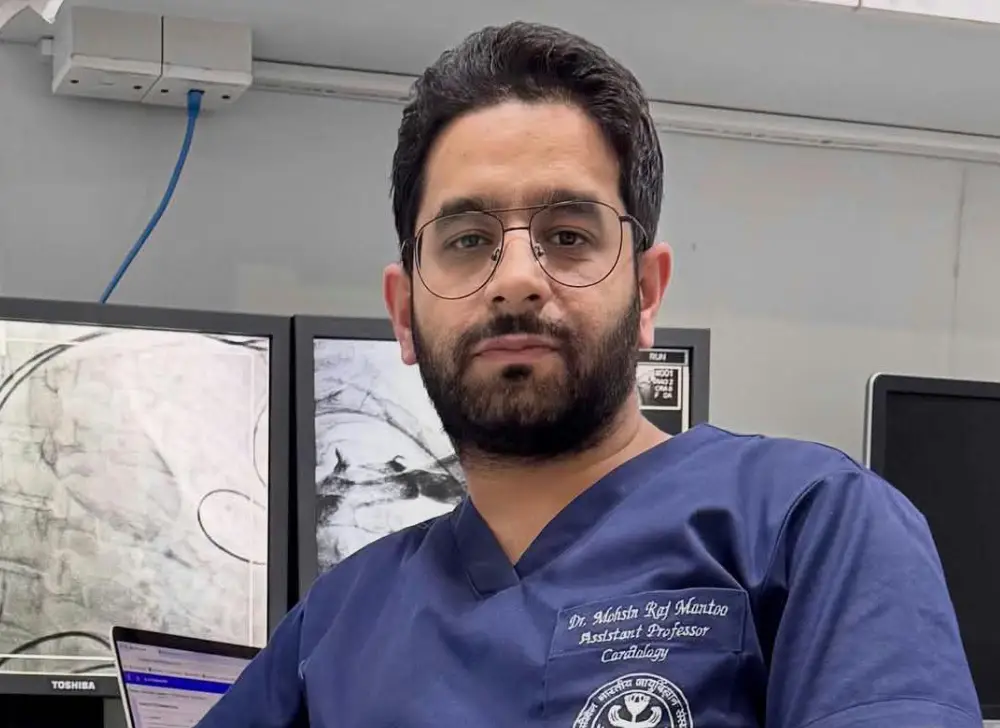
Cardiologist Dr Mohsin Raj Mantoo discusses why heart disease strikes silently, why prevention beats treatment, and why family habits, stress and diet decide the outcome. Lilac Ali brings the essence of the conversation
KASHMIR LIFE (KL): The human body is extraordinarily complex, yet the health of many organs does not depend on you alone. People around you also play a role. As the saying goes, “the heart is to be cared for by the spouse.” There is even scientific study exploring this idea. But how true is it?
Dr Mohsin Raj Mantoo (DM): The majority of heart diseases are silent until an acute event, such as a heart attack or heart failure, occurs. These events often develop over months, years, or even decades. A heart attack in one’s fifties may have its roots as early as the age of twenty to twenty five.
These risks can be controlled if prevention is practised. Prevention is a shared responsibility. Family members, older or younger, can advise one another. The care that can be taken in one’s twenties and thirties is often not possible later in life. Once the disease sets in, it becomes difficult to manage.
Treatment is complex, but prevention is much easier with a healthy lifestyle. Simple steps such as jogging, walking, a healthy diet and managing stress make a significant difference. However, the treatment of conditions like heart attack and heart failure is painful and lifelong. So, conversations around heart health should sensitise young people, so they avoid harmful habits.
KL: Let us imagine a person who jogs, eats healthy, and goes to the gym, but tension at home constantly stresses him out. Which organ is most affected by this stress?
DM: All organs are affected, but particularly the heart, by both acute and chronic stress. Acute stress, a quarrel at work for example, can trigger a cardiac event. Chronic stress includes joblessness, financial strain and relationship problems. Both contribute to heart disease, but in different ways.
Acute stress can raise blood pressure immediately. Depending on a person’s sensitivity, this can lead to abnormalities in the heart’s blood vessels, and may even trigger an underlying, previously silent condition. Certain syndromes in cardiology, such as broken heart syndrome, are linked to stress.
Stress can affect the heart’s ability to pump blood, contribute to coronary artery disease, and in severe cases lead to a heart attack. A very common complaint is chest pain due to emotional stress. This may or may not always be linked to the heart, but sometimes stress places extra demand on the heart and unmasks an existing silent condition. Heart disease remains the leading cause of death across Kashmir. Stress is one of the major contributing factors.
KL: There is a rising phenomenon across Kashmir, young people suddenly suffering a heart attack while playing or exercising. How do we understand this?
DM: It is not as common as it appears. Sudden deaths occur more often in the elderly, people in their sixties and seventies, than in the young. It gains attention because the individual is young and seemingly fit, which makes it shocking. I have personally witnessed such cases in my circle; healthy individuals aged thirty to thirty five dying suddenly. However, not every such death is a heart attack, even though we often label it that way.
A heart attack, by definition, is caused by blockage of blood flow in the heart’s arteries. Sudden cardiac deaths in young people are often due to other causes, such as cardiomyopathy, genetic conditions, or electrical disorders like channelopathies and arrhythmias. These may not even be visible on routine scans. These conditions can cause a kind of short circuit in the heart, leading to dangerously fast heart rhythms and cardiac arrest.
At the same time, lifestyle changes have shifted many diseases, like diabetes, hypertension and heart disease, from old age into middle age. This is not just genetics; it is largely driven by lifestyle patterns. If we look at patients with myocardial infarction, about twenty to thirty per cent fall into the category of “young MI”. Even then, the majority of cases still occur in older individuals. Around 90 per cent of these cases are caused by well known, traditional risk factors such as high blood pressure, smoking and high cholesterol. Only about one in ten patients has an atypical cause, such as a genetic disorder. Hence, most of these diseases are largely preventable.
KL: The stomach is active only when we eat, and even the brain enters a resting phase at times. But there are two organs that cannot afford to stop even for a moment, the lungs and the heart. Is there a specific diet for the heart, considering it never takes a break?
DM: The heart cannot stop; if it stops pumping blood, other organs begin to fail within minutes. Without immediate revival techniques like CPR, the damage becomes irreversible. The brain too cannot survive without a constant supply of glucose.
Although I am not a dietician, there are broad principles I advise patients to follow. It is important to limit refined carbohydrates and sugars, commonly found in foods like white rice and sugary items. The space on the plate should instead be filled with protein rich foods. In medical science, there is still debate about whether fats or carbohydrates are more harmful, so moderation in both is key. Processed, heavily salted and smoked foods should be avoided, as should sugary drinks, including cold beverages and sweet tea. People in their twenties or thirties need to be wary of the composition of foods they consume.
Proteinaceous foods such as lean meat, nuts, fruits and vegetables should make up about half of your plate, with carbohydrate rich foods reduced in proportion and replaced by these options.
KL: What are the causes of heart disease in Kashmiri patients?
DM: The patient population is essentially similar across India, particularly in North India. Coronary heart disease is the leading cause, around five out of ten patients present with it. Secondly, heart failure is quite common.
Thirdly, valve related problems are seen, especially affecting the two valves on the left side of the heart. Earlier, many of these cases were due to rheumatic heart disease, but that has significantly decreased. Now, age related degeneration is a more common cause. The fourth common issue is arrhythmia, irregular heart rhythms. Patients may feel this as palpitations, where the heartbeat becomes either too slow or dangerously fast. These four conditions can also occur together. In children, congenital heart diseases, such as holes in the heart, are also seen.
KL: For disease management, we usually start with medical advice and medication. What percentage of patients eventually require surgery?
DM: Take hypertension as an example. About half of patients are aware of their condition, while the rest remain unaware, as symptoms do not always appear. Of those who are aware, only about half take medication, and among them, only a portion achieve proper blood pressure control.
In some patients, these factors can eventually lead to heart disease. One common example is coronary heart disease, where the blood vessels supplying the heart become narrowed. The heart has three major vessels, and when they are affected, it increases strain and can lead to chest pain, sometimes triggered by emotional stress.
Many cases can be managed with medication, which helps in two ways: reducing the risk of acute events like heart attacks and controlling symptoms such as pain. Most patients can be stabilised with medication alone, though the outcome depends on how many vessels are involved. If all three vessels are affected, recovery becomes more challenging. Only a small fraction of patients do not respond adequately or develop acute complications; these may require interventions such as bypass surgery.
Persistent chest pain often indicates significant blockage, requiring both medication and procedures. During an acute myocardial infarction, the standard treatment is primary PCI, commonly known as stenting, usually needed in acute situations, especially when chest pain is continuous. The earlier the problem is identified, the better the outcome.
If hypertension is controlled early, the risk of heart disease is low. If symptoms like chest pain during exertion appear, lifestyle changes and timely treatment can still prevent progression. But once a heart attack occurs, immediate action is essential. As the medical saying goes, “time is myocardium.” The concept of the “golden hour” reflects this urgency. Maximum heart muscle can be saved if treatment is given within the first hour, since the heart requires a continuous energy supply and damage becomes irreversible after about fifteen to twenty minutes.
KL: How has technology helped cardiologists manage heart disease more effectively?
DM: Now, everything is driven by technology. Tools like ECG and echocardiography, although nearly a century old, have advanced significantly. We have moved from simply feeling the pulse with our hands to using highly sophisticated machines. Through echocardiography, we can assess the thickness of the heart walls, the flow of blood, and how effectively the heart pumps.
Angioplasty, in particular, has transformed patient care. In the 1970s, a clot would often cause significant damage to the heart muscle, leaving patients with miserable lives. Since the advent of technologies like angioplasty and echocardiography, countless lives have been saved. However, research in India shows that the average time between the onset of symptoms and receiving tertiary care is around six to twelve hours. In contrast, in many Western countries, this time is typically zero to three hours; they treat patients quickly and preserve the heart’s function.