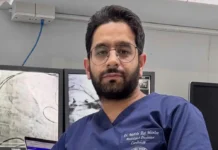
An Apple Talks interview with SKUAST-K scientist Dr Khalid Zaffar Masoodi transcribed by Wajeeha Hajirah, explores Kashmir apple genetics, scab resistance genes, endophytes, rodent repellents, and orchard futures.
KASHMIR LIFE (KL): You returned from America after your studies and joined SKUAST. Your first work was collecting plants and trees, including apples and vegetables. You studied their cell structure and genes. How many kinds of apples have you investigated so far?
DR KHALID ZAFAR MASOODI (KZM): SKUAST-K and the Central Institute of Temperate Horticulture (CITH) hold around 200 apple genotypes. We have worked on almost all of them. We have done barcoding and studied their genome and transcriptomes.
An apple cell has around 45,000 genes. It has 17 chromosomes, and 2n is 34. These genes run different cellular processes. Some are quality traits, like colour or disease response. Each gene has a different function.
At some point in evolution, the apple genome doubled. Say gene A doubled, so you now have two copies. One of them mutates. Its activity either increases or decreases. Apples have many genes. Some are functional and some are not.
KL: How many of these 45000 genes are fundamental to key traits, such as colour, shelf life, crispness or how long the fruit survives in a certain environment?
KZM: Yes, it has been sequenced. We sequenced the apple transcriptome in Kashmir, for example that of Ambri. Whenever we sequence a genome or transcriptome, it goes into a gene bank. This one is the National Centre for Biotechnology Information, under the National Institutes of Health. Anyone in the world can see these genes. Like the mouse and human genomes, the apple has already been sequenced, and its database is registered there.
We worked on apple in 2017. We wanted to look at scab and perhaps find something new. Kashmir produces 1.8 to 2.4 million tons of apples. Around 35 lakh families are directly associated with the crop.
We saw that indigenous and wild varieties do not have scab. Economic crops like Delicious lose 30 to 40 per cent annually to scab. To save them, we use fungicide worth around Rs 325 crore. Scab is not fully controlled. The fungicide also reaches us through water bodies, and that eventually causes problems.
Some varieties, like Maharaji, have no scab. But Maharaji is sour, though good for diabetic people. Many varieties are free of scab but not really edible. They can be hard and not tasty. So we asked why they do not get scab.
Apple has 18 genes, including one called the Rvi gene, which helps in scab resistance. The specific one is Rvi6. Scientists made a scab resistant apple by putting the Rvi6 gene in it. But the fungus is smart. It modifies and adapts itself. It causes scab even in the resistant variety.
So we thought we could take genes from Ambri or Maharaji and put them in Red Delicious or Golden Delicious, which are prone to scab. We knew these specific genes do not work alone. There are many factors.
For example, the Rvi gene is a receptor protein. When the fungus attacks, it releases effectors. The receptor detects them, and an LRR protein detects that the apple has been attacked. The secondary messengers get activated. They make PR protein or salicylic acid, which can fight the fungus.
We decided to take genes from the genotypes we have. We took their RNA extract. The 45,000 genes of apple make messenger RNA, ribosomal RNA, tRNA, sRNA and more. There are around 52 types of RNA. The messenger RNA codes the protein. So we trap the messenger RNA.
Many genes do not produce protein. They have become silent, or they carry histone modifications that make them epigenetically silent. So we trap only the genes that are expressed. Once extracted, these become cDNA. Then comes the RNA sequencing technique.
We found around 800 genes that were expressed in scab resistant apples and not in susceptible ones, and vice versa. Then we checked the fold change. We saw genes expressed ten times more. We noted increased P values and fold changes. On this basis, we kept the threshold at ten folds and a P value of 0.001. That gave us around 20 genes highly expressed in scab resistant apples. They can be used as candidates.
Once confirmed, the transcript is collected at the gene bank. Other researchers can use it for further studies. Maharaji is crispy, but Ambri gets a little soggy. They can combine genes. Our intention was to find scab resistance, and we found around 20 new scab resistance genes. Now we can clone these genes and put them in Red Delicious to make scab resistant apples.

KL: It is a huge accomplishment to find 20 new genes that can help us. What are your plans to take this research forward?
KZM: Yes, of course. But good research takes time. We started in 2017, and it took time to get results. There are many factors, like funding. We have requested some government funding agencies. We want to work on some genes and make apples that help reduce fungicides. That would reduce the health effects on the population. It would also cut the 30 to 40 per cent annual loss due to scab.
KL: So we are where we were a few years ago? We know we have the genes, but need more time?
KZM: We also started working on endophytes. These are beneficial microbes in plants. They can be bacteria or fungi. We had a resistant and sustainable variety. So we checked which endophytes they carry. Perhaps they produce something that gives scab resistance, as in Ambri and Maharaji.
We took their endophytes, around 52, and registered them in the gene bank. We found one type that produced a new kind of compound. We tested it in the lab in vitro, and the results were great. Then we did a field test on certain plants, and the results were great again.
Recently we got our patent for that compound, which kills scab. We have given it to Dr Zahoor A Bhat, a wonderful plant pathologist, to cross check. We will also send it outside the state to test the fungus. It will be a biological control. You spray the fungal spore, and it kills the scab causing fungus without causing any harm.
KL: Apples face different problems. Not all are fungal or bacterial. Some are viral. Some diseases do not affect the apple directly but the leaf. Have you thought about a complete package at the genetic level, one we have not yet located but we may have it in the future?
KZM: That is a great question. We are tackling this from many angles. Mites and porcupine attacks also happen. Getting a transgenic plant to market is quite difficult. It has to go through many processes. You will see many transgenic plants outside India, but in India they are regulated. We have released Bt cotton, mustard and Bt corn.
We are looking for bio-control agents from Kashmir. Porcupine and rodent attacks are common in saffron and apples. They cause damage. Mazar mond is used as a repellent in graveyards. Its purpose is to save dead bodies from being eaten by rodents. So we checked its components to see what the repellent actually is. We found a component that can be used as a repellent.
We made rodent repellent balls. We placed them in fields, rooms and offices. They work great for three months. They do not kill the animals. One of my students filed a patent and is starting a startup, RodentX. She will sell these balls.
We are trying to teach our master’s students innovation, application and marketing. Our university is technology driven. We want students to do technology driven work, not work that only ends up on a wall. By the end of their degree, we want students to bring forward a product that benefits people.
KL: You study the characteristics of different plants. The rule of nature is that where there are problems, there are solutions as well. The point is to find them. Scab and mites, including red mites, come from different species, bacterial, viral or fungal. Can we find a set of suggestions?
KZM: SKUAST has packages of practices for saffron, apple and almond. Yes, we can make such a set of suggestions. We have solutions for porcupines, rodents and scab, so we can make a package. Some are at an advanced stage and in the market. Some are still in infancy.
Not only our lab but many labs are doing good work in pathology. In fruit science, the work is wonderfully led by Prof Ashiq Pandit. Tariq Sahab is a wonderful farm scientist in pathology. There are also many new start-ups. As an ecosystem, we are working towards farmers exponentially. Every farmer’s problem is being addressed. It is also the farmers’ responsibility to respond accordingly.
We do go and meet them. I have visited farmers and cattle breeders with my students. We understand their problems on the ground and then make a report.
KL: Once lavender is planted, it stays for a long time and is not labour intensive. If we also keep bees alongside, the honey from its nectar costs around 40 to 50 thousand rupees a kilogram. Should not there be a concept for this be thought about apple orchards in which we grow many things?
KZM: There are concepts like this. A vegetable garden near a poultry farm is one. The garden gives feed, and in return the animals give natural fertiliser. Yes, SKUAST has given many packages like this.
KL: To solve a pain problem, there are two ways, ointment or pills. Similarly, plants can be treated physically, or you can opt for genetic engineering. If we create a scab resistant variety, will it be considered genetically engineered?
KZM: If we find a resistant gene, we can put it in. But we can also delete genes to prevent scab. That is another option.
When we insert a gene, we do not know if it has succeeded. So along with the gene, we put in an antibiotic resistance gene. If the cells grow, our gene has also been inserted successfully. But this has a few side effects. The other way is to delete genes by machine, and there is no residue. Adding or substituting a gene is more difficult. Deleting a gene is much easier. Deleting a gene does not make it genetically engineered.
KL: Now we import high density plants from Europe. Are they genetically engineered or not?
KZM: Their rootstocks are strong, and they give more fruit. They have great growth promotion and are resistant to diseases. They are short and do not grow tall. Fruit production is higher. As you mentioned, production has increased from 1.7 million tons to 2.5 million tons. They are not genetically engineered. They are the result of grafting.