Once thronged by tourists, Apple Valley’s shops and orchards stand quiet after route restrictions, leaving traders, farmers and jobless graduates waiting for visitors to return, reports Afreen Ashraf
Seated inside one of his stalls at the Government Tourist Resort in Cheeniwari, Mohammad Qasim watches the road leading towards Pahalgam, hoping the next vehicle will pull over. A 65-year-old retired government school teacher, Qasim never expected to enter the world of business. But unemployment cast a shadow over his family’s future. He invested in two stalls, securing them on lease through government auctions in 2019 and 2022.
“I bought these stalls for my two sons, because of unemployment,” the teacher, who has taught a generation, said. Regular jobs were out of reach, so he wanted to create opportunities himself.
For Qasim, the stalls became more than a post-retirement venture. They became a symbol of hope. His story is far from unique.
Over the years, many residents leased stalls at the tourist resort, hoping to build small businesses around the steady flow of travellers. For them, these modest spaces are more than commercial ventures. They are a source of income, a way to support families, and an alternative to the uncertainty of an increasingly competitive job market. What began as individual efforts to secure livelihoods gradually evolved into a shared story of resilience and entrepreneurship. That story now stands at risk of unravelling.
Apple Valley Rises
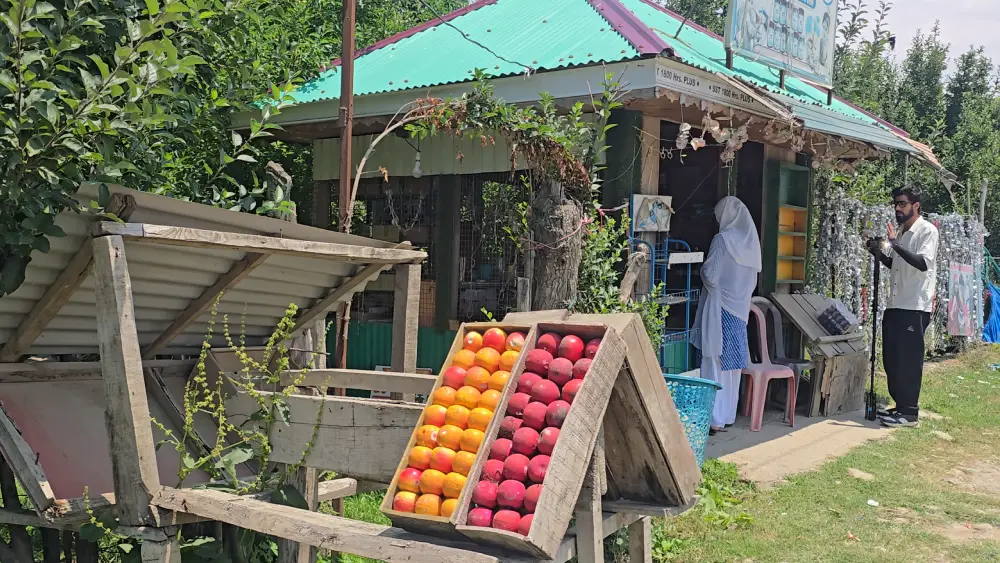
What led people like Qasim to invest in these roadside businesses is closely tied to the rise of Apple Valley. It is a picturesque 40-kilometre stretch along the Bijbehara-Langanbal-Pahalgam road, and for years it was one of south Kashmir’s most popular stopovers. The orchards gave the place its identity. Its location on the road to Pahalgam made it a natural stop for travellers, and tourism and small business flourished side by side. Kashmir’s famous apple orchards became part of the tourism experience, creating opportunities for residents along the way. Over the years, Apple Valley grew into much more than a scenic stretch of road. Travellers began making it a regular stop to enjoy the landscape, taste local food, and shop for fresh fruit, dried fruit, handicrafts and other local products.
According to the Apple Valley Resorts Association, the road eventually became home to several restaurants, handicraft showrooms, apple juice stalls, hotels and other tourism-linked businesses. Together, they employed dozens of residents and became an important source of income for families in the area. “Over the years, nearly 12 resorts, more than 200 apple juice stalls, and several handicraft and handloom showrooms, eateries and roadside vendors came up along this route,” a member of the association said.
As tourism activity grew, the Tourism Department also invested in infrastructure to support businesses and attract visitors. Stalls were constructed, including the ones later leased by Qasim, and allotted to residents through auctions. The explicit aim was to encourage entrepreneurship and create livelihood opportunities in a region where formal employment remained scarce.
“Tourists stopped to look at the landscape, buy local produce, eat at roadside restaurants, and visit showrooms that gradually appeared along the road,” Javeed Ahmed, a salesperson at one such showroom, said. As visitor numbers increased, residents invested in businesses, hoping to benefit from the growing movement of tourists through the area.
Building a Livelihood
Mohammad Ismail first visited the area in the early 2000s, when tourism was beginning to take shape. Seeing its potential, he bought land and, years later, converted it into a showroom that became a source of employment for several people.
“When I first came here, tourism was slowly picking up. I saw the potential of this place and decided to buy land here,” Ismail said. “Later I built a showroom, which was run by me along with 12 other salespersons.”
With time, Ismail expanded further, opening a vegetarian restaurant to cater to the food preferences of many travellers. “Most of the people who come here prefer vegetarian food, so we decided to start a restaurant for them. We had both locals and non-natives working with us,” he explained. At its peak, the restaurant employed around 40 people. For business owners like Ismail, Apple Valley was not only a place to invest money, but also a space where employment was created for others.
A Road Grown Quiet
The picture has since changed. Businesses that grew around the steady movement of tourists are now going through a difficult period. The Kashmir Village Emporium, which once had 12 salespersons managing customers, now operates with only three employees. The restaurant attached to it has also seen a major reduction in staff, from nearly 40 workers to fewer than ten today.
Business owners say the decline began after authorities restricted tourist movement along this route, following the Pahalgam attack. The road that once carried visitors towards Pahalgam grew quieter. The reduced footfall directly affected the shops, restaurants and small businesses that depended on tourists stopping along the way.
“The staff we had earlier is no longer needed because the customers are not the same,” admitted Ismail. “Earlier, we needed more people to handle the rush, but now the situation has changed. Even those who are still here are mostly looking after the property rather than serving customers.”
Authorities have cited security concerns behind the restrictions, with residents claiming they were told that the dense apple orchards in the area could make movement difficult to monitor. Many residents, however, believe the decision should be reconsidered, pointing out that the area has remained peaceful.
The demand to reopen the road has found support among political leaders. Bijbehara MLA Dr Bashir Ahmad Veeri said he has raised the issue with Lt Governor Manoj Sinha and Chief Minister Omar Abdullah, and in the Jammu and Kashmir Assembly. “The resurgence of this route encouraged local entrepreneurs to invest in hotels, eateries and showrooms. The continued closure has left these investors economically vulnerable,” Veeri said.
Members of the Apple Valley Resorts Association said they have repeatedly approached the authorities over the issue. “We have met the authorities several times. They assured us the road would be reopened, but nothing has happened so far,” an Association member said. “Since I had a shop here, not a single casualty has happened on this route. We understand the concerns of the authorities, but this area has always been safe. The orchards and businesses here have supported many families, and we request that movement from this side should be looked at again,” added another businessman.
Thin Margins
For many who invested in Apple Valley, the slowdown has meant more than a decline in business. It has affected the livelihoods they built around the steady flow of tourists. The impact has touched not only large showrooms but also the small entrepreneurs who built their trade around visitors who once stopped here.
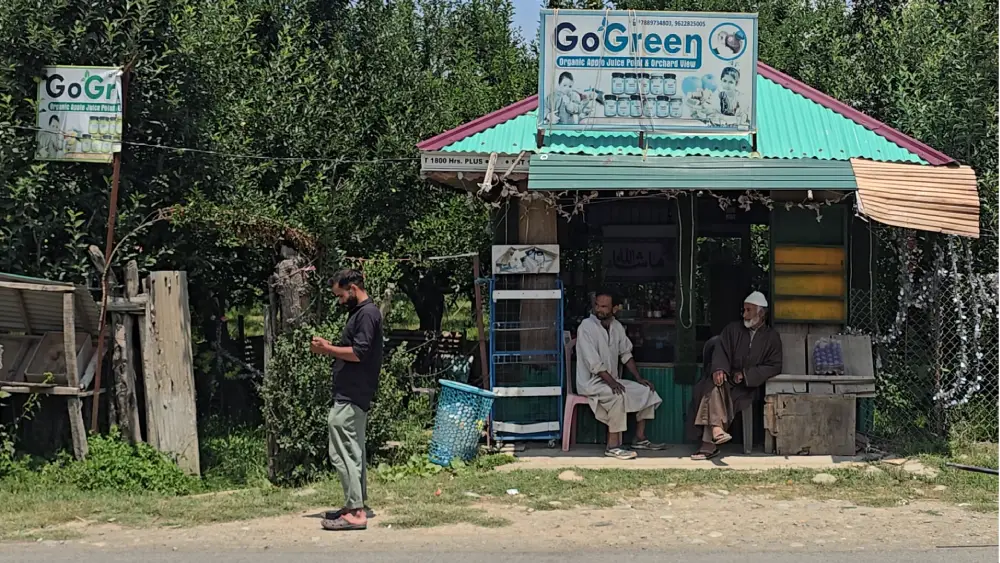
One such example is Ghulam Qadir, a farmer who turned the apples grown in his orchard into a range of products for passing travellers. Wrapped in a brown pheran, 76-year-old Qadir sits on a chair outside his modest apple juice shop, Go Green. He quietly watches the road.
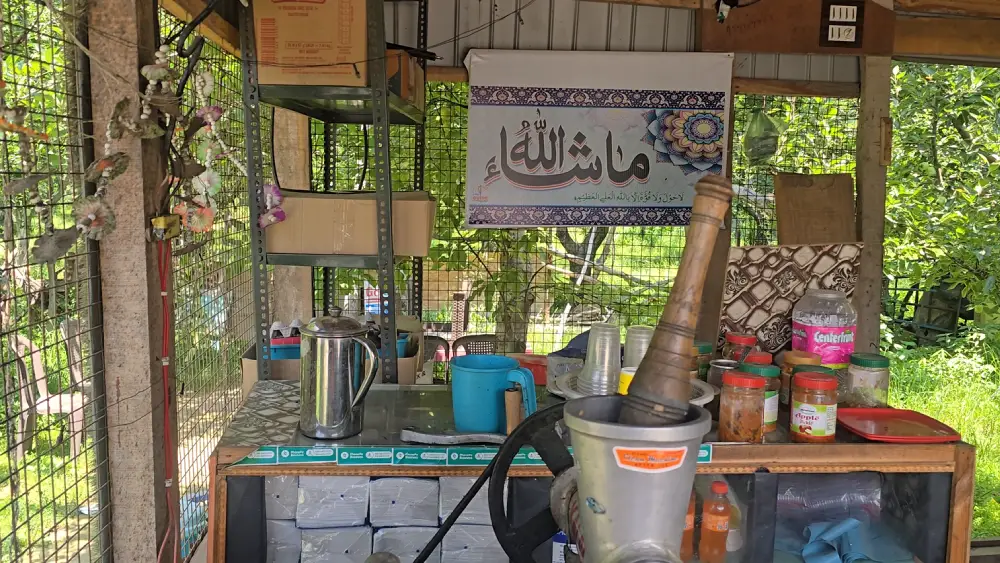
Inside, bottles of fresh apple juice sit alongside jars of homemade apple jam, packets of dried apples and bottles of apple pickle. Qadir opened the shop when tourists frequently stopped along the route. “I had an apple orchard, and when I saw the business opportunities growing in the area, I decided to set up a stall. Initially, I bought a steel juice maker and started serving fresh apple juice to travellers. Gradually, I expanded the business by turning apples into different products,” Qadir said.
But with the decline in tourist movement, his once-busy shop has grown quieter. Still, he opens it every day. “If I stay home, I feel anxious,” he admitted. “At least here, I remain busy and keep hoping that things will improve.” For Qadir, the shop is more than a place to sell apple products; it is an effort to turn his orchard’s produce into a source of income. His experience reflects that of many business owners in Apple Valley, for whom shutting up shop is not an option.
Another shop owner said he continues opening every day despite poor business because he is still repaying a bank loan. “If I keep my shop closed, the bank will summon me,” he said. For many like him, opening the shutters each morning has become less about selling goods and more about meeting old obligations. Loans that once seemed a reasonable bet on Apple Valley’s future have, for some, turned into a daily burden. It is a burden that now outlasts the customers who might help repay it.
A Generation Without Work
The decline has also affected the young people who once found work in these businesses. For years, Apple Valley employed youth, including many educated men who could not find suitable jobs elsewhere. Showrooms, restaurants and roadside shops became a source of income for them, allowing them to work and earn a livelihood.
Javeed Ahmed, a salesperson at Kashmir Village Emporium, remembers the time when businesses needed more workers to manage the flow of tourists. He said many of the boys who worked with him were graduates who had joined this trade for lack of other options. “Most of the boys who worked with us earlier were graduates. They were educated, but due to the lack of job opportunities, they joined this work. They were earning and supporting their families while staying here,” he said.
Today, many of those young workers are no longer part of these businesses. As customer numbers declined, shops reduced their staff, leaving fewer employment opportunities for those who once depended on the tourist movement through Apple Valley.
The change has affected more than sales and profits. It has altered a network of businesses built up over years, where orchards, restaurants, showrooms and small stalls supported one another and created employment for local families. Each depended on the other. The slowdown in one has rippled through the rest, and the confidence along the road has now shattered.
Watching The Road
For Mohammad Qasim, the change is reflected in the two stalls he leased after retirement, hoping they would provide a livelihood for his sons. Today, those stalls see only a fraction of the visitors they once did. His sons, a BTech graduate and an MSc in Geography, remain without regular employment, and the business he hoped would create an opportunity for them has yet to do so.
Still, each day, Qasim sits inside one of the stalls, watching the road leading towards Pahalgam. Every passing vehicle brings the possibility that someone might stop. Like many others who built their businesses around Apple Valley, he continues to wait for the visitors who once made the road a source of livelihood. He waits, too, for the day the road itself might reopen to them.