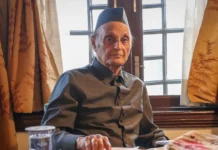
In Kashmir Life’s History Talks, archaeologist Dr Abdul Rashid Lone traces Kashmir’s history from Palaeolithic lake beds through Neolithic settlements to Kushana-era trade, art, and ancient Buddhist influence. Lilac Ali brings out the crisp transcript of the conversation
KASHMIR LIFE (KL): There seems to be a consensus that Kashmir was once a body of water and perhaps Ladakh too. Where does that story of origins begin?
Dr ABDUL RASHID LONE (ARL): The earliest history of Kashmir takes us back to the Palaeolithic age. All accounts, geological and historical alike, tell us that Kashmir was once a lake, an inland sea. Volcanic eruptions occurred, tectonic plates shifted, and the valley tilted northward. The southern plate pushed against the northern one, pressure built, and eventually there was a rupture. It took millions of years for the water to drain out.
The earliest Palaeolithic settlements we know of come from the Lidder Valley. HD Sankalia, of the Indian Archaeological Department, surveyed the area and found tools used millions of years ago. His report concluded that, both technologically and chronologically, these tools are among the earliest in all of South Asia, suggesting Kashmir Valley may well have been humanity’s first home in South Asia.
Unfortunately, there is no comprehensive excavation report for this site, even though it was discovered in the 1960s; there is only one thin research paper. That absence leaves a significant void. The tools were found on the surface because the lower ground was still waterlogged, so finds are concentrated in the south. There is geographical evidence of the water receding gradually, with human settlement following that retreat further down over time.
The second set of evidence comes from Balpora in Shopian, again stone tools, since this was still the Stone Age. Middle Palaeolithic tools were found there: scrapers, choppers, implements for hunting and gathering wanderers.
Moving forward, Central Kashmir yields later evidence. In Ganderbal, around Manasbal Lake, researcher Aijaz Ahmad Banday discovered a cave whose excavation produced more tools. So the pattern is: lower and middle Palaeolithic in the south, upper Palaeolithic in the centre.
At Bomai, near Sopore, middle Palaeolithic tools have been found, notably alongside a rock engraving that scholars have variously interpreted. At Samboora, excavations have turned up upper Palaeolithic tools, and Scottish archaeologist TT Paterson’s 1935 research also points to the upper Palaeolithic at that site. Surveys since then continue to yield new finds.
The Palaeolithic Age, broadly dated from around two million years ago to roughly 18,000 BCE, shows a clear lower, middle, and upper sequence suggesting continuous occupation. Then comes the Mesolithic Age, and here we hit a gap. We have no firm evidence for it in Kashmir, largely attributed to climatic factors like ice ages. But the search is ongoing. We cannot declare it did not exist as we cannot jump directly from Palaeolithic to Neolithic.
Then comes the Neolithic Age, the New Stone Age, and with it, a transformation. The climate stabilised, and human civilisation began to take root. The earliest evidence of settled civilisation comes from Qasimbagh in North Kashmir, dated to around 4000 BCE, surveyed by Mumtaz Ahmad Itoo in collaboration with Sydney University.
Burzahama, dated to around 3000 BCE, is better known because it received more excavation and funding unlike Qasimbagh. Kashmir has 48 identified Neolithic-age sites, but only three or four have actually been excavated: Burzahama, Gufkral, and Kanispora. Kanispora also has Kushan-period evidence, with Neolithic layers beneath. Neolithic finds have also come from Ganderbal. It is a continuous process, with something new always surfacing.
What makes the Neolithic genuinely revolutionary is the shift in how people lived. In the Palaeolithic, humans were wanderers; in the Neolithic, cultivation arrived, and settlements followed. Storage became necessary. At Burzahama, pits have been found that may have served as dwelling spaces, storage, or both. Because people now needed to carry and preserve food, pottery was invented: vase-like pots of grey clay – jars, cooking vessels, storage pots. Alongside utility came aesthetics, the earliest evidence of a hunting scene depicted in art in Kashmir comes from Burzahama.
The method of constructing caves and pits in Kashmir was quite distinct compared to regions like the Swat Valley, or even Iron Age pits and dwellings in the European context. Dug into Kashmir’s unique karewa soil, these pits stayed naturally warm, making them effective and safe for storage and habitation. They came in circular, rectangular, square, and tapering shapes, each pit telling a different story. This period lasted around 2,000 years.
KL: What is the story behind these pits, and where exactly are they found?
ARL: Evidence of these pits extends far beyond Gufkral. We find them across South Kashmir, though they have not been well-documented or researched yet. When a section was cleared at Pethanpora, two pits were clearly visible. When the Archaeological Survey of India excavated a site around Budgam, the cleared side revealed hundreds of pits. This was not an isolated phenomenon. These settlements were contemporary, making pits was standard practice.
Archaeologists comparing them to similar pits in the north-western subcontinent concluded they may not have been dwelling pits at all.
KL: How did the architecture change moving into the next phase of this era?
ARL: In the second period, structures were built right over the ground, and the old pits were closed up. As the weather stabilised and floodwaters receded, people moved down to the valley floors and started cultivation. Burzahama shows remnants of brick walls from this phase. This is also the point where links began to develop with the outside world.
At Burzahama, a red pottery jar was discovered with a black painting of a horned animal, containing more than a thousand finished beads of steatite and carnelian stone. We know they were imported because there are no manufacturing residues or raw material leftovers found locally. Scholar Randall Law concluded that carnelian stone doesn’t occur in Kashmir at all.
Because of discoveries like this, my professor, Nayanjot Lahiri, believes Kashmir had developed strong trade links with the north-western subcontinent. Kot Digi, in present-day Pakistan, shows similar artefacts and findings. We also know timber was transported from Kashmir via the Jhelum River for the Indus Valley Civilisation, where demand was huge, and the people in that lumber business would naturally have led this exchange.
KL: Parallel to the Indus Valley Civilisation there were other civilizations too.
ARL: Yes. A specific harvesting tool found at both Burzahama and Gufkral is said to have originated from Chinese civilisations in the northeast. So trade and cultural connections were coming from both west and east.
After the Neolithic age, a new generation erected large rocks, as at Burzahama, belonging to the Megalithic period, said to have been used for tracking stars and keeping time.
Two hundred years after the megalithic period lies a major historical blind spot: from 1000 BCE to 800 BCE, there is a complete lack of both textual and archaeological evidence.
After that gap, history becomes continuous, from 800 BCE to modern times. Research from Semthan gives us a clear chronology: between 800 BCE and 500 BCE, the old Neolithic lifestyle was abandoned, cultivation began in earnest, and iron came into use.
People moved permanently to the base of the valley as the water fully drained away, allowing widespread rice cultivation, while iron tools made farming easier. We know this sequence definitively from Semthan, but archaeologists attest the transition held across Kashmir.
KL: Do we know if the people who established these new Iron Age settlements were the same people from the older eras?
ARL: That remains a tempting question, and we still don’t know for sure if they were natives or foreigners. Because of the data gap between 1000 BCE and 800 BCE, we can not say whether these were the same people who travelled down from Gufkral to settle in Semthan.
From 800 BCE to the 1st century, proper settlements grew, advanced firing techniques emerged, and different pottery types developed as external links flourished again. The period between 500 BCE and 300 BCE is called Northern Black Polished Ware (NBPW) as it had a very elite, decorative pottery whose epicentre was Bihar but which spread across the subcontinent, though few examples have been found within Kashmir. This pottery was valuable enough that we have seen instances of it repaired with iron nails after breaking.
A few punch-marked coins, believed to be the earliest currency in Indian monetary history, were also found in Semthan, indicating cultural exchange links with the Indian plains. Exactly how these coins arrived here is still an open question.
During this period, the use of iron blossomed, driving the widespread cultivation of rice. This agricultural surplus led to dedicated craft centres, and Semthan developed as Kashmir’s first urban centre around 500 BCE, the first true city, and capital of South Kashmir.
The Rajatarangini also mentions the Mauryan ruler Ashoka, though his presence here remains controversial due to lack of physical evidence. Ashoka’s edicts, rock engravings, are typically found wherever he travelled, across the subcontinent. Had he visited Kashmir, similar engravings would likely be here too.
Around 300 to 200 BCE, after the Mauryan Empire declined, the Indo-Greeks arrived from Greece into north-western India. In Kashmir, they went directly to Semthan, already an established major centre, staying about two hundred years. We have clear evidence of their presence: Indo-Greek pottery, seals of rulers like Menander and Eucratides, and impressions of the deity Apollo. This era marks Kashmir’s first major encounter with the outside world, alongside significant linguistic and cultural developments.
After the Greeks, the Kushanas arrived, leaving distinct pottery and coins. Under them, a major school of art developed. The vast Kushana Empire had capitals in Mathura, Gandhara, and Amaravati, with their signature art flourishing under Emperor Kanishka. Their presence in Kashmir is heavily attested in the Rajatarangini, and archaeologists have mapped around 70 sites related to the Kushana period.

KL: There is a famous dialogue attributed to Menander. Where did that take place, and what is the story behind it?
ARL: Yes, the Milindapanha, a philosophical dialogue between the Buddhist sage Nagasena and the Indo-Greek king Menander I. The text places this debate twelve yojanas from Kashmir, so not very far away at all.
Buddhism in Kashmir surged during Kanishka’s reign, transforming the cultural landscape and leading to the construction of numerous stupas. Kashmir also developed a unique, local school of art cantered on terracotta, driven by local artisans under Kushana rule, the Kashmir Terracotta School of Art.
What makes it remarkable is that while the rest of India sculpted primarily in stone, artisans here worked extensively with terracotta – figurines, toys, bangles, and decorated tiles with intricate impressions, unearthed across 24 different settlements. This tile art was tied to Buddhism, used to pave the ground around Buddhist religious sites.
This was also the era when Kashmir became deeply linked to the far west. Persian historian Mirkhvand writes of Persian rulers gifting garments to Roman princesses, noting the luxury fabric originated from Kashmir. During excavations at Palmyra, Syria, physical remains of kostis (costus) were uncovered, locally known as Koth, an aromatic Himalayan medicinal plant native to Kashmir, prized in antiquity for perfumes and medicine. Finding it in a Syrian dig site proves it travelled from Kashmir 1,500 years ago.