As Jammu and Kashmir’s fertility rate collapses from 4.5 to 1.4, doctors report a rising, under-discussed cause suggesting the young women’s ovaries are ageing decades before their time, reports Asrar Syeed

Jammu and Kashmir is facing its worst fertility crisis in decades. The total fertility rate (TFR), the average number of births per woman, has fallen from 4.5 in 1980 to around 1.4 (NHFS-V) today. Experts warn that this decline could trigger a broader fertility crisis in the region, with consequences for the region’s overall population trajectory.
A TFR of 1.4 sits well below the replacement level of 2.1, the threshold a population needs to sustain itself across generations without relying on migration. If the trend holds, Jammu and Kashmir faces the same demographic arithmetic already reshaping parts of East Asia and Europe: a shrinking, ageing population, a smaller future workforce, and mounting pressure on family structures built around the assumption of children.
Much of the conversation around falling fertility in India tends to focus on choice: women marrying later, prioritising careers, or opting for smaller families by design. What gets less attention is the share of that decline that is not a choice at all.
Behind the statistic are common women for whom infertility has meant years of medical visits, and strained marriages. Increasingly, they are being diagnosed with Premature Ovarian Failure (POF), clinically known as Primary Ovarian Insufficiency (POI), a condition that few in Kashmir had heard of a decade ago.
Masrat’s Ordeal
Masrat began visiting her gynaecologist regularly at 30, long before she married at 40. For a decade, she kept a weekly reminder for fertility testing at the clinic. After marriage, she was unable to conceive, a reality she calls her worst nightmare come true: remaining childless.
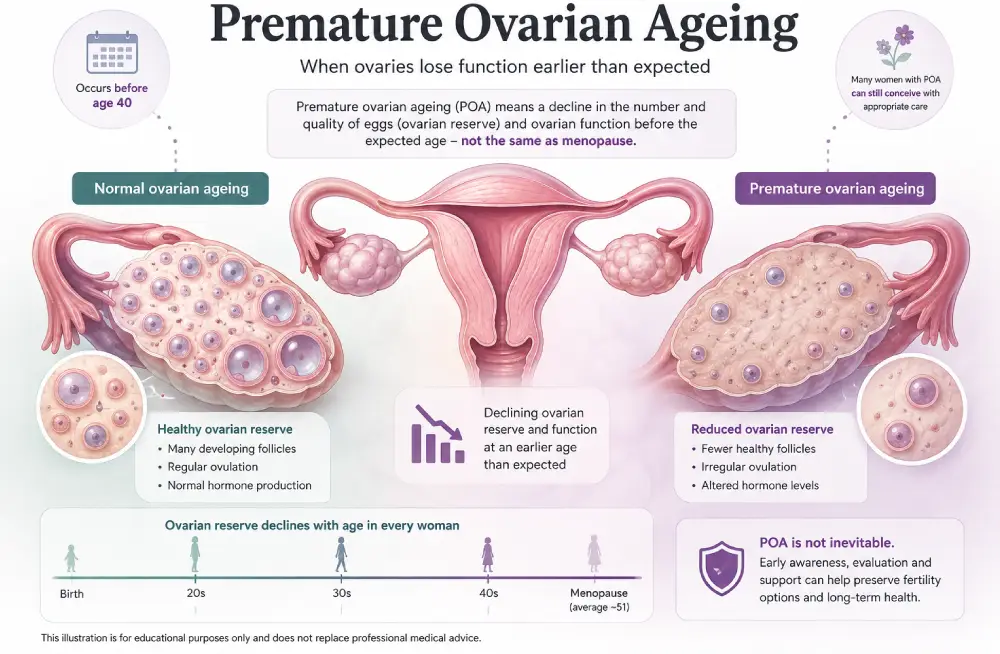
POF occurs when the ovaries stop functioning normally before age 40. Egg production drops, oestrogen levels decline, and the entire hormonal balance is disrupted. The condition is notoriously unpredictable: periods and ovulation may continue sporadically even as ovarian reserves decline sharply. As a result, it can remain undetected until a woman begins trying to conceive.
That unpredictability is what makes POF distinct from ordinary age-related fertility decline. A woman with the condition may continue to have regular periods for months, with no outward sign that her ovarian reserve, the finite pool of eggs she is born with, is declining prematurely. In some cases, the depletion may resemble the rate typically seen in women approaching their late forties
Clinicians increasingly prefer the term Primary Ovarian Insufficiency (POI) to Premature Ovarian Failure because “failure” suggests a complete and permanent shutdown of ovarian function. In reality, ovarian activity in women with POI can be intermittent, leaving a narrower but real window for treatment and, in some cases, conception.
Doctors Confirm
“We see it here also,” said Dr Farhat Jabeen, a senior gynaecologist who has treated Kashmiri women for many decades. “Patients with Premature Ovarian (Insufficiency) are in Kashmir also. This is an entity which we now clearly see in Kashmir.”
Farhat said she has personally observed that over the last 10–20 years, more patients came to her with “this kind” of health issue. “Apart from the actual rise, there are other factors: women are more aware, they seek advice from doctors, and the stigma that once existed has reduced,” she said. “The availability of specialists has also increased.”
Healthcare professionals in Kashmir have repeatedly pointed to late marriage as a compounding factor. Peak fertility for both men and women falls between ages 20 and 30. The odds of conceiving gradually decline once either partner reaches 30.
Dr Jabeen’s second observation is that stigma, not just incidence, has changed. For years, reproductive health issues in Kashmir went undiscussed even within families, let alone in a doctor’s office. A woman experiencing irregular cycles or unusual symptoms was more likely to be quietly worried about than clinically evaluated. That more women are now walking into gynaecology clinics with these concerns may partly reflect a real rise in cases. At the same time, she said, it also reflects a slow erosion of the silence that once kept the condition undiagnosed until it was too late to act on.
Shazia’s Story
Shazia married at 25. It was early, by the standards doctors themselves recommend, yet she and her husband have been unable to conceive. The couple is now seeking a divorce.
“We got married at a very early age, despite that both of us have been unable to conceive,” she said. “We have sought every possible medical help; repeated visits to specialists have resulted in nothing progressive. When we got married, we never knew that such a disaster was awaiting both me and my husband. Being childless is very disheartening, and only those who are not able to have a child can understand this.”
It was only after marriage, and repeated visits to gynaecologists, that Shazia learned she had premature ovarian failure, despite showing no early warning symptoms. Her doctors identified a sedentary lifestyle as a possible factor in the “early ageing” of her ovaries, alongside academic pressures, limited physical activity and the demands of pursuing financial independence. These factors can contribute to delayed marriage and may affect reproductive health in both women and men.
What Causes It
A 2015 study titled Prevalence and Causes of Infertility Among Women of Jammu and Kashmir by Uzma Amin, Nilofer Khan and Dr Imtiyaz Ali Bhat, published in the International Journal of Development Research, found that 45.5 per cent of infertile women in the study were diagnosed with reproductive organ pathology, followed by endocrine disorders (31 per cent), unexplained causes (22 per cent), menstrual disorders (1.25 per cent), and other causes (0.25 per cent).
POF itself has multiple potential triggers, from genetic factors to chronic stress, poor sleep, and being underweight or overweight. “Yes, we see a rise in early ovarian ageing in young females in Kashmir, which is affecting their fertility,” said Dr Afshan Iqbal, Senior Consultant, Obstetrics and Gynaecology. “That is why healthcare professionals are giving much importance to early marriage and not delaying childbirth if possible, because age-related decline in ovarian function reduces fertility chances.”

Genetic abnormalities, autoimmune disorders, and medical treatments such as chemotherapy and radiation are established causes of POI. Environmental and lifestyle factors can also trigger it.
“Extreme body weight, chronic stress, poor sleep, circadian disruption, environmental toxin exposure, heavy metals, poor nutrition, and sedentary habits like eating processed food with preservatives- all of these are factors that can lead to Premature Ovarian Insufficiency,” said Dr Berkheez Shabir, Consultant Obstetrician, Gynaecologist, and IVF Specialist.
Several of these factors track closely with broader lifestyle shifts underway in urban Kashmir over the past two decades. These include longer working hours, increased screen time and disrupted sleep patterns. Besides, a shift toward processed and packaged food, and reduced physical activity among students under sustained academic pressure. But none establishes a direct causal link with POI in an individual patient. Research on lifestyle triggers is still evolving, while genetic and autoimmune causes remain more firmly established. But the overlap between what doctors describe as risk factors and how daily life in the Valley has changed is difficult for clinicians to ignore.
Sharifa’s Pain
Sharifa married at 26, with no history of PCOD or irregular cycles, only an underweight frame that had worried her family before marriage. She and her husband tried to conceive immediately but could not.
She did conceive once, but the pregnancy was terminated after doctors found underlying medical complications. The couple has not conceived since.
“Being childless is not easy,” she said. Told by her doctor that her ovaries had begun “ageing” and that pregnancy might no longer be possible, she said the news left her more burdened with stress than she had ever been. This strain that she says has affected her overall wellbeing over the years.
Missed Signs
POF often presents with no clear symptoms, making it one of the more unpredictable reproductive health conditions. Periods and ovulation can continue even as ovarian reserves fall faster than normal. Doctors say early warning signs can include irregular periods, disrupted sleep, mood swings and hot flashes.
Awareness remains low, particularly outside urban centres. “Girls in Kashmir are still not aware of it. It is usually after their marriage that they consult a doctor when they do not conceive, and by then it is late,” said Dr Berkheez, noting that late detection significantly complicates treatment.
The pattern is consistent: symptoms that may warrant investigation, like irregular sleep, mood changes or unusual menstrual cycles, are often dismissed as the ordinary stresses of young adulthood. This is particularly common among women balancing education, work and family expectations. It is only the failure to conceive after marriage that prompts a clinical workup, by which point the diagnosis often arrives as a shock rather than a confirmation of something already suspected.
 Early Detection
Catching POI early widens the options available to patients. “Early detection will certainly help, particularly with early ovarian ageing, as fertility is maintained in the early stages, though prospects remain grim for patients with premature ovarian failure,” said Dr Afshan Iqbal. “If detected early, we can tell patients to complete their family, or go for egg freezing if they are not yet married or don’t want children yet.”
Kashmir’s medical infrastructure for reproductive health has expanded in recent years, reducing the need for patients to travel outside the region for treatment. But that shift has brought its own risks.
“Earlier, Kashmiri patients used to travel to other states, but now, because of awareness of the treatment and centres available in Kashmir, that number has dropped,” said Dr Mir Jaffar, a clinical embryologist. “Kashmiri patients are also easy to lure into expensive treatments; outside players have understood that it is easy to catch patients here and profit from them.”