Kashmiri writers, translators and institutions discuss with Babra Wani why translation matters for a language with limited global reach, and the losses, gains and challenges of the craft
Hafsa, an avid reader, believes the translation is a blessing in disguise. “We were able to read all the amazing Persian poets through the translation of their works and that is amazing,” she said. “I really think that translating one language to another helps and it makes that language, the work, more accessible.”
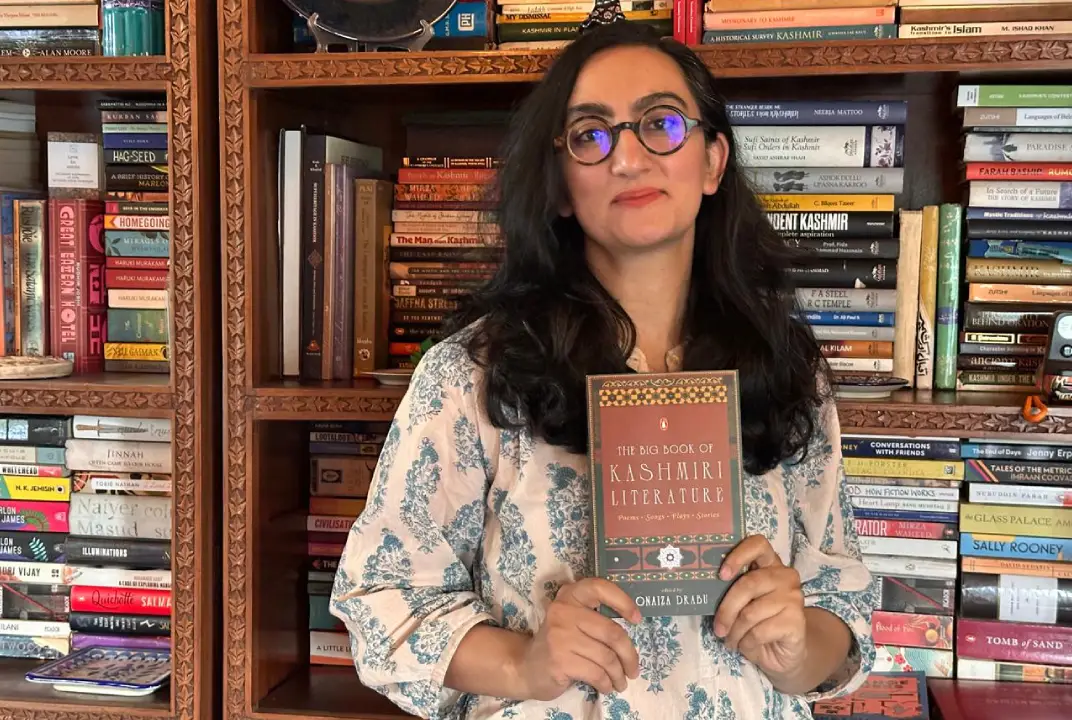
The debate around translation recently entered the mainstream with the release of Onaiza Drabu’s anthology, The Big Book of Kashmiri Literature, comprising songs, poetry, plays and stories written in Kashmiri and translated into English. Around 20 translators helped compile the 664-page book, which spans six centuries, from fourteenth-century mystical verse, folk chants and metaphysical ghazals to modern flash fiction, radio plays and novel excerpts.
Translator, author and linguist Dr Roop Krishen Bhat holds a PhD in linguistics, with his doctoral thesis on Kashmiri grammar, and spent 10 to 15 years studying the language. He has published around 45 books, including translations and short-story collections, and has translated between Kashmiri, English and Hindi.
“Both languages, the source language and the target language, equally, whoever has the mastery and understanding are good translators,” he said. Literal, word-for-word translation, he said, often fails to convey the meaning and character of the original. Instead, a translator must find an equivalent expression and ensure the intended meaning is conveyed.
“Language reflects the culture,” Bhat said, citing honorific forms as an example: in Kashmiri, a plural form can address a single person as a mark of respect, a distinction English lacks. “This is basically a cultural expression,” he said. “If you are aware of it, you can become a good translator.”
Bhat considers prose easier to translate than poetry, where similes, rhythm, tone and cultural references function differently across languages. “Understanding them and making them equal is a tough task,” he said. He has translated three books for the Sahitya Akademi but noted there have not been enough major translation projects involving Kashmiri literature in recent years. “We really need translators,” he said. “The more translators there are, the more we can say that we are getting richer.”
Bhat believes translation can reconnect younger Kashmiris with their language and heritage, which he said has historically lacked institutional support and remained behind Urdu in official spaces. He drew a parallel with Shakespeare’s Othello, noting some publishers have rewritten older English works in contemporary language. “You can call it a rewrite. It is not exactly a translation, but it is a rewrite,” he said.
Neerja Madam
Translator and former English educator Neerja Mattoo praised Onaiza Drabu’s efforts to make Kashmiri literature accessible: “She has worked very hard.” Mattoo’s own journey began as a student under Professor J L Kaul, “like another father” to her, who gave her two Kashmiri short stories to translate for a Sahitya Akademi collection: Akhtar Mohi-ud-Din’s Swarga Hoor and Ameen Kamil’s Kaukar Jung.

She returned seriously to translation when Kashmir’s situation deteriorated in the 1990s. “I thought that people should know that not only is there bloodshed in Kashmir, but there is a lot of literature in Kashmir,” she said. She became interested in the contrasting traditions of mystic and romantic lyric poetry, noting two Kashmiri women pioneered both, and went on to compile the poetry of Kashmiri women poets.
On translating poetry, she said: “I did not even try to keep that kind of rhyme scheme. But I tried to get the same metre in English.” Meaning came first: “You cannot play with meaning. You have to keep the meaning honest.”
Mattoo said translators are poorly rewarded. “I don’t think I get a proper due,” she said. “I did not earn much from my translations.” She often distributed printed copies herself. “You should not think that I am doing it for appreciation, for work, for money,” she said. “If you feel like doing it, then do it. Then only will you do an honest job.”
She recalled a Delhi conference on DH Lawrence where a senior Delhi University professor overheard her speaking Kashmiri and asked, “Is Kashmiri a language? I never thought it was one.” The remark, she said, became another motivation for her work. She rejected any suggestion that Kashmiri is inferior. “How can they think it is inferior if they read Lal Ded?” she asked. “One of the greatest philosophies in this world is expressed in those vaakhs of Lal Ded.”
Rediscovering Ghani
Dr Mufti Mudasir Farooqi, professor of English at the University of Kashmir and translator of The Captured Gazelle: The Poems of Ghani Kashmiri and Yusuf’s Fragrance: Poems of Mahmud Gami, both published by Penguin India, said translation, especially retranslation, is vital because Kashmiri has a relatively limited global readership. “Our literature is very rich, and the world should know our literature,” he said.

He described translation as carrying not just language but culture, civilisation, values and worldview. Losses are inevitable: “In translation something is lost and something is gained,” he said, and every translator must aim for “maximum gain and minimum loss”. Poetry is harder than prose, requiring the translator to negotiate meaning, rhythm, rhyme, form and mood. “No one needs to read the original text more closely than the translator,” he said, adding the translated work must also stand independently, with its own literary and aesthetic value.
Farooqi cited Edward Fitzgerald’s translation of Omar Khayyam’s Rubaiyat as a work hailed as great despite being unfaithful to the original. “It is easy to find fault with translations but more difficult to produce one that is very faithful and appealing at the same time,” he said.
Fresh Voices
Muhammad Nadeem, who has translated short stories and poems, noted Aga Shahid Ali remains the only Kashmiri writer with an entry in the Norton Anthology of Poetry. “It is high time our literature is represented in world literature,” he said, adding that Kashmiri novelists have largely stopped writing about Kashmir. He also sees translation as a form of dissent at a time when books are being banned from libraries. “Translating our literature and storing it in multiple languages is important,” he said, citing Azad, Mahjoor, Rahi, Akhter Mohiuddin, Lal Ded and Nund Reshi as writers whose work translation could preserve.

Journalist Rounak Bhat began translating in 2024, starting with poetry by Pandit Zinda Kaul, known as Masterji. Early feedback was discouraging, and he continued privately, calling himself jokingly a “bathroom translator”, before being introduced to Onaiza Drabu and joining her anthology project.
Bhat now works mainly with Kashmiri prose, which he called “very niche” compared with the dominant poetic tradition. Dina Nath Nadim wrote the first Kashmiri short story in the 1950s, while Akhtar Mohiuddin wrote the first novel around the same period; Bhat estimates the total number of Kashmiri novels at around 40 to 50.
A Kashmiri Pandit raised in Jammu, Bhat learned Kashmiri largely through his family rather than formal education. “I grew up hearing Kashmiri a lot because my parents would only speak Kashmiri at home,” he said. His main early difficulty was the script rather than the language itself, having been educated in Hindi and later Urdu.

Certain words, such as khaslat, have no precise English equivalent, and he relies on family members as an informal repository of vocabulary. “The main challenge really is, one, to understand words and, two, to make sure that you are able to land them well into English,” he said.
He prefers prose to poetry. “Kashmiri poetry is sacred,” he said. “I let the experts do the experts’ thing.” He named Akhtar Mohiuddin, Hari Krishna Kaul and Hriday Kaul Bharti among the finest figures in Kashmiri prose, and argued translation can draw readers back to the originals rather than replace them. “It compels people to go back to the originals and find out what was it in the original,” he said. He wants Kashmiri taught earlier in schools: “The very first lesson that is taught in our schools should be in our own mother tongues.”
Nasheem Ashraf, a postgraduate from Ashoka University and another contributor to Drabu’s anthology, came to translation through her research into women’s narratives in South Asia, where she found a gap in the historical record. “The narratives of women in our official… archives, there are very few of them,” she said, arguing their work survived largely through oral tradition owing to limited access to formal publishing.
She said figures such as Lal Ded and Habba Khatoon are often reduced to mystic or romantic stereotypes that obscure the political force of their work. “If people actually knew what Lal Ded wrote about and believed in, they would not associate that docile character with her,” she said. “The history we have officially seen of Kashmir, we only know it from a male gaze, from a male lens.”
Ashraf translated the work of Zeba Zeenat, a self-taught Kashmiri poet she said remains largely unknown, tracking down a locally published, error-ridden copy of her writing through personal contacts. “Nobody knows about her,” she said. “And look at the kind of work she’s done.”
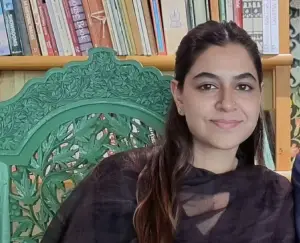
Born in 1997 and raised in Srinagar, Ashraf did not grow up speaking Kashmiri fluently despite her family speaking it at home. “I did not grow up speaking in Kashmiri. I still don’t,” she said. “It is something that I had to teach myself.” She recalled Professor Abir Bazaz telling her that Kashmiris needed to return to their language, advice whose significance she only later understood.
“We have to train ourselves to speak in Kashmiri, because we do not think in Kashmiri,” she said, describing it as “a conscious political choice”. Yet she said certain expressions surface naturally in Kashmiri when speaking to her niece and nephew: “Something that is really, really deep, that you cannot explain often in words, you always find that expression in your mother tongue.”

On loss and gain in translation, she said: “Of course, a lot is lost in translation. But a lot is also gained in translation.” She found prose allowed more freedom than poetry. Her translation of Zeba Zeenat required consulting family members familiar with the poet’s Sufi context. “Even if you translate one line from someone… you should do whatever you can to do justice,” she said.
Ashraf sees translated anthologies as an entry point back to the original language. “I think this is a gateway,” she said. “It can be a very good, important outline also. It is like a map.” She said inherited language carries something beyond what can be learned. “I know that people can learn Kashmiri, but there is something that you inherit through your legacy, through generations,” she said. “I think it is a privilege in that sense.” She pointed to growing numbers of young Kashmiris studying the language and its literature at universities abroad. “We are going back to our culture. We are going back to our language,” she said.