by Faiqa Masoodi
Spread over 300 kanals at the foothills of Hari Parbat, Badamwari is a historic almond garden that blends natural beauty with cultural legacy. Once neglected, it was revived by Jammu and Kashmir Bank, reclaiming its place as a cherished springtime destination for locals and tourists alike.
Nestled at the foothills of Hari Parbat in Shehr-e-Khaas, the heart of Srinagar city, Badamwari Garden is a 300-kanal expanse of almond trees, flowering plants, and gentle cascades. It stands as a living emblem of Kashmir’s natural beauty and cultural heritage.
Each spring, as the almond trees burst into bloom, Badamwari becomes a sanctuary for nature lovers, locals, and tourists alike. The air turns fragrant, the vistas glow in soft pink and white hues, and the garden offers a serene escape into a world of colour, memory, and revival.
History
The origins of Badamwari Garden remain somewhat obscure, with no definitive records marking its inception. However, historians suggest the garden pre-dates the rule of Sultan Zain-ul-Abidin, Budshah, in the 14th century, implying a legacy that stretches back even further. Through the centuries, the garden has witnessed the rise and fall of numerous regimes, each leaving its mark on the landscape.
The Afghans built a fort atop a nearby hill, just a few hundred metres from the garden. During the Dogra rule, hundreds of almond saplings were planted here under the orders of Maharaja Ranbir Singh in 1876. Both regimes reportedly drew water from a deep well inside the garden to supply their fort garrisons — a feature that remains one of Badamwari’s enduring attractions.
View this post on Instagram
Some historians believe the garden was once referred to as Bagh-e-Waris Khan, named after the nobleman said to have revived Kashmir’s ancient garden tradition. The well in the garden, still known as Cha-e-Waris Khan, is attributed to him. Oral histories speak of the well-being used as an interrogation site where suspects were tied and lowered into its depths — a terrifying experience that often provoked confessions. Today, the well holds fascination for visitors who whistle into it just to hear the echo rise back, a ghostly reminder of its dark past.
Over time, the garden became known as Badamwari — the Garden of Almonds — and its annual bloom came to symbolise the arrival of spring and the Kashmiri New Year. The garden served as a popular venue for family picnics, community gatherings, and folk celebrations.
Decline and Revival
For decades, particularly during the 1990s and early 2000s, Badamwari fell into neglect. Political turmoil and armed conflict led to official apathy. Encroachments and poor maintenance nearly erased its beauty and significance.
The turnaround came in the early 2000s when the Jammu and Kashmir Bank undertook a comprehensive revival project as part of its Corporate Social Responsibility initiative through its Heritage Trust, constituted by economist and bank chairman Dr Haseeb A Drabu to invest in the revival of Kashmir’s cultural spaces. With an investment of over Rs 7 crore and hiring the best landscape architects and engineers, the garden was restored not only as a recreational space but as a symbol of Kashmir’s cultural pride. The fencing was reinforced, structures with traditional burza pash roofs were restored, and intricate latticework and khatamband ceilings were reintroduced to reflect authentic Kashmiri design.
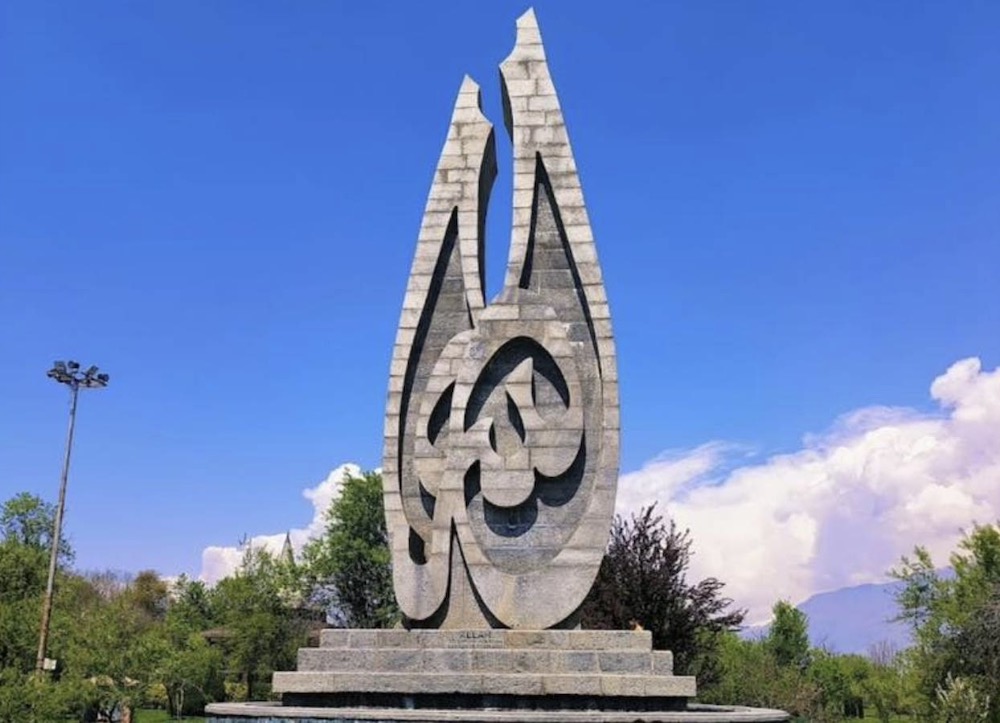
Noted Kashmiri artist Masood Hussain was commissioned to create installation artworks in the garden. One of the centrepieces is an almond-shaped sculpture fountain inscribed with the word ‘Allah’ in elegant Arabic calligraphy — a spiritual and aesthetic highlight that draws much admiration.
In March 2008, the garden was formally reopened to the public. New additions included a 2,000-seat amphitheatre, an art gallery, and a jogger’s path, bringing new life and energy to the space.
A Space Designed for Experience
Badamwari’s grandeur is evident the moment one enters through its main gate — a 25-foot-tall structure built of traditional limestone and designed in the classic pointed arch style of Mughal architecture. A second gate, identical in symmetry, stands to the east about 100 metres away, with the Zabarwan Hills forming a majestic backdrop.
The tiled walkways are thoughtfully laid out, with a 1.15-kilometre jogger’s track offering gentle gradients and natural resistance, especially on the northern slope, ideal for high-intensity workouts. Many compare the sensation to running on a treadmill. Rope skipping spots dot the path, and laughter therapy groups animate the corners with their hearty guffaws — a sight that adds vibrancy to the tranquil setting.
Every detail of the garden appears intentionally curated. Small huts with chayeh paash (thatched roofs) resemble old Kashmiri village homes, evoking nostalgia and reminding visitors of a vanishing rural tradition.
View this post on Instagram
A Haven for Nature Lovers
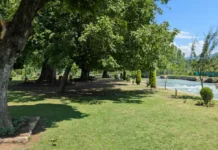
Spring transforms Badamwari into a floral paradise. Thousands of almond trees bloom in delicate pinks and whites, carpeting the garden in vibrant hues. Their fragrance mingles with the mountain breeze, creating a multisensory experience. Fountains, flower beds, and shaded alcoves enhance the garden’s charm.
Visitors stroll along the walkways, taking in the scenery and relaxing amidst nature. The garden offers both respite and inspiration, becoming a favourite spot for photographers, artists, and poets.
Tourism and Cultural Reconnection
In recent years, Badamwari has reemerged as one of Kashmir’s most celebrated springtime destinations. Tourists flock to the garden to witness the famed almond blossom, often sharing their experiences on social media, further boosting its popularity.
Its proximity to major sites like Hari Parbat Fort, the Makhdoom Sahib Shrine, and Nigeen Lake makes it a convenient stop on the Srinagar cultural circuit.
Cultural events during spring are now a regular feature. Local artists perform traditional Kashmiri folk music and dance, restoring the garden’s role as a centre of communal life and expression.

A Garden of Memories
To Kashmiris, Badamwari is more than a public park — it is a vessel of memory. Many older residents recall childhood picnics beneath the almond trees, sipping tea from samovars and playing traditional games.
Kashmiri poet Zarief Ahmad Zarief is among those who have spoken emotionally about the garden’s past, recalling spring gatherings that united communities. Such memories underscore the deep cultural and emotional resonance the garden continues to hold.
Badamwari’s revival is not merely the story of a restored garden; it is the story of a people reclaiming a space where memory, nature, and culture entwine in graceful bloom.