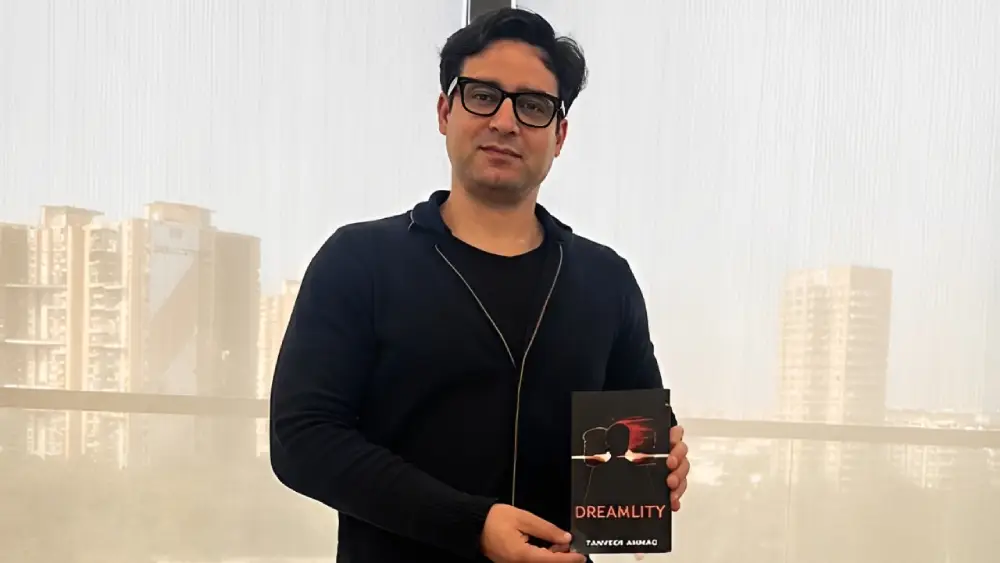
A Kashmir-born geneticist’s debut novel fuses neuroscience, stem cell science and dream logic into a melodramatic thriller about identity, ambition and inherited memory, wearing his scientific life as its skin, writes Mir Rameez Raja
Before a single page of Dreamlity unfolds, it is worth sitting with who is writing it. Dr Tanveer Ahmad spends his working life redesigning CAR T cells with AI, engineering stem cells to repair inflammation, and building optogenetic tools that reveal how proteins traffic inside neurons.
That work is serious enough to land in Nature Communications, and cheap enough, he insists, to reach a patient in Srinagar as easily as one in Boston. That tension – between the cutting edge and the accessible, between the lab bench and the ordinary person it’s meant to serve – turns out to be the emotional spine of his fiction too, not just his research philosophy.
The acknowledgements section is unusually candid about this crossover. It is the single most revealing part of the book for understanding the author’s process, not just his plot. Real colleagues become characters outright. Dr Divya Carter, the neuroscientist who explains the stem cell procedure at the novel’s hinge, is named as a direct portrait of a real collaborator. REMAI, the biotech company at the story’s centre, and MicroCRISPR, a corporate culture the author draws on for its “insights,” both echo the institutional world Tanvir actually inhabits: IGIB, NIH, MCARS, the lab groups and PhD students he thanks by name.
His own father is credited with lending his voice to Haksar Bal, the woodcutter-father whose grief opens the novel’s second chapter. This is not incidental colour. It tells you that Dreamlity is not really a scientist’s excursion into genre fiction. It is an attempt to fictionalise the emotional weather of a research career involving the ethical arguments, the mentor-protégé rivalries, and the years of uncertain trials. This all gives it a plot dramatic enough to carry that weight.
The Story
The novel opens with two cars racing toward each other on the flooded Mumbai Sea Link. One is driven by a man consumed by fury, the other by a man consumed by heartbreak. Both wear near-identical Om pendants. It is a deliberately mythic collision, and the book spends the rest of its length working backwards and forward from that crash to explain how these two strangers came to be bound together.
The story then jumps to Mirkash, a fictional Kashmir village, in 2006. A boy named Ramed, luminous, epileptic, adored by everyone around him, collapses again during a seizure. His father Haksar carries him through a forest to a temple, then to a threadbare village dispensary. This is Dreamlity at its most sincere: a portrait of a Kashmiri childhood, a temple built from Parakhpur walnut wood, a village doctor working with a single sterilised glass syringe, a friendship with a scarred, stunted cousin named Dheeraj who never outgrows his childhood clothes. It reads like memory rather than invention, and it likely is, in some transposed form.
From there the novel accelerates Ramed into adulthood and into REMAI, a biotech powerhouse. He becomes a rising star working alongside Ely, an ethics-driven executive he loves, and Ardem, a junior colleague whose early hero-worship curdles into resentment. The science staged here – engineered neural stem cells, donor compatibility, optogenetic memory retrieval – is recognisably drawn from Tanvir’s actual field. It is dramatised into a company boardroom instead of a peer-reviewed paper.
The central conceit: after the crash, a catastrophically injured man named Damer receives an experimental neural stem cell transplant, from a donor whose brain was otherwise intact. Slowly, disturbingly, he begins to inherit not just tissue but memory, personality, even love, from the donor whose cells now inhabit him.
What follows is less a thriller in the conventional sense than a slow identity collapse. Damer becomes uncertain where he ends and the donor begins. A police inspector and a psychiatrist circle the case, trying to determine whether his crimes are confession-worthy or symptoms of something science cannot yet name. The story eventually pushes toward a reveal that ties Ardem’s professional envy, Ramed’s death, and Damer’s fractured self into a single, orchestrated tragedy.
It ends not with resolution but with a cremation in Mirkash. Damer, stripped of the answers he had spent the book chasing, finds something closer to faith than science at the temple where it all began.
Thought Process
What is genuinely interesting here is how faithfully the novel’s central metaphor mirrors Tanvir’s actual research question. His real work asks what happens when engineered cells are introduced into a damaged brain: do they simply repair it, or do they change what the brain is? Dreamlity takes that open scientific question and pushes it to its most extreme, most human implication.
If a stem cell can carry a trace of its donor, could it carry enough of a person to make you, in some sense, become them? That is a legitimately compelling premise. It is also clear Tanvir is not borrowing sci-fi furniture he does not understand; the risk disclosures Dr Carter gives to Damer’s parents read like something written by someone who has sat in rooms where those conversations actually happen.
The ethics subplot between Ramed and Ely is the book’s clearest piece of autobiography-by-proxy. His instinct to push technology forward runs against her insistence on not compromising principle. It reads like the argument that plays out in every ambitious lab working at the edge of what regulation and evidence can support, restaged here as a romance.
The Best
The novel’s real strength is atmospheric, and it is strongest exactly where Tanvir is writing what he knows without needing to invent it. The Mirkash chapters have a specificity – the walnut-wood temple gates, the kerosene lantern, the rusted stretcher, the doctor’s dust-caked bulb – that no amount of research could fake. They are the most emotionally convincing pages in the book. The core scientific conceit is also legitimately original for the genre.
Most “memory transfer” fiction reaches for full brain uploads or digital consciousness. Grounding it instead in stem cell donor compatibility is a smarter, more plausible, and more disquieting idea. It lets the book ask an interesting question about grief: whether inheriting someone’s love for a person is the same as loving them.
The Title Earns Its Keep
One thing worth dwelling on separately: the title itself is doing real conceptual work, and it is a smarter piece of writing than some of the prose surrounding it. Dreamlity, dream plus reality, fused into a single coined word, is not just a catchy portmanteau. It is the book’s actual thesis stated in miniature. Tanvir invents a fictional procedure called Neuronotization to carry this idea through the plot. It is a process by which a subject’s neuronal activity is captured as an electronic signal and effectively archived, so that a person’s memories, sensations, and interior life can be reconstructed and, disturbingly, relived by someone else.
By the time it arrives, with Damer describing electrode sessions he was never physically present for, insisting the memories are “not mine but real”, the novel has built a genuinely unsettling epistemological puzzle. If a memory can be transferred with enough fidelity, on what basis does anyone get to claim it as their own? That is the strongest philosophical question in the book. The prose around it does not always trust it to land on its own; the scene tends to explain its own implications rather than letting Dr Naman’s disbelief do that work for the reader.
The research-team detail here is another small giveaway of the author’s own world. Dr Naman’s investigation pulls in specialists from Stanford, Yale, and Mumbai. This reads less like invented scaffolding and more like Tanvir reaching for the actual shape of international scientific collaboration he has lived inside for years – postdoctoral fellowships abroad, a research career built on cross-border partnerships – brought back almost unconsciously into how his fictional lab solves a fictional mystery.
The Structure
The 338-page novel is ambitious in scope but uneven in pacing. The Mirkash and REMAI timelines are cut against each other for much of the book’s first half, and this works well while the two threads are still mysteries to the reader. The parallel construction generates real tension about how a village boy’s epilepsy and a biotech executive’s ethics battle are going to collide. But once Damer’s condition takes over the narrative in the second half, the alternating structure gives way to long unbroken stretches of explanation and confession. The momentum the early chapters build gets spent on unpacking backstory rather than advancing new stakes.
A slightly more ruthless edit, trusting the reader to hold the mystery a little longer, cutting some of the interrogation-room exposition, would have let that back half move with the same urgency as the opening collision.
The prose leans hard into maximalism throughout. Nearly every character introduction stacks multiple similes and physical descriptors before any action occurs. Interior monologue is frequently told to the reader rather than dramatised – “his voice was almost a plea, hidden beneath gruff authority.” Dialogue, especially in the interrogation and ethics-office scenes, tends toward speeches rather than exchanges; characters explain their feelings fully formed rather than discovering them.
The structural device of two symmetrical, fated car crashes and matching pendants is striking once, but it is leaned on repeatedly, in ways that tip from mythic into melodramatic. And the cast is large: Ramed, Ardem, Damer, Ely, Dr Naman, Dheeraj, Haksar, Aasha, Shirin, Nadir, and Ashutosh. It is large enough that some, like the inspector, feel more like structural devices to relay exposition than fully realised presences.
None of this is unusual for a self-published debut, particularly one written by someone whose primary craft is scientific precision rather than narrative economy.
Reviewed purely as a debut thriller, Dreamlity is a sincere, scientifically literate, occasionally overwrought first novel. It is promising but worth a read for the science alone.
It is worth being direct about a further question. The central premise, that a transplanted memory might carry enough of a person to destabilise someone else’s identity, is a genuinely interesting philosophical question. Novels like Ishiguro’s Never Let Me Go have mined similar territory with real literary force, working almost entirely through implication and restraint. Dreamlity takes similar territory and states its meaning aloud, repeatedly, through dialogue and interior monologue that explains rather than trusts the reader. Its structure, built around twin car crashes and a mystery unravelled through interrogation, is organised around suspense rather than theme. That’s a thriller’s architecture, not a literary novel’s.
None of that, however, erases what the book does have: documentary authenticity in its Mirkash chapters that no craft training could fake, and neural-engineering detail unusually well-informed for the genre, because its author has actually lived inside that science rather than researched it second-hand.