What does Kashmiri humour reveal about society, culture and literary history? Zahir Banihali’s 725-page study explores satire, folklore, poetry, drama and criticism across centuries, writes Rayees Ahmad Kumar
Banihal, often described as the gateway to Kashmir, occupies a distinctive place in the literary and cultural landscape of Jammu and Kashmir. Situated between the Kashmir Valley and the Chenab and Jammu regions, the area has produced a notable generation of poets, scholars, critics and writers whose work has contributed significantly to the region’s intellectual traditions.
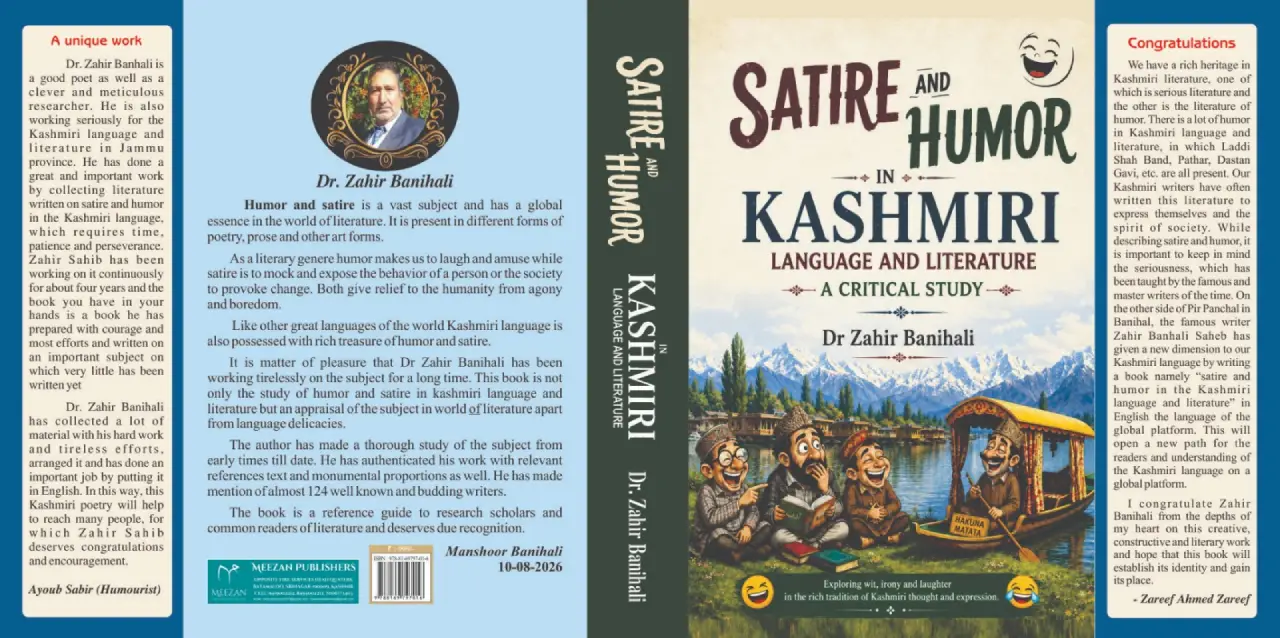
Among them is Dr Ghulam Nabi Mir, better known as Zahir Banihali, a writer, poet and retired veterinary officer who currently heads the Pir Panchal Adbi Forum, Banihal. The author of 21 books in Kashmiri, Urdu and English, Banihali has now produced an ambitious study devoted to an aspect of Kashmiri literary culture that has received comparatively limited systematic attention: satire and humour.
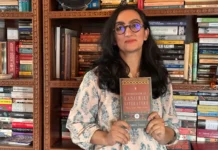
Titled Satire and Humour in Kashmiri Language and Literature: A Critical Study, the 725-page volume has been published by Meezan Publishers, Srinagar. Divided into 26 chapters, the book attempts to examine satire and humour not simply as literary devices but as cultural practices that have evolved through different periods, genres, languages and forms of expression.
The scale of the work is also reflective of Banihali’s wider engagement with the literary history and cultural heritage of Jammu and Kashmir. Before him, writers such as Dr Marghoob Banihali, who authored more than 50 books in Kashmiri, Urdu and English, and Manshoor Banihali, known for his writings on the history, culture and geographical heritage of Banihal, have contributed to the region’s literary profile.
In his introduction to Banihali’s book, noted writer and litterateur Ayaz Rasool Nazki observes that the subject required an unusual degree of commitment and dedication. He describes the volume as a substantial contribution that can serve as a reference for readers and researchers interested in satire and humour in Kashmiri language and literature.
The origins of the book, however, lie in a much more modest academic exercise. In his acknowledgement, Banihali recalls that his interest in undertaking a comprehensive study was sparked by a seminar on humour in the Kashmiri language held at Government Degree College, Banihal, in 2019. Banihali had presented a paper on the subject, which, he recalls, received appreciation from Hajini. He was subsequently encouraged to develop the paper into a comprehensive research-based study.
In the preface, writer Bashir Bhaderwahi notes that by selecting a subject that has received relatively little scholarly attention, Banihali has made a contribution to Kashmiri literary studies.
The opening chapter, Satire and Humour: An Introduction, establishes the conceptual framework of the study. Banihali treats satire and humour as important branches of literature but distinguishes their principal functions. Satire, in his formulation, employs wit, irony, ridicule and laughter to examine government, society, injustice and human behaviour, while humour is primarily associated with amusement, delight and the relief of tension.
The distinction becomes important throughout the book because Banihali does not treat laughter merely as entertainment. In the succeeding chapters, he examines the purpose, utility, significance and social impact of satire and humour. Humour, he argues, can bring joy, relieve tension and strengthen human relationships, while satire can expose hypocrisy, corruption, prejudice, injustice and other human weaknesses.
The book therefore approaches its subject simultaneously through psychological, social, cultural and literary perspectives.
Another chapter examines the sources and origins of the concepts of satire and humour. Banihali draws upon literary theories, philosophical observations and historical references in an attempt to establish how the two concepts have been understood across different traditions.
Chapter VI is among the most extensive sections of the study. Here, Banihali moves beyond Kashmir to examine satire and humour across languages and civilisations. His survey encompasses traditions associated with Ancient Greece, China, Rome and Egypt as well as Arabic, Persian, Pashto, English, Kashmiri, Turkish, Ladakhi and Urdu literature. Through quotations, references and literary examples, he attempts to demonstrate that satire and humour have accompanied human societies across different historical and cultural settings.
The next section brings the discussion closer to the subcontinent. Banihali traces the presence and development of satire and humour in Indian literary traditions and argues that their roots can be found even in early Vedic and Sanskrit literature, dating to roughly 1500–500 BC. Although much of this literature is religious and philosophical, he identifies elements that can be read through the prism of humour and satire.
He then turns to Kashmiri prose and examines the ways in which humorous and satirical elements existed even before the emergence of modern literary forms. The study also classifies different forms of satire, including Horatian, Juvenalian and Menippean traditions.
Chapters X, XI and XII shift the focus to humour, parody and elegance in Kashmiri literature. Banihali traces what he describes as a long history of satire and elegance in the Kashmiri language and literary tradition and discusses a range of forms and expressions, including Hijawa, Hazal, parody, Tasne, Zirki, Thatta, jokes, lying, distortion, mourning and hints.
The study then becomes, in parts, a literary survey of Jammu and Kashmir itself. Chapters XIII and XIV examine the lives, writings and continuing literary significance of poets, scholars, critics and litterateurs from both the Kashmir and Jammu regions.
Among those discussed are Lal Ded, Sheikh Noor-ud-din Noorani, Rasool Mir, Mahmood Gami, Dr Aziz Hajini, Master Zinda Koul, Maqbool Shah Kralwari, Mehjoor and Arjun Dev Majboor. Banihali examines their literary contributions and poetic traditions while also considering the relevance of their work to the contemporary cultural landscape.
The following chapters move from literary texts to performance traditions. Chapters XV, XVI and XVII examine drama, Ladi Shah and Bhand Pather.
For Banihali, these forms are important because Kashmiri literary culture cannot be understood exclusively through written poetry and prose. Storytellers, dramatists and fiction writers have contributed to the development of the culture, while folk performers have carried satire and social commentary into public spaces.
Ladi Shah occupies a particularly distinctive place in this tradition. The performer combines satire, humour, poetry and social commentary in a form that has long been embedded in Kashmiri popular culture. Bhand Pather, meanwhile, represents a centuries-old folk theatre tradition in which dance, music, humour, satire and social criticism come together.
Chapters XVIII, XIX and XX examine Dastaan or storytelling, Rouf and Wanwun, and cartoon and caricature.
Banihali places storytelling within a broad international literary context, noting that it existed as a source of recreation and transmission of experience in societies long before modern forms of entertainment became available. He also examines Wanwun, particularly the songs traditionally sung by women during weddings and festivals such as Eid, Urs and Diwali. These songs, he observes, reflect the circumstances, emotions and experiences of those who perform them.
Cartoon and caricature form another dimension of the study. Banihali treats them as visual forms through which satire, humour and criticism can be combined. The book discusses a number of prominent cartoonists and examines their contribution to this particular mode of expression.
The final chapters include selections of paintings and cartoons, while another chapter lists Banihali’s other published works. The concluding chapter turns to a personal expression of gratitude and devotion to the Holy Prophet Muhammad (ﷺ), with the author describing himself in humble terms as a servant of his servants.
The volume has also received appreciation from noted humourist Ayoub Sabir and historian and cultural activist Zarief Ahmad Zarief.
Taken as a whole, Satire and Humour in Kashmiri Language and Literature: A Critical Study goes considerably beyond a conventional discussion of jokes, comic writing or literary satire. Its ambition is to assemble a broad intellectual history of laughter, ridicule, parody, folk performance and social criticism, while placing Kashmiri literary traditions alongside those of other languages and civilisations.
The book brings together poets, critics, scholars, performers, storytellers, dramatists and cartoonists, examining their work through the larger questions of humour and satire. In doing so, it also opens a wider discussion about the relationship between literature and society: how communities laugh, what they choose to ridicule, how social criticism travels through performance and poetry, and how humour survives as a form of cultural memory.
For students and researchers of Kashmiri language and literature, the volume’s principal significance lies in the breadth of material it attempts to bring together. Its 725 pages represent years of reading, collection and interpretation, while its treatment of literary, folk and visual traditions gives the study an encyclopedic character.
Zahir Banihali’s work thus arrives as both a literary study and a substantial compilation of Kashmiri cultural material. Its value will ultimately be measured through the scholarship and discussion it generates, but the book has already placed satire and humour firmly within the field of serious inquiry into Kashmiri language and literary history.
(This is a web-only book review. A teacher, the author is a writer from Qazigund, Kashmir. Ideas are personal)