SRINAGAR: At a powerful seminar hosted by the Amar Singh Club in Srinagar to mark World Elder Abuse Awareness Day, the Club’s senior most patron Dr Karan Singh delivered a passionate address, urging society to rethink outdated notions around retirement and elderly care. The event, held under the Club’s ‘Common Interest Conversations’ programme, was chaired by senior advocate Zaffar A Shah and witnessed wide-ranging discussions on the societal, emotional, and economic vulnerabilities faced by Kashmir’s ageing population.
Speaking on the Multiple Dimensions of Ageing, Dr Karan Singh, a towering figure in Kashmir’s public life, denounced the age-old norm of retiring people at sixty, saying it was a relic of British-era policies. “Life expectancy has grown unprecedentedly. Why must we let go of productive minds simply because of a number?” he asked. He argued that older individuals often grow sharper with experience and wisdom, and society must harness that. “The tragedy is not only elder neglect. It’s also that crores of our children sleep without proper food, impairing their physical and mental development — all this is interconnected.”
In a philosophical yet pointed talk, he stressed the need for religious grounding, physical fitness, and clean habits from a young age to ensure healthy ageing. “If you poison yourselves in your twenties, you cannot live a healthy life as a senior,” he said. Congratulating the Amar Singh Club for its initiatives like Cashmere Recuperation and Cashmere Cradleland, Dr Singh called the proposals “excellent” and deserving of institutional support.
Adding a legal and social perspective, senior advocate Zaffar Shah warned that elder issues had become serious only because the traditional Kashmiri joint family structure had eroded. “This break has created an ‘empty nest syndrome’,” he said, referring to elderly parents being left behind as children pursue careers abroad. While acknowledging that the law, particularly the 2007 ‘Maintenance and Welfare of Parents and Senior Citizens Act’, provides for support and even punishment for negligent children, Shah said laws alone cannot compensate for the disintegration of familial bonds.
“In Kashmir, a majority of the elderly are retired government professionals — officers, engineers, doctors, teachers. They are rich in wisdom. They must not retire from life,” he said, suggesting the creation of social hubs close to their homes for interaction and peer support. In a note of optimism, he pointed to the newfound emotional closeness between children and grandparents as a valuable avenue for transferring culture, language and maturity. “But something has gone very wrong in our society,” he said, adding that it’s the relationships with neighbours, relatives, and community that serve as the real ‘tonic’ in old age.
Yet, perhaps the most sobering insight came from Dr Zubair Saleem, Chairman of the Moul Mouj Foundation. Backed by hard data, his speech brought to light the economic and psychological realities that many elderly people face in Kashmir. “Only twenty per cent of our elderly patients are financially independent. Thirty-five per cent are semi-dependent, and a whopping forty-five per cent are fully dependent on their adult children, most of whom are themselves financially burdened,” he said.
What sets elder care in Kashmir apart, he argued, is the silent suffering — not just of the elders, but of their families too. “This is not just a problem of neglect, but of circumstantial failure. And the most heartbreaking part is that none of the parents we treat speak against their children. The parents remain parents — sacrificing till the end.”
He redefined elder abuse as not just physical mistreatment, but also emotional and medical neglect. “Not bringing your parents out of their homes, or not knowing what medicines they take — that too is abuse,” he said. He criticised the stigma against Old Age Homes, pointing out that many elders live in isolation and distress even while residing in their own homes. “We refuse to send them to centres that might help, yet don’t provide what they need at home either.”
In a more personal tone, he advised attendees to avoid what he called the ‘three whites’ — white sugar, white salt, and white maida, and replace them with balanced meals and regular physical activity. “Healthy ageing begins with daily habits,” he stressed.
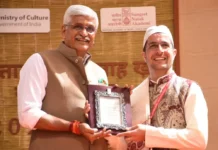
At the close of the programme, Dr Karan Singh honoured two elderly members of the Club, M Amin Kathwari, aged 94, and Dr Abdul Majeed Siraj, aged 92, with the Active Nonagenarian Awards in recognition of their vibrant and engaged lifestyles.
The event, anchored by Amar Singh Club Secretary Nasir Hamid Khan, also saw a renewed call for support to the Cashmere Cradleland proposal — a civil society initiative aimed at addressing eldercare, digital addiction, late marriages, and mental health, among other issues. Khan said that plans to auction the proposed 139-acre site at Tattoo Ground for a “Global Amusement Hub” under the asset monetisation policy would be a cultural betrayal. “The people of Kashmir are already too amused. We need healing, not a circus,” he concluded.