by Dr Farooq A Lone
Kashmir faces a deepening drug addiction crisis, fuelled by conflict, unemployment, changing substances, and organised networks. Experts warn society risks losing another generation unless urgent collective action is taken
Perhaps the gravest problem faced by Kashmir society today is drug abuse and addiction. The figures emerging from recent surveys are not just alarming, they are frightening. They reveal a rampant spread of narcotic drugs and psychotropic substances across Jammu and Kashmir.
For conflict-ridden regions, such social tragedies often deepen existing wounds. After Udta Punjab, the darker reality is that many now speak of Udta Jammu and Kashmir. This menace must be confronted at every level: individual, family, community, clergy, civil society, and government. The time for looking the other way is long past. Denial today means disaster tomorrow.
A Long History
Substance use in some form has always existed in our society. What has changed is the type of substances, the scale of abuse, and, most disturbing, the speed with which addiction now spreads. Organised networks, often backed by vested interests, are deliberately targeting our vulnerable youth.

Half a century ago, the hukka, the hubble-bubble, was an everyday household tradition in Kashmir. It was the first thing to be placed before a guest, almost as an expression of hospitality. The material of the hukka, earthen, aluminium, copper, or intricately carved kandkari jajeer, quietly reflected a family’s social status. Kashmiri Pandits often used elegant brass hukkas with long pipes. Tobacco in the chillam varied in strength, from Lout (light) to Goub (strong), and its quality almost indicated a person’s level of indulgence.
In rural households, many men and women relied on black or brownish tobacco powder called naswar, either taken orally or inhaled. Its use has now drastically come down.
A small number of chronic hukka users eventually drifted toward cannabis (charas), giving rise to the so-called shoda pend, the village corners where habitual users gathered around a shared chillam. Their numbers were small, and their identities were known. Even then, this habit shattered many young lives in every neighbourhood. Adding to the tragedy, superstitious beliefs led some families or individuals to offer charas to the shodas, hoping their wishes might be fulfilled. Shodus cha nazar mokej was a common belief among such people.
The Liquor
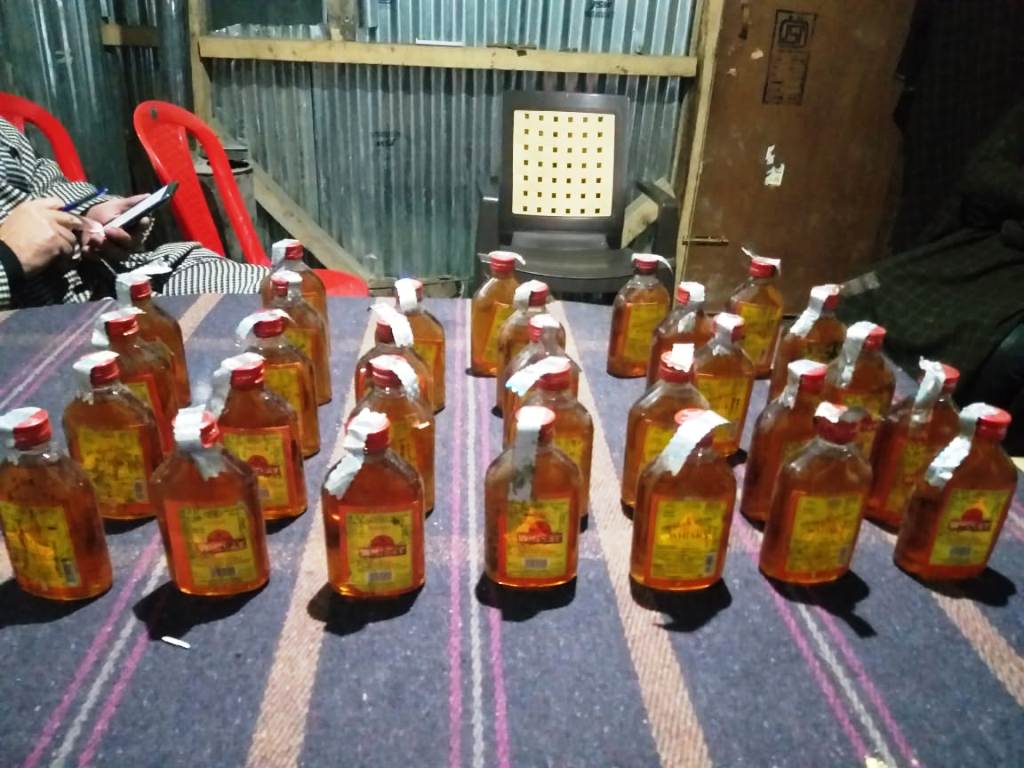
Alcohol consumption, though present, was limited due to its scarce availability. Being known as a sharabi carried a heavy social stigma and could even hamper the matrimonial prospects of one’s children. And yet, we witnessed well-to-do individuals becoming paupers due to alcohol addiction.
Meanwhile, cigarette smoking gained popularity among the affluent youth. Brands became badges of social status, Golden, Cavenders, Four Square, Capstan, Gold Flake, Dunhill, and so on. Public health warnings like Smoking is Injurious to Health and Smoking Causes Cancer no doubt slowly reduced cigarette and tobacco use, but its victims continue to thrive. Today, the traditional jajeer has almost vanished from Kashmiri homes, and cigarette smoking has reduced significantly.
A Massive Shift
But everything changed with the eruption of turmoil in the late twentieth century. The decades of conflict reshaped our psychology, our social fabric, and even our emotional resilience. As turmoil deepened, so did psychiatric issues like stress, depression, obsessive-compulsive disorder, post-traumatic stress, and rising substance use. School-going children, adolescents, and young adults became the most affected.
Senior psychiatrist Dr Mushtaq Margoob was among the first to warn society of a developing crisis. Psychiatrists and community medicine experts noted the growing use of cannabis, brown sugar, heroin, spasmoproxyvon, codeine, sleeping pills like Alprax and Anxit, and a disturbing range of inhalants such as Fevicol, thinner, shoe polish, and varnish. Some children even resorted to inhaling the smell of dirty socks. At first, society was in denial mode, preferring silence over confrontation. But the numbers soon became impossible to ignore. Psychiatrists and other experts started to put it starkly: “We have lost one generation to bullets, and we may lose another to drugs.”
A series of region-wide surveys pointed to two major causes: prolonged conflict and unemployment. But recent studies have added newer triggers like peer pressure amplified by social media, easy availability through various platforms, family breakdowns, rising emotional isolation, and lack of recreational or creative outlets for youth.
The Law Enforcement
In the last few years, law-enforcement agencies have reported unprecedented seizures of heroin and brown sugar, much of it trafficked across borders. The potency of drugs has increased even more than their availability. The rise of intravenous heroin use among young people poses another silent danger: the spread of Hepatitis C and HIV. At isolated places anywhere, one can expect heaps of used syringes, indicating the spread of the menace.
In response, the government has strengthened the Narcotic Drugs and Psychotropic Substances (NDPS) enforcement mechanism, launched mass awareness campaigns, and increased the number of drug-de-addiction centres. Yet, the magnitude of the crisis demands much more.
The Way Out
We must understand that drug addiction is not merely a crime; it is a medical, psychological, and social emergency. Punitive action alone cannot solve it. A multi-pronged strategy is essential.
First, the supply chain must be crushed. Strong border vigilance, strict policing, and community intelligence networks are crucial. The public can play a major role by reporting suspicious activity without fear or stigma.
Second, awareness must begin early. Schools, colleges, mosques, temples, gurudwaras, churches, and local media must regularly engage with young people. Religious leaders, teachers, and parents can collectively build a protective wall of guidance.
Third, rehabilitation must receive serious attention and investment. Some de-addiction centres are doing exceptional work, but far more such facilities, properly staffed, funded, and free of social stigma, are needed across all districts. Addiction is a disease; its victims deserve treatment, compassion, and reintegration.
Fourth, families must reclaim their role. Open conversation at home, non-judgmental listening, and emotional presence can often prevent a young person from seeking solace in substances.

Drug addiction is a curse. Until the chain is broken, victims remain trapped in lifelong bondage. We have all seen families ruined by this scourge. Instead of helplessness, what we need is vigilance. Instead of denial, honesty. Instead of silence, action.
This crisis is not about “them.” It is about us, our children, our society, our collective future. And unless everyone of us recognises the gravity of the moment, we risk losing not just individuals but entire generations.
The time to act is now, this very moment, not tomorrow, as drug addiction is a thief that steals first the dreams, then dignity, and finally life itself. The responsibility is ours, and so is the hope.
(Author is a retired IAS officer who was Chairman of Jammu and Kashmir Public Service Commission. Ideas are personal.)