UN NEWS
Amid reports that Israel’s security cabinet has given the green light to a ceasefire deal with Hamas, the UN World Health Organization (WHO) expressed cautious optimism on Friday over the potentially major boost to aid relief in the devastated enclave.
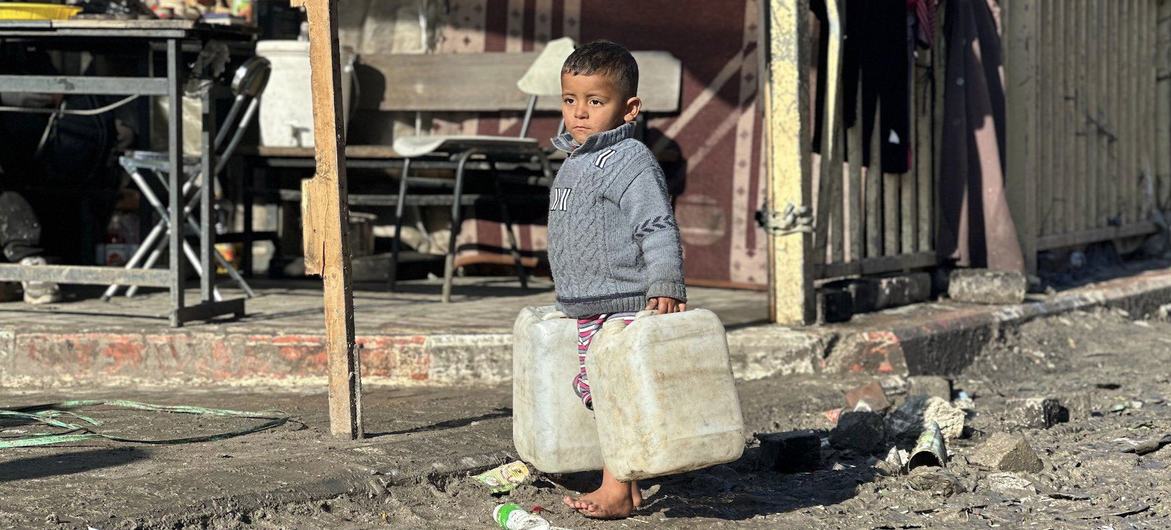
“The target is to get between 500 and 600 trucks in per day over the coming weeks,” said Dr Rik Peeperkorn, WHO representative in the occupied Palestinian territories (OPT).
This would represent “a huge increase” from the 40 to 50 lorries reaching Gaza in recent months and be similar to the level of aid reaching Gaza before war erupted on 7 October 2023, drastically reducing relief deliveries.
Massive challenge
Speaking from Jerusalem, the WHO medic described the ceasefire announcement as “a sign of hope” but warned that the challenge is massive and daunting, because of chronic and severe shortages of food, fuel and medical supplies.
Plans are in place for deliveries to begin on Sunday, the veteran humanitarian said, adding: “We have ordered temporary prefabricated clinics and hospitals which we will integrate into the existing facilities…integrating existing health facilities as part of that, to expand some needed bed capacity, address urgent health needs and health service delivery.”
Humanitarians have repeatedly warned that the crisis in Gaza for civilians has reached catastrophic levels.
More than 46,000 people have been killed, according to the authorities and more 110,000 have been injured – often with life-changing injuries – since the conflict began in October 2023.
The disease is spreading and the risk of famine remains high – needs that it is critical to address, Dr Peeperkorn said, especially when more than 12,000 patients – a third of them children – still await evacuation for specialized care.
Slow progress on evacuations
But the pace of evacuations has been painfully slow. Of 1,200 requests submitted between November and December 2024, only 29 were approved, a rate of just 2.4 per cent, according to WHO.
The WHO and other agencies have stressed the immediate need to provide food, water and medical supplies, but also fuel and spare parts for hospital generators.
Gaza’s healthcare system has been shattered, with only half of its 36 hospitals currently operational. Critical health infrastructure continues to be targeted, according to the UN health agency, which pointed to 664 healthcare attacks since October that have caused deaths among civilians and medical workers, also damaging vital health facilities.
Despite the dire conditions, WHO aims to implement an ambitious 60-day emergency health response plan, once a ceasefire kicks in.
This includes scaling up existing health efforts, setting up temporary medical clinics and restoring essential healthcare services. Efforts will also focus on combating malnutrition, bolstering disease surveillance and providing medical supplies to areas that have been difficult to access until now.
$10 billion needed for health
According to WHO, more than $10 billion is required to restore Gaza’s shattered healthcare system, and substantial international support will be essential to avoid further loss of life and prevent a complete breakdown of the region’s health infrastructure.
In addition to addressing the immediate health needs, broader humanitarian aid is also a pressing requirement. Food, clean water and shelter are fundamental priorities, alongside other crucial medicines and medical equipment, which remain in desperately short supply.
For the moment, international agencies continue to work under difficult and dangerous conditions, hoping that the ceasefire will offer a lifeline to those trapped in the besieged enclave.
Earlier on Wednesday, speaking to reporters at UN Headquarters, António Guterres commended mediators Egypt, Qatar and the United States for their dedicated efforts in brokering the agreement.
“Their unwavering commitment to finding a diplomatic solution has been critical in achieving this breakthrough,” he said.
He called on all relevant parties to uphold their commitments to ensure that the deal is fully implemented.
Ease the suffering
Guterres noted that from the outset of the violence, he has called for an immediate ceasefire and the immediate and unconditional release of all hostages.
Stressing that the priority must be to ease the tremendous suffering caused by the conflict, he said the UN stands ready to support the implementation of the deal and scale up the delivery of sustained humanitarian relief.
“It is imperative that this ceasefire removes the significant security and political obstacles to delivering aid across Gaza so that we can support a major increase in urgent lifesaving humanitarian support,” he said, warning that “the humanitarian situation is at catastrophic levels.”
The Secretary-General called on all parties to facilitate rapid, unhindered, and safe humanitarian relief for all civilians in need.
For its part, the UN “will do whatever is humanly possible, aware of the serious challenges and constraints that we will be facing”. He expects that these efforts will be matched by humanitarian organizations, the private sector and bilateral initiatives.
“This deal is a critical first step, but we must mobilize all efforts to also advance broader goals, including the preservation of the unity, contiguity, and integrity of the Occupied Palestinian Territory,” he said.
Palestinian unity is essential for achieving lasting peace and stability, and he emphasized that unified Palestinian governance must remain a top priority.
“I urge the parties and all relevant partners to seize this opportunity to establish a credible political path to a better future for Palestinians, Israelis, and the broader region,” he continued.
He highlighted the need to end the occupation and achieve a negotiated two-state solution between Israelis and Palestinians.
Before concluding his remarks, Guterres paid tribute to the civilians who have lost their lives in the conflict, including UN personnel and humanitarian workers.
The war in Gaza recently entered a third year.
Israel launched the military campaign following the 7 October 2023 Hamas-led attacks on its territory. Some 1,200 people were killed and 250 were taken as hostages, with around 100 still being held.
More than 46,000 Palestinians have been killed since the conflict began, according to Gaza’s health authorities.
UNRWA threat looms
Gaza has a population of just over two million, and 1.9 million have been displaced, according to the UN Palestine refugee agency, UNRWA, which is housing hundreds of thousands in its schools-turned-shelters.
Commissioner-General Philippe Lazzarini welcomed the ceasefire announcement in a post on social media, noting that “many have been hoping for this moment for the past 15 months.”
“What’s needed is rapid, unhindered and uninterrupted humanitarian access and supplies to respond to the tremendous suffering caused by this war,” he wrote.
The Secretary-General has repeatedly referred to UNRWA as the “backbone” of relief efforts in Gaza. The agency has suffered immense losses as 265 staff members have been killed and its facilities have come under attack.
The ceasefire announcement comes as two Israeli laws aimed at ending UNRWA ‘s operations in the Occupied Palestinian Territory are due to take effect in mere weeks.
“The agency’s collapse – whether immediate or gradual – will only compound the immense suffering in Gaza,” Mr. Lazzarini said earlier on Tuesday at a meeting in Oslo focused on the two-state solution.
The killing ‘must stop’
Officials from across the UN system have also welcomed the news on Gaza, where the end of the war has been long overdue, according to the President of the General Assembly, Philémon Yang.
“The killing and maiming of civilians must stop. All the remaining hostages must be released,” his Spokesperson said in a statement.
“Humanitarian organizations must immediately be given full, safe and unhindered access to deliver badly needed assistance in large scale to the civilian population in Gaza.”
Hope and humanitarian aid
For the Under-Secretary-General for Humanitarian Affairs, the agreement offers much-needed hope to millions whose lives have been devastated by the conflict.
“In preparation, humanitarian agencies have been mobilizing supplies to scale up aid delivery across Gaza”, Tom Fletcher said in a statement from Ukraine, where the UN is assisting millions impacted by Russia’s full-scale invasion.
“We will do our utmost to respond with the ambition, creativity, and urgency this moment demands, despite the significant security and political challenges to our work.”
Remove all barriers
“We urge the Security Council to use its collective voice and weight to insist the ceasefire is sustained, international law respected, and that obstacles to saving lives are removed,” the UN relief chief added.
“We urge Member States to ensure that our humanitarian operations are funded to meet the overwhelming needs. And we call for accountability for the atrocities committed.”
UN at the ready
The top humanitarian official in the Occupied Palestinian Territory, Muhannad Hadi, said the UN stands ready to support the agreement and maximize the scale-up of aid as best it can,
“This deal must allow a significant increase in aid delivery across Gaza so that we and our partners can provide aid to the best of our ability,” he stressed.
Childhood under attack
The head of the UN children’s agency UNICEF, Catherine Russell, said the ceasefire deal is “long overdue” – both for the children and families of Gaza who have endured more than a year of bombardment and for the hostages and their families in Israel who have suffered so much.
She outlined the war’s “horrific toll” on Gaza’s children, with at least 14,500 dead and thousands more injured. Furthermore, an estimated17,000 boys and girls are unaccompanied or separated from their parents, and nearly one million have been displaced from their homes,
Call for accountability
The High Commissioner for Human Rights, Volker Türk, said he was “hugely relieved by the news of the first phase of a ceasefire in Gaza, and it is imperative that it now holds.”
He emphasized the need to pursue accountability and justice for the grave violations and abuses that have been committed.
“Those responsible for the heinous acts of 7 October, the subsequent unlawful killings of civilians across Gaza, and for all other crimes under international law must be held to account,” he said.
Furthermore, the rights of victims to full reparations must be upheld, he added, noting that “there is no true way forward without honest truth-telling and accountability on all sides.”