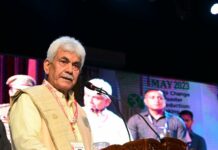
SRINAGAR: The Holy Relics of Lord Buddha, among the most sacred treasures preserved by India, have returned home after a historic week-long exposition in the Republic of Kalmykia, Russia. Jammu and Kashmir Lieutenant Governor Manoj Sinha, who led the Indian delegation to bring back the relics, said the event had not only deepened the civilisational bond between India and Russia but also symbolised “a spiritual homecoming for the Buddhist people of Kalmykia.”
The Holy Relics, which were taken to Elista, the capital of Kalmykia, are revered fragments of the mortal remains of Gautama Buddha, enshrined in India’s National Museum, New Delhi. These relics are part of the globally significant collection discovered during archaeological excavations at Kapilavastu and Piprahwa in Uttar Pradesh in the late nineteenth century. Recognised as a National Treasure of India, they are rarely taken out for exposition abroad, making the Kalmykia visit a moment of profound historical and spiritual significance.
The sacred relics were enshrined for public veneration at the Geden Sheddup Choikorling Monastery, also known as the “Golden Abode of Shakyamuni Buddha.” Over ninety thousand devotees from across Russia and neighbouring regions visited the monastery during the exposition to pay their homage. The event, held under the Ministry of Culture’s aegis, was organised in collaboration with the International Buddhist Confederation (IBC), the National Museum, and the Indira Gandhi National Centre for the Arts (IGNCA).
“The Holy Relics of Lord Buddha are considered the Buddha himself. Their exposition in Kalmykia is not only a gesture of faith but a bridge of friendship and shared spiritual values between our two nations,” Lieutenant Governor Manoj Sinha said after offering prayers and presenting a khatak — the traditional Buddhist ceremonial scarf — before the relics.
He lit a lamp at the monastery, offered prayers before Bakula Rinpoche’s image, and presented a Kashmiri shawl to Shajin Lama, who blessed the Indian delegation. “The fondness and devotion shown by the people of Kalmykia and other regions of Russia towards the relics is a rare gesture that has left an indelible mark on our hearts,” Sinha said.
The Lieutenant Governor emphasised that the event revived the enduring legacy of the 19th Kushok Bakula Rinpoche — the eminent Buddhist monk and diplomat from Ladakh who was instrumental in rekindling the Buddhist faith in Mongolia and the Russian regions of Buryatia, Tuva, and Kalmykia. “This exposition has deepened our spiritual connection and reminded the world of the unifying power of Buddha’s message of compassion, wisdom, and non-violence,” Sinha said.
The sacred relics had been taken to Kalmykia by a high-level Indian delegation led by Uttar Pradesh Deputy Chief Minister Keshav Prasad Maurya, accompanied by senior monks and officials from the Ministry of Culture. The exposition marked the first-ever display of Buddha’s relics in the Russian Republic and was viewed as a powerful symbol of India’s growing cultural outreach.
During his visit, Sinha also met Batu Sergeyevich Khasikov, Head of the Republic of Kalmykia, and discussed future collaborations in cultural and spiritual exchange. He thanked the Kalmyk leadership for facilitating the exposition and announced that an India Festival would be organised in Kalmykia in April 2026 to further strengthen bilateral cultural ties.
The Lieutenant Governor described the return of the relics as a “moment of sacred fulfilment.” In a post on X, he wrote: “Holy Relics of Lord Buddha are back home after week-long exposition at Kalmykia, Russia. The exposition underscored our commitment to foster mutual understanding, build trust and cooperation, and create lasting connections through shared spiritual experiences. Holy Relics are back home, but Buddha’s enduring presence in Kalmykia will continue to guide seekers for their own awakening.”
As India and Russia approach the 80th anniversary of their diplomatic relations in 2027, the journey of the Holy Relics has emerged as a defining moment of cultural diplomacy — reaffirming the timeless civilisational bond between the land of the Buddha and the only Buddhist republic in Europe.