by Dr Mehak Majeed and Dr Sabreen
Lal Ded pioneered a role in shaping Kashmiri Sufi mysticism, transforming poetic discourse through spiritual inquiry, linguistic innovation, and enduring philosophical influence across centuries.
Big changes often establish themselves as a certain expressed discomfort with the status quo. Quite often, the person or people initiating structural changes like these do not themselves know what majesty is being shaped, with the potential of altering the ideologies of people across generations to come.
One such change in Kashmir shaped itself with the very birth and existence of Lal Ded in the 14th century. Broadly accepted as a Sufi-mystic poetess, Lal Ded pioneered a poetic movement in Kashmir that fundamentally established a school of mystic Sufi thought. Lal Ded is identified as the first medieval mystic poetess of Kashmir. Her contribution added value to the Kashmiri language, not known before. It was her pioneering work that anchored the poetic discourse of the land for years to come.
While the poetic discourse of the land could have taken any genre, be it adorning the beauty of one’s beloved, love for the land, or constructs of human thinking, it was Lal Ded’s mystic anchoring of the discourse that paved the way for Sufi-mystic poetic expression in the region.
Woman Led Tradition
Being pioneered by a woman, this poetic tradition has influenced people across the length and breadth of the region. It was Lal Ded’s way of looking at God above and the human form below that altered the poetic discourse of the land, from adorations of feminine beauty to the human being as a form seeking the divine light of the universe.
Sir George Abraham Grierson, in his celebrated work Linguistic Survey of India (LSI), refers to Lal Ded as the “wandering ascetic.” Her work is recognised as pioneering in the region. It is established that the works of Lal Ded anchored the poetic discourse of Kashmir, which went on to take multiple forms of Sufi-mystic arrangements.
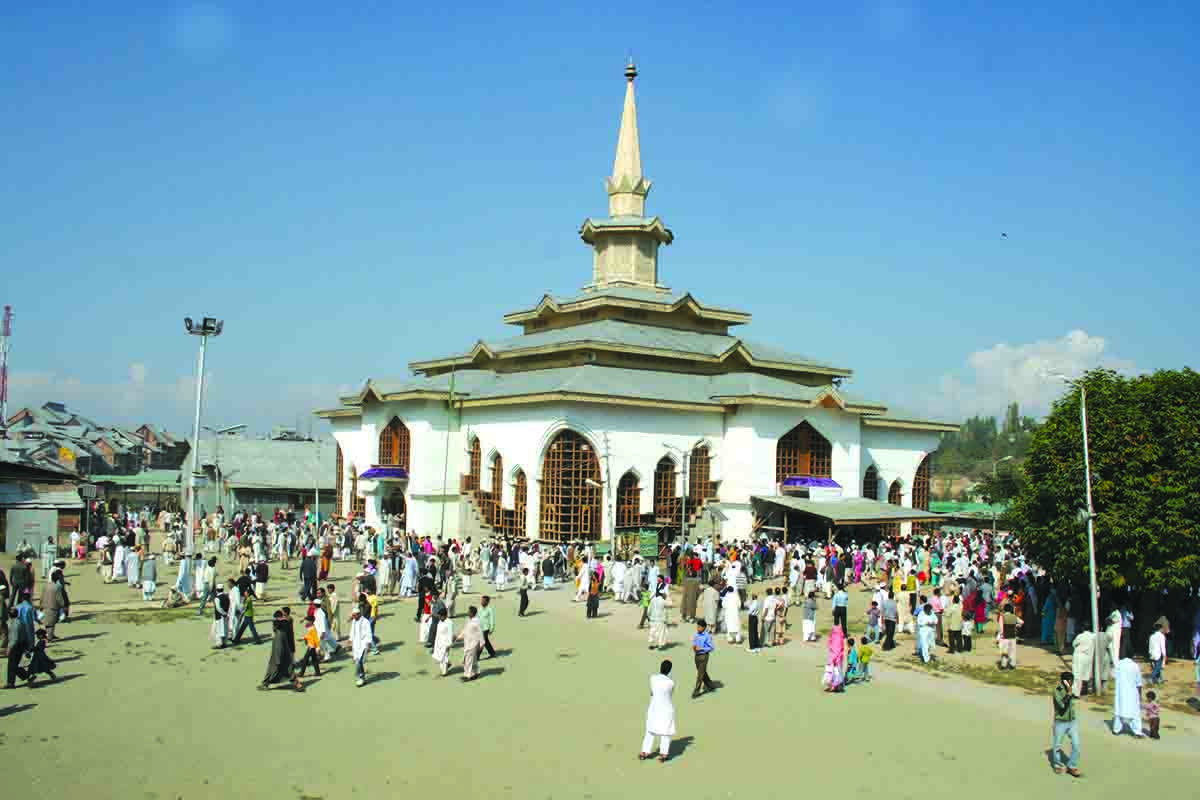
To pay tribute to Lal Ded for choosing to focus the Kashmiri poetic genre on mysticism, Shaikh Nur-ud-Din Nurani writes:
That Lalla of Padmanpur, she drank
Her fill of divine nectar
She was indeed an Avtar of ours.
O God, grant me the same boon!
Thoughts like these were carried forward by multiple poets of repute who followed. Each wished to contribute a minuscule word or verse toward the furtherance of Sufi mysticism. They tried, but always confessed that nothing came close to Lal Ded’s understanding of divinity.
Shams Faqir, in his 19th-century work, while paying tribute to Lal Ded’s intellect and understanding of the universe in its absolute form, says:
Lalla merged her Prana in the transcendent;
For while she went ostensibly to bathe
At the sacred shrine of Shurayar ghat,
With a leap and bound she jumped across
To where there is none other than God.
Some of her work was translated by Bakhshar Razdan in the 18th century. On understanding the intellectual depth of her work and vision, Razdan took it upon himself to familiarise the world with a unique yet powerful way of connecting humanity with God. Her aphorisms were carefully analysed through her four-stanza verses known as Vaakhs.
Eternal Transition
Vaakhs continue to inspire people across the land. Quite often, they are quoted in everyday conversation. One of the most important Vaakhs, laying the foundation of her Sufi-mystic tradition, states:
Asthen ay te gatchun gatche
Pakun gatshe den kiho rath.
Yorai ay ta turi gatshun gatshe;
Kenh na-ta kenh na-ta kenth na-ta kyah?
We have been coming into existence continuously,
and we cannot escape death;
It is inevitable to move on this path night and day.
We ought to go back to the place from where we came.
There must be something in this;
Otherwise, what is all this?
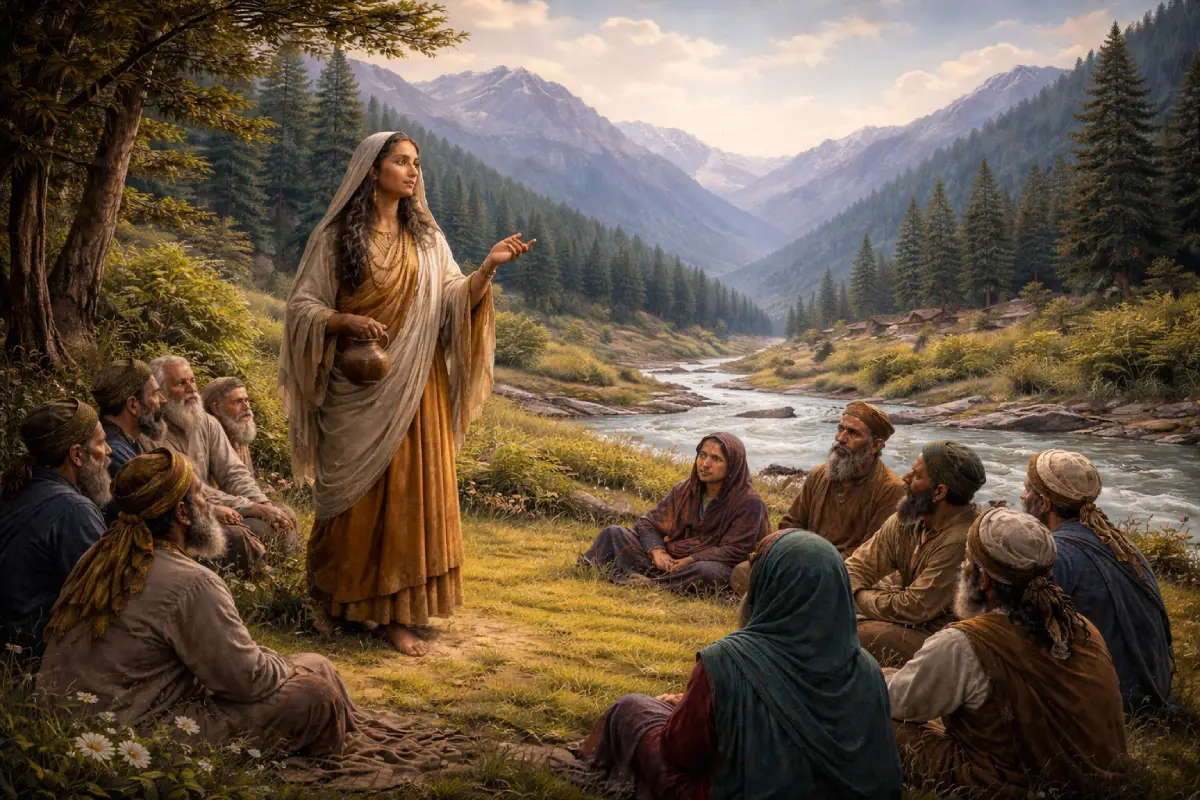
In these verses, the poetess expresses her fundamental wish for eternal transition. These lines have inspired common people, mystics, and poets alike across centuries. R. C. Temple observes that Lal Ded uses words with a plain yet esoteric meaning throughout her work. This characteristic, he notes, is unique and identifies it as the primary reason Lal Ded holds the position of being the starting point of the Sufi-mystic movement in Kashmir.
In one Vaakh, she says:
Damah dam kormas damanhale
Prazalyom daph ta naneyem zath
Andarium prakash nebar tshotum
Gati rotum ta karmas thaph.
For a moment, I suppressed the bellows of my respiration,
Lo and behold! The lamp lit up brightly, and I realised myself!
The light within me sparkled out;
In the encompassing darkness, I seized it and held it tightly.
Adding to the depth of the above verses, she expresses:
Dihchi lari dari-bar troprim,
Prana-tsur rotum ta dyutmas dam;
Hradayichi kuthari andar gandum.
Omaki cobuka tulimas bam.
Closing fast the windows and doors of the house of my body,
I caught hold of the thief, prana, and barred him in;
Tying him hand and foot inside the closet of my heart,
I lashed him hard with the whip of Om.
To culminate the idea under discussion, in another mystic Vaakh she says:
Lal boh tsayas savaman bagabaras,
Vuchum Shivas shakt milth ta vah!
Tati lai karmas amritsaras
Zindai maras ta me kari kyah.
I, Lalla, willingly entered through the garden gate,
There, O joy! I found Shiva united with Shakti;
There and then, I was absorbed, drinking at the lake of nectar,
Immune to harm am I, dead to the world though alive within.
New School of Thought
While being the central figure of a new school of thought in Kashmiri poetic discourse, her style of writing upheld elements from the Sanskrit literary tradition of the land. Alliteration, metaphors, lyricism, and poetic diction merge into one, forging foundations that have shaped the ideas of millions across generations.
Had Lal Ded not made these contributions at that critical juncture in history, literary philosophers doubt whether the rich Sufi tradition indigenous to Kashmir would have existed at all. On the contrary, Kashmiri Sufi discourse has been ever-growing, ever-evolving, and continues to flourish, owing to the anchoring Lal Ded provided in the 14th century.
(The authors are affiliated with the IUST and work at the intersection of gender, region and feminist discourse. Ideas are personal.)