by Mohammad Arfat Wani
Roup Reshi’s life of ascetic devotion, miracles, and compassion shaped Kashmir’s spiritual legacy and continues guiding faith-driven hearts today.
Kashmir, also referred to as the paradise on earth, is a place where nature’s majesty rubs shoulders with the spirituality of its depths. Its white-capped mountains, meandering streams, and verdant valleys are not just marvels of creation but also quiet testaments to the footprints of saints who trod this earth with hearts aglow with divine love. The Valley has been blessed throughout history with great friends of Allah whose presence transformed its soil into a sanctuary of belief.
Among the myriad saints who illuminated Kashmir, figures such as Hazrat Amir Kabir Mir Syed Ali Hamadani, Hazrat Sheikh Nooruddin Noorani, popularly known as Nund Reshi, Baba Naseebuddin Ghazi, Baba Shakuruddin, Baba Reshi, and Hazrat Zainuddin Wali light up the spiritual galaxy of the region. Among these towering personalities, the name of Hazrat Roup Reshi shines with a unique brilliance, as his life stood as an ideal reflection of piety, humility, and nearness to Allah, and his miracles continue to inspire belief in millions of hearts.
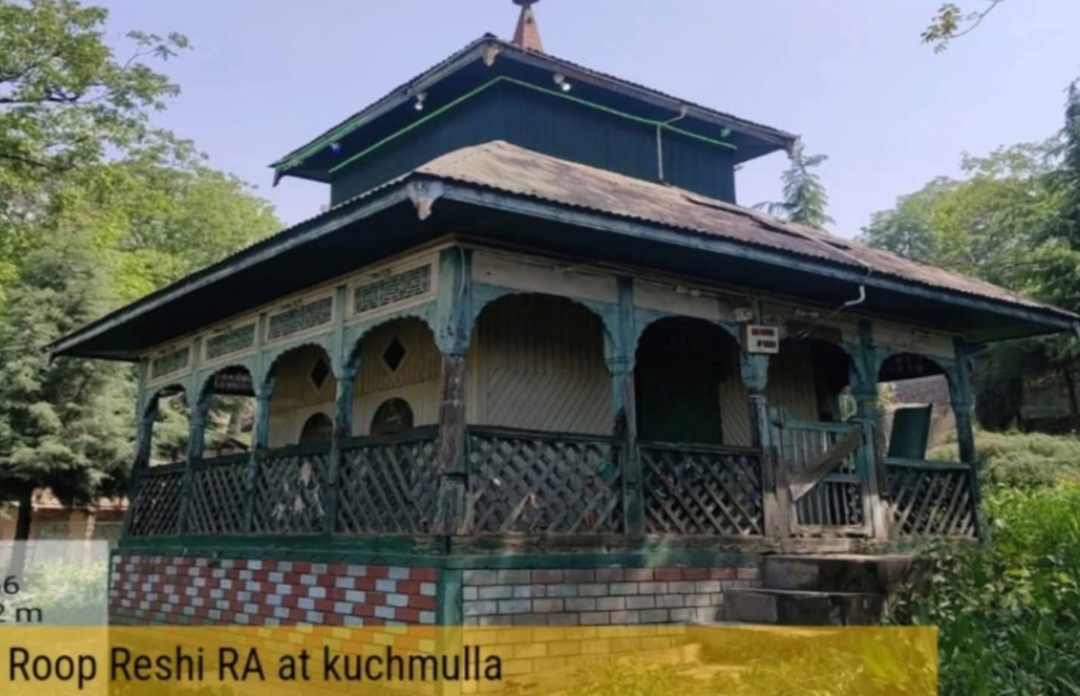
The sacred shrine of Hazrat Roup Reshi is located in the peaceful village of Kuchmulla in Tral, where each stone bears the fragrance of his memory and every gust of wind whispers blessings from his aura. Being a village dweller, I have witnessed how people from far and wide arrive at his shrine with hope in their eyes and prayers in their hearts, and depart with an inner peace that defies expression. Historical records state that there were two saints by the name of Roup Reshi: one resting at Habba Kadal in Srinagar and the other in Kuchmulla. Both were contemporaries of Baba Naseebuddin Ghazi and were highly revered by the people of their time.
Hazrat Roup Reshi was born in the village of Largam, located barely two kilometres from Kuchmulla. From his early childhood, he renounced worldly pleasures and immersed himself in the remembrance of Allah. Though he lived as a shepherd, his true occupation was day-and-night zikr. He followed the Owaisi path, guided directly by divine wisdom from Allah without an earthly teacher, a rare spiritual distinction granted only to the purest souls. As a member of the Rishi order, he rejected luxury and abstained from meat, fish, and eggs throughout his life. Even today, during his Urs, the people of Kuchmulla honour this practice by refraining from these foods in remembrance of his life of austerity and devotion.
Historical accounts, including Tarikh-i-Hassan, describe his prolonged periods of spiritual retreat in the Kali Paadin forest near Largam, where he would fast for months and remain engrossed in worship, sometimes subsisting for days on the bare minimum. His devotion to Hazrat Sheikh Nooruddin Noorani was profound; he memorised and recited the Sheikh’s poetry to spread the message of divine love. His miracles remain deeply etched in Kashmir’s collective memory.
One such well-known account concerns the Sheikh family of Kuchmulla, who are said to have embraced Islam through his blessings. Their ancestor, Ziyon, a blind Hindu, according to the local legend, was brought before the saint. Hazrat Roup Reshi instructed the boy’s mother that if she allowed her son to accept Islam, his eyesight would be restored. Upon her consent, by the will of Allah, the blind man regained his sight, embraced Islam under the name Sheikh Inayatullah, and settled in Kuchmulla. His descendants continue to reside there, proudly preserving their lineage. Over time, the Sheikh family rose to prominence as Zaildars, influential landlords and respected community leaders.
Hazrat Roup Reshi spent his final days in Kuchmulla, where he attained union with his Creator. Tradition holds that when the people of Largam arrived to claim his blessed body, the residents of Kuchmulla had already laid him to rest in their land. His shrine now stands there, surrounded by an ancient graveyard and a mosque, both silently bearing witness to his eternal presence. His Urs is observed annually on 26 Safar with deep reverence. It is strongly believed that during this period, meat, fish, and eggs should not be cooked, as folklore recounts that when a family once violated this custom, their kitchen caught fire. Even today, stories are narrated with reverence that a lion visits his shrine on Thursday nights, bowing in devotion, a living symbol of his spiritual stature.
In 1983, Roup Islamia High School was established in Kuchmulla in his honour, serving as a centre of learning for generations and a dignified remembrance of his name. His life imparted lessons of selflessness, chastity, and unwavering love for Allah, teaching humanity that true greatness lies not in wealth or power but in devotion and sincerity. His teachings remind us that love and trust are the true treasures of existence.
In an age increasingly overwhelmed by materialism and spiritual neglect, the teachings of Hazrat Roup Reshi continue to shine like a guiding lamp, illuminating lost hearts and leading them towards the light of Allah. His mausoleum remains a sanctuary where hearts find peace, prayers find answers, and souls experience the warmth of divine love. His legacy urges humanity to cleanse the heart of hatred, embrace humility and compassion, and live a life of faith and service. The air of Kashmir still carries the fragrance of his grace, and as long as this Valley endures, his name will continue to shine as a beacon, illuminating believers’ hearts and reminding them that the true path to success is the one that culminates in Allah.
(Author is a nursing student. Ideas are personal.)