SRINAGAR: India on Friday said it was “closely following” the newly signed Makkah Joint Defence Agreement between Pakistan, Saudi Arabia and Turkey, as New Delhi began assessing the implications of the trilateral security arrangement amid a rapidly changing security environment in West Asia.
Ministry of External Affairs spokesperson Randhir Jaiswal, responding to questions at the weekly media briefing, said India was closely monitoring the development.
“This is also a development that we are closely following, and we shall keep you updated,” Jaiswal said.
Delhi’s response came hours after Pakistan, Saudi Arabia and Turkey signed the defence agreement in Makkah. The pact commits the three countries to treating an armed attack against any one of them as an attack against all three.
Jaiswal was also asked about reports of Somalia entering into a security pact with Pakistan. “We continue to closely follow the developments between Somalia and the other country that you mentioned,” he said.
The Makkah agreement brings together three influential Muslim-majority countries at a time of heightened tensions across West Asia. The region has been affected by the war involving Iran, Israel and the United States, attacks on Gulf infrastructure and disruption to maritime and energy routes.
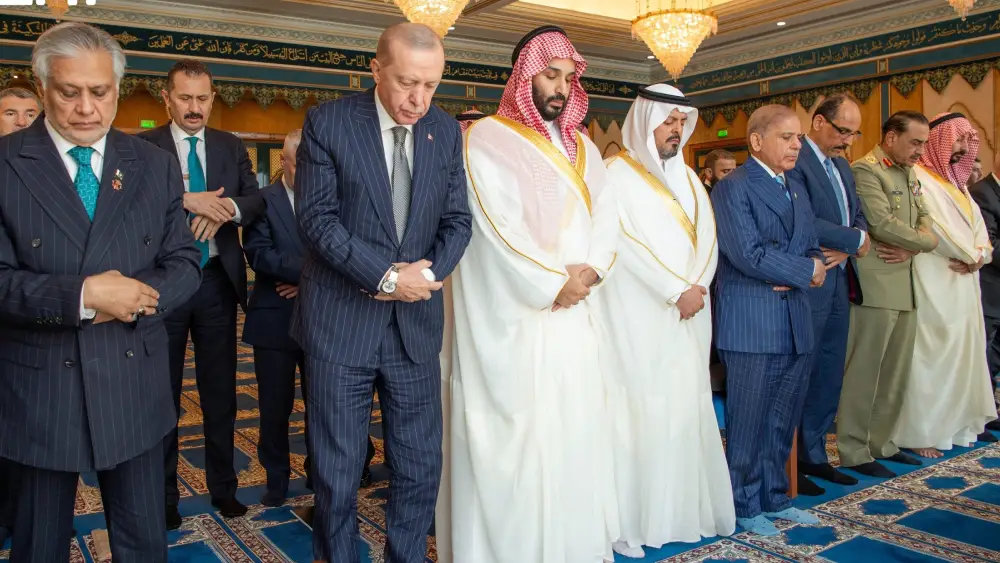
The agreement was signed in Makkah by Saudi Crown Prince Mohammed bin Salman, Turkish President Recep Tayyip Erdogan and Pakistan Prime Minister Shehbaz Sharif.
According to the joint statement issued after the meeting, the agreement is intended to strengthen collective deterrence against aggression. It states that an armed attack against any one of the three states “shall be regarded as an attack against them all”.
The agreement also provides for greater defence cooperation among the three countries.
However, the pact does not spell out specific military obligations or operational commitments. It remains unclear what form military assistance would take if one of the three countries came under attack.
Turkey has described the arrangement as purely defensive. Turkish Vice President Cevdet Yilmaz said the agreement was not directed against any particular country.
Turkish presidency communications director Burhanettin Duran said the agreement would strengthen the shared security and collective deterrence of the three countries and contribute to regional peace and stability.
A Turkish official said the pact did not replace or cancel any existing bilateral or multilateral agreements the three countries have with other states or organisations.
The official also said the arrangement could remain open to other regional countries. The agreement is also expected to promote cooperation in defence industries and military coordination.
For Saudi Arabia, the agreement comes amid growing concerns over the security of its territory and critical infrastructure.
The kingdom has come under attack during the conflict involving Iran and its regional allies. Saudi oil facilities and other critical infrastructure have been targeted, while maritime routes and energy shipments have faced growing risks.
The attacks have also raised questions over the reliability of existing security arrangements in the Gulf.
Saudi Arabia has consequently been seeking to diversify its defence partnerships. The kingdom insisted that the new agreement does not constitute the creation of a military axis or a sectarian bloc. It also said the pact was not connected to nuclear ambitions or an arms race.
The Saudi position was that the agreement was aimed at developing sustainable and self-reliant defence capabilities. It would also not come at the expense of Saudi Arabia’s existing strategic relationships in the Gulf, the Arab world or internationally.
The Makkah agreement builds on a bilateral defence arrangement signed by Pakistan and Saudi Arabia last year. That agreement also provided that an attack on one country would be treated as an attack on the other.
Pakistan has deployed troops, fighter aircraft, drones and an air-defence system to Saudi Arabia, according to the reports.
The agreement brings together countries with very different strategic and military capabilities. Pakistan is the only nuclear-armed country among the three. Turkey has NATO’s second-largest military and a rapidly expanding defence industry. Saudi Arabia is one of the world’s largest oil exporters and has considerable economic and regional influence.
The agreement has generated speculation about the emergence of an “Islamic NATO” or a broader Muslim security alliance.
Officials from the three countries have sought to play down that interpretation.