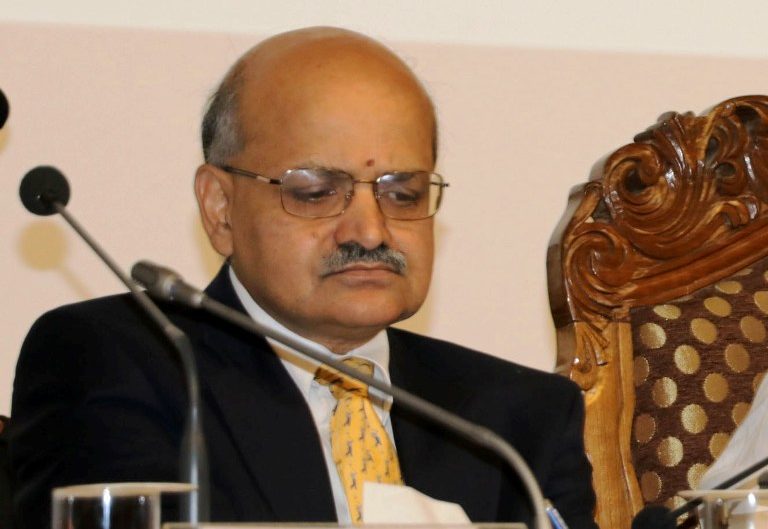
SRINAGAR: India is now the fourth-largest economy in the world, overtaking Japan in terms of nominal GDP, according to a statement made by NITI Aayog CEO BVR Subrahmanyam. Speaking at a public event on May 24, Subrahmanyam declared, “We are the fourth largest economy as I speak. We are a USD 4 trillion economy. This is not my data. This is IMF data. India today is larger than Japan.”
The announcement, made with much optimism, follows the International Monetary Fund’s (IMF) April 2025 World Economic Outlook report, which projects India’s GDP will reach USD 4.19 trillion in 2025, marginally ahead of Japan. However, the IMF has not yet officially declared that the transition has already taken place. The IMF estimates that India will overtake Japan in nominal GDP sometime during 2025, suggesting Subrahmanyam’s remarks may be slightly ahead of the actual data.
Until 2024, India ranked as the fifth-largest economy globally. With this projected shift, only the United States, China, and Germany remain ahead. Subrahmanyam noted that if India maintains its current trajectory, it could become the third-largest economy within the next 2.5 to 3 years.
Union Minister Dr Jitendra Singh also linked this economic milestone with India’s recent military posture, specifically referencing the success of Operation Sindoor. Addressing civil society members in Jammu, Singh said, “In a rapid stride and giant leap towards Viksit Bharat, India’s economy has overtaken Japan, rising from rank 5 to rank 4. This has happened soon after and despite Operation Sindoor.”
Singh argued that the economic achievement has dismantled the narrative created by sceptics who feared the operation would trigger financial instability. “The steady and consistent rise in India’s economic graph continued the same trend while the Pakistan economy has gone for a toss,” he said, attributing this resilience to strategic planning under Prime Minister Narendra Modi.
Industrialist Anand Mahindra, commenting on the development, called it a “dream come true.” Reflecting on his time in business school when the idea of surpassing Japan seemed audacious, he said, “It is no small achievement.” However, Mahindra urged the nation to focus next on raising per capita income, stating, “India’s next leap must be in per capita GDP, not just overtaking Germany.”
India’s per capita income has more than doubled in the past decade, from USD 1,438 in 2013-14 to an expected USD 2,880 in 2025. Yet, the gap between India and the world’s top economies remains significant. The United States, which retains the top spot, is projected to have a GDP of over USD 30 trillion in 2025, nearly seven times India’s estimated GDP. China and Germany follow with GDPs of approximately USD 19.2 trillion and just above USD 4.2 trillion, respectively.
The IMF predicts India’s economy will grow at 6.2 per cent in FY26, a slight dip from its earlier estimate of 6.5 per cent, citing global trade tensions and geopolitical uncertainty. Despite this, the growth outlook remains robust, especially due to private consumption, particularly in rural areas.
India’s rise from being part of the so-called ‘fragile five’ economies a decade ago to now being among the top four has been chronicled in NITI Aayog’s approach paper Viksit Rajya for Viksit Bharat @ 2047. The paper envisions India becoming a USD 30 trillion economy by 2047, categorising this transformation through six strategic building blocks, including empowered citizens, innovation leadership, and robust governance.
Meanwhile, the Union Government has been engaging with non-political voices to shape public perception and policy, as seen in Dr Jitendra Singh’s interaction with professionals from various fields in Jammu. Participants voiced both support and concerns, particularly over the perceptional impact of recent security incidents such as the one in Pahalgam, urging coordinated efforts to restore confidence in the region’s economic and tourism prospects.
Singh said that such engagements will continue to ensure inclusive development, particularly in Jammu and Kashmir, and reaffirmed the government’s commitment to broad-based economic growth.
While India’s official climb to fourth place may still be in transition according to global metrics, the country’s growing confidence, both economically and diplomatically, is already shaping domestic and international narratives.