SRINAGAR: Israel intensified its campaign against Iran’s leadership on Wednesday, with Defence Minister Israel Katz announcing the killing of Iranian Intelligence Minister Esmail Khatib in an overnight strike, a development later confirmed by Iranian state television. The assassination marks one of the most high-profile targeted killings in the ongoing war and signals a deepening escalation between the two adversaries.
Katz said “significant surprises are expected throughout this day on all fronts,” hinting at further Israeli operations. Iranian President Masoud Pezeshkian condemned the killing as an “unfair assassination.” The strike follows Israel’s killing a day earlier of senior Iranian figures, including Ali Larijani and General Gholam Reza Soleimani, head of the Basij paramilitary force.
Shortly after the assassination, Iran issued fresh threats to target oil and gas infrastructure across the Gulf. According to AP and Reuters, Iranian state television warned that facilities in Saudi Arabia, the United Arab Emirates and Qatar, including refineries, petrochemical complexes and gas fields, could be struck “in the coming hours.”
The warning followed reported attacks earlier in the day on Iran’s own energy installations, including parts of the South Pars gas field, one of the world’s largest natural gas reserves.
Iran’s threats included specific references to Saudi Arabia’s Samref refinery and Jubail petrochemical complex, the UAE’s Al Hosn gas field, and key Qatari facilities such as Ras Laffan and Mesaieed. Tehran has increasingly targeted energy infrastructure in the Gulf since the war began on February 28, in what analysts describe as a strategy to disrupt global oil markets and pressure Washington.
Brent crude prices surged past $100 per barrel, rising more than 40–50 per cent since the conflict began, reflecting mounting fears of supply disruptions. Reuters reported a further intraday jump of over 6 per cent, nearing $110 per barrel, as markets reacted to the latest escalation.
Qatar, which shares the South Pars field with Iran, described the reported attack as a “dangerous and irresponsible” escalation, warning it could destabilise global energy supplies. The country has already shut down its liquefied natural gas production, cutting roughly 20 per cent of global LNG output.

The crisis has also intensified around the Strait of Hormuz, a critical maritime chokepoint through which roughly one-fifth of global oil passes. Iran has continued to restrict shipping traffic, raising concerns of a broader energy crisis.
While Tehran insists the waterway remains open, it has limited access to vessels linked to the United States and its allies. Gulf states have begun diverting exports through alternative pipelines, including Saudi Arabia’s East-West pipeline and the UAE’s Habshan-Fujairah route, according to international energy reports.
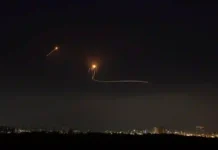
On the battlefield, Iran launched multiple missile barrages into Israel, including weapons equipped with cluster munitions. Israeli officials said at least two civilians were killed near Tel Aviv when one such missile evaded interception and dispersed bomblets over a residential area.
Cluster munitions, which release multiple submunitions mid-air, are banned by over 100 countries but not by Iran or Israel. Military analysts cited by Reuters said such weapons complicate interception efforts, as they must be destroyed before dispersal.
Israeli authorities also reported damage to infrastructure, including a major train station, while debris from intercepted missiles caused severe damage to three private aircraft at Ben Gurion Airport.
In a separate development raising international concern, a projectile struck near the Bushehr nuclear power plant in southern Iran. The International Atomic Energy Agency (IAEA) confirmed the incident but said no damage or radiation leak had occurred.
IAEA chief Rafael Grossi urged “maximum restraint,” warning that attacks on nuclear facilities could risk catastrophic consequences. Iranian and Russian officials said the impact caused no injuries or structural damage.
The conflict is rapidly expanding beyond Iran and Israel. In Lebanon, Israeli airstrikes targeting Hezbollah positions have intensified. According to Reuters, over 900 people have been killed and more than one million displaced since early March.
The United Nations Children’s Fund (UNICEF) reported that at least 111 children have been killed and over 300 wounded in Lebanon in just over two weeks, describing the toll as equivalent to “a classroom of children every day.”
In Iraq, attacks on U.S. facilities have continued, while Iranian gas exports to Iraq have been halted, affecting up to 40 per cent of the country’s energy supply.
Diplomatic efforts remain stalled. Iran has called on the BRICS bloc to intervene, while India, currently chairing the grouping, has urged restraint without taking sides, according to DW.
Meanwhile, the United Nations Security Council adopted Resolution 2817, calling for an immediate cessation of hostilities and protection of civilian infrastructure, though divisions among major powers persist.
As the war enters its third week, analysts warn that continued escalation, particularly targeting energy infrastructure and shipping routes, could trigger a prolonged global economic shock, with oil markets, supply chains and regional stability all at risk.