SRINAGAR: A rapidly widening military confrontation between the United States, Israel and Iran intensified Sunday, with retaliatory missile and drone strikes hitting Israel and several Gulf states, as Washington confirmed three US service members were killed during operations inside Iran.

The escalation follows the killing of Iran’s Supreme Leader, Ayatollah Ali Khamenei, in a joint US-Israeli strike on Saturday. Iranian state media confirmed his death hours after the attack, which also targeted senior officials in Tehran.
The US Central Command (CENTCOM) said three American service members were killed in action and five others seriously wounded as part of “Operation Epic Fury.” Several additional personnel sustained minor injuries.
In a statement posted Sunday morning, CENTCOM said major combat operations are continuing and further details would be withheld pending notification of next of kin.
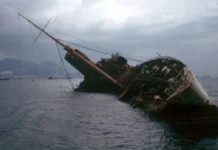
Separately, CENTCOM reported that US forces struck an Iranian Jamaran-class corvette in the Gulf of Oman during the opening phase of operations. The vessel was said to be sinking at a pier in Chah Bahar. Iran has not confirmed the strike.
Iran launched what Israeli officials described as “dozens” of missiles toward Israeli territory. In the town of Beit Shemesh, at least nine people were killed when a missile struck a synagogue where civilians were sheltering, according to Israeli police and emergency services.
Israel’s Magen David Adom confirmed 28 injuries in the Beit Shemesh strike. In the Tel Aviv region, a woman died from wounds sustained during the barrage. Total Israeli fatalities since hostilities began have reached at least 10.
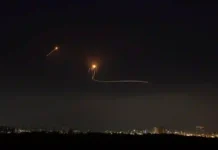
Residents in Tel Aviv reported multiple explosions overnight, attributed either to missile impacts or interceptions by Israel’s air defence systems.
The Israeli military said it had carried out a new wave of strikes on Tehran on Sunday, targeting what it described as the “heart” of the Iranian capital after claiming to have dismantled key air defence systems in western and central Iran.
Iran extended its retaliation beyond Israel, launching missile and drone strikes at U.S. military installations and Gulf countries.
The United Arab Emirates said three people were killed and 58 injured in Iranian attacks. According to the UAE Defense Ministry, 165 ballistic missiles and 541 drones were launched toward the country since Saturday, with the majority intercepted.
Kuwait reported one death and more than 30 injuries. Its military said 97 ballistic missiles and hundreds of drones had been detected and intercepted since the escalation began.
Shipping routes were also disrupted. Maritime authorities reported two vessels attacked in the Strait of Hormuz, a strategic chokepoint through which roughly a fifth of global oil trade passes. Global shipping giant Maersk said it had paused traffic through the Suez Canal and Bab el-Mandeb Strait, rerouting vessels around the Cape of Good Hope.
Iranian President Masoud Pezeshkian announced that a temporary three-member leadership council has assumed the duties of supreme leader until a successor is selected. He said state institutions remain intact despite the strikes.
Iran’s Foreign Minister Abbas Araghchi said the country’s military capability remained unchanged and vowed continued retaliation against Israeli and US targets.
Iran’s parliamentary speaker, Mohammad Bagher Ghalibaf, warned in a televised address: “You have crossed our red line and must pay the price.”
US President Donald Trump told Reuters and The Atlantic that Iran’s new leadership has expressed interest in talks and that he had agreed to speak with them. He did not specify timing or participants.
In a separate interview with Fox News, Trump said 48 Iranian leaders had been killed in the strikes and described the operation as progressing “rapidly.” He reiterated that the objective was to eliminate threats posed by Iran’s missile and nuclear programs.
The international reaction was swift and divided.
German Chancellor Friedrich Merz said Berlin shared US and Israeli objectives in curbing Iran’s nuclear and ballistic programs, while acknowledging legal ambiguity around the strikes.
EU foreign policy chief Kaja Kallas described Khamenei’s death as “a defining moment in Iran’s history” and said EU foreign ministers were meeting in emergency session.
UN Secretary-General António Guterres urged all parties to halt attacks and return to negotiations, warning of “a potential wider conflict with grave consequences for civilians and regional stability.”
Russian President Vladimir Putin and Chinese Foreign Minister Wang Yi condemned the killing of Khamenei as a violation of international law.
Meanwhile, protests erupted in several cities worldwide. In Karachi, at least nine people were killed in clashes after protesters stormed the U.S. Consulate. Demonstrations were also reported in Baghdad, Istanbul, Berlin and Paris, with some gatherings celebrating the end of Khamenei’s rule and others denouncing US and Israeli actions.
Energy markets reacted sharply to the instability. OPEC+ announced it would increase oil production by 206,000 barrels per day in April to stabilize prices amid fears of supply disruption.
Major Middle Eastern airports, including Dubai, experienced temporary closures due to airspace restrictions and nearby explosions, causing significant global aviation disruption.
Analysts say the killing of Khamenei, who ruled Iran for 36 years and held ultimate authority over the armed forces and foreign policy, marks the most significant rupture in the Islamic Republic’s leadership since the 1979 revolution.
While some Iranians reportedly celebrated his death, state media broadcast images of large mourning gatherings in Tehran and other cities.
With missile exchanges ongoing, shipping disrupted and regional bases targeted, diplomats and security officials warned that the coming days will determine whether the conflict can be contained or escalates into a broader regional war.