by Dr Nadeem Shabir
For now, the general public’s risk remains low. The CDC maintains that these are isolated cases of animal-to-human transmission rather than signs of a developing human epidemic.

A Silent Spillover
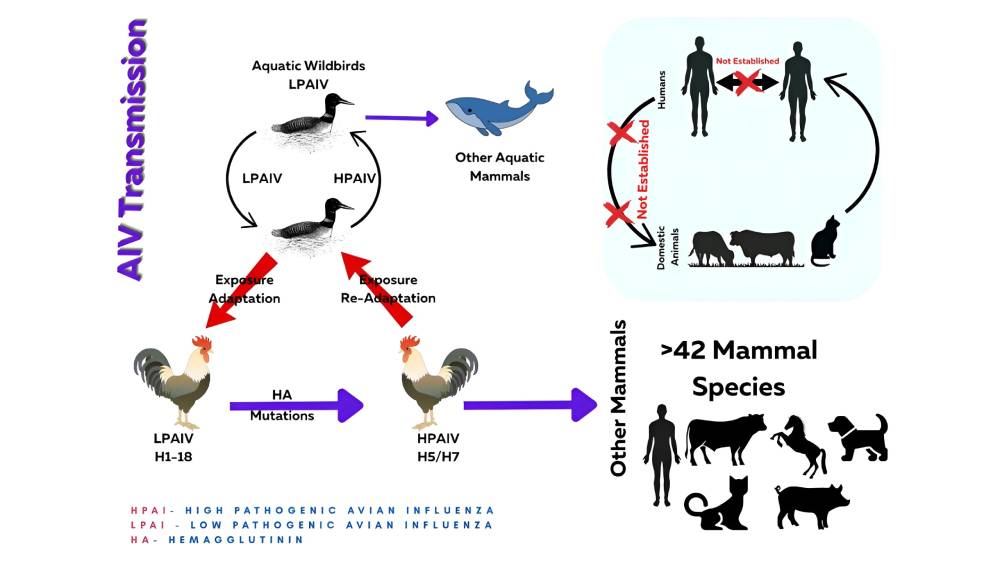
It began quietly on a dairy farm in Texas in early 2024. A few cows grew listless and abruptly produced less milk. Days later, around two dozen barn cats were fed raw milk from these cows. Within one to two days of the cows falling ill, more than half of the cats collapsed and died. Post-mortem examinations revealed severe brain inflammation caused by the H5N1 bird flu virus.
Scientists realised this marked the first confirmed case of avian influenza transmission through milk. The virus appeared to have jumped from wild birds into cows, and then into cats through unpasteurised milk. Healthy cows were found to shed H5N1 at extremely high levels. Laboratory analysis of infected udders detected infectious virus concentrations ranging from 10^4 to 10^9 TCID₅₀ per millilitre of milk.
A Coast-to-Coast Outbreak
Within weeks, H5N1 cases were emerging in dairies across other states. Data from the USDA and CDC show that by May 2024, dozens of herds in at least nine states, Texas, Colorado, Idaho, Kansas, Michigan, New Mexico, North Carolina, Ohio, and South Dakota, were affected. Reports later confirmed that the outbreak had expanded further.
By the end of 2024, hundreds of herds were infected nationwide. Genetic sequencing linked all of these infections to a single spillover event. Scientists believe that a reassorted strain of H5N1 entered a cow in December 2023 via a wild bird. As cattle moved between farms, the virus spread silently across the country. All detections through early 2025 involved the same clade 2.3.4.4b strain, identified as genotype B3.13.
Most infected cows showed few symptoms beyond a mild loss of appetite or discoloured, thick milk, allowing the continued movement of animals and milk without detection.
Crossing Species Lines
This outbreak has proved unusually versatile in crossing species barriers. On the original Texas farm, cats that drank raw milk developed severe neurological disease, including blindness, tremors, and collapse, before dying.
Other farmers reported dead foxes, raccoons, and pet cats near infected barns. Wildlife also became affected. In one case in Florida, researchers found the same H5N1 strain in the lungs and brain of a wild bottlenose dolphin.
First Human Infections
The virus also reached humans. On 27 March 2024, a dairy worker in Texas developed conjunctivitis after handling sick cows. He tested positive for H5N1, showed no other symptoms, and recovered.
The second infection was detected in May 2024 on a Michigan dairy, where the worker also experienced eye irritation and later recovered. Both individuals had contracted the same cattle-associated strain. So far, there has been no evidence of human-to-human transmission.
Adaptation in Real Time
Why did bird flu suddenly find a foothold in cows and other mammals? Genome sequencing offers insights. Researchers found that the H5N1 strain circulating in U.S. cattle had developed mutations favourable to mammals. All cases trace back to genotype B3.13, likely formed by genetic reshuffling in birds before December 2023. In a study published in Science, Nguyen and colleagues concluded that a single wild-bird event seeded the entire cattle outbreak, with seemingly healthy cows spreading the virus between farms.
Deep sequencing uncovered rare pre-adaptive mutations in the virus, including one near residue 199 of the hemagglutinin protein, which increases its ability to bind a broader range of receptors.
Laboratory assays confirmed a shift in receptor preference. While the cow-derived H5N1 still primarily targets avian-type (α2-3) sialic acid receptors, it has begun to show affinity for human-type (α2-6) receptors. High-resolution structural studies found the hemagglutinin protein binding to tissues in the human respiratory tract and eye, aligning with the conjunctivitis seen in infected farm workers. This dual specificity enables the virus to enter mammalian cells more efficiently.
At present, the Texas cow strain does not transmit easily through the air. Ferret studies suggest inefficient droplet spread. However, virologists warn that every new cow infection presents an opportunity for the virus to mutate further and edge closer to full human adaptation.
Containment and Surveillance
Government agencies responded swiftly. In April 2024, the United States Department of Agriculture introduced a requirement for all lactating cows to be tested for H5N1 before being moved across state lines. Since then, dozens of dairy operations have undergone testing, with infected cattle placed under quarantine. The USDA also initiated sampling of meat.
In one instance, viral fragments were detected in the muscle tissue of a condemned dairy cow. However, the agency confirmed that no infected meat had entered the food supply. The Food and Drug Administration tested hundreds of pasteurised dairy products, including milk, cheese, and ice cream, and reported no detection of live H5N1 virus.
Public health authorities intensified surveillance efforts. By the spring of 2025, the Centres for Disease Control and Prevention had monitored more than 7,300 individuals who had been exposed or potentially exposed on farms. No further human infections were reported beyond the initial cases in Texas and Michigan. The CDC continues to stress that pasteurised milk is safe, as the heat treatment process destroys H5N1. However, it advises against the consumption of raw milk or undercooked dairy products.
For now, the general public’s risk remains low. The CDC maintains that these are isolated cases of animal-to-human transmission rather than signs of a developing human epidemic. Gaps persist in the surveillance framework, and testing on farms remains voluntary unless animals are being transported across state borders. Moreover, H5N1 RNA has been found in approximately one-fifth of raw milk samples sold at retail, though no samples have contained live virus.
A Virus on the Brink
The larger concern lies in the potential trajectory of this outbreak. The pattern resembles a virus rehearsing for a pandemic. H5N1 retains a high case fatality rate in humans, with approximately half of known infections resulting in death. If it acquires efficient human-to-human transmissibility, the consequences could be severe.
The recent mutations identified in the virus, combined with its broadened host range and enhanced adaptability to mammalian biology, suggest that it is closer than ever to breaching the barrier between birds and humans. The CDC has warned that the situation could shift rapidly if H5N1 gains the ability to spread effectively among humans. Scientists continue to urge caution, noting that every new infection offers the virus another opportunity to evolve.
This outbreak, emerging from within the dairy supply, has served as a stark warning, a reminder that the next pandemic virus may already be present in the most familiar corners of the food system.
(The author is a CRISP Fellow at the University of Oxford, a Wellcome Trust/India Alliance Fellow, and Assistant Professor and Principal Investigator of the Avian Influenza Surveillance Programme at SKUAST-Kashmir. He currently leads surveillance of avian influenza in domestic poultry along the migratory corridors of Jammu and Kashmir. Ideas are personal.)