by Syed Zeeshan Jaipuri
Noha has moved into high production. There are visuals, sets, branded YouTube channels, premiere countdowns. The majlis is reduced to a thumbnail. The nala-e-dil has become a beat drop.
I do not remember how old I was. I only recall sitting on the stairs of a house that was still under construction. The cement was grey, soft in places, and the rods jutted out like bones from a half-healed wound. It was Muharram. Somewhere nearby, someone was reciting a Noha. We were children, gathered like birds in the pauses between verses, trying to make sense of a grief that felt too old and too vast for our small limbs.
What drew us in was the horse, Zuljanah, the riderless steed of Imam Hussain. Revered, mourned, followed in processions, he had become more than a symbol. The Noha was a conversation between Zuljanah and a five-year-old girl waiting at the camp. It began in Persian:
“Bigo kujan Baba Husaina?”
(Tell me, where is my father Hussain?)
Then came the Urdu echo, for those of us who could not understand Persian but recognised the ache:
“bol kahan hai mere baba Husaain”
The repetition between Persian and Urdu worked like a seesaw. It lifted the weight of sorrow only to let it fall again. We sat there, half-understanding, half-imagining: a little girl tugging at the reins, a horse soaked in blood, silence where once there was prayer.
Some memories arrive blurred, out of focus, like faces in old photographs. I do not remember exact dates or the order of events. Only fragments: the soft hum of a Noha in the background, a black cloth on the wall, the chill of Muharram air.
A Language of Mourning
If asked when I first connected with a Noha, not as a child listening but as a soul remembering, I would say I always did. The attempt to make sense of a Noha, to feel it rather than understand it, seems in me as old as my soul.
Perhaps it is because Karbala, in our part of the world, is not history. It is atmosphere. It is present in the air when the Muharram moon is sighted. It lingers in the way people lower their voices. It is stitched into black shirts ironed with care by mothers. It echoes in the cry of “Ya Hussain”, which sounds less like a chant and more like a heartbeat.
Some of us did not learn Karbala. We remembered it.
I must have been older, though I still do not know how old. I was in a room at my maternal grandparents’ house, watching my mother sit cross-legged in front of a tape recorder. A cassette was spinning. She would press play, listen to a line, pause, then write it down in a diary with a blue pen. Then again, play, pause, write.
The Preservation of Grief
The Noha was titled Parcham i Abbas, a tribute to Hazrat Abbas and his alam, that solemn banner of loyalty and loss. I did not grasp all the words then, but the title endured. Parcham, the flag. Abbas, the one who held it until his arms were severed.
It was not just a Noha being written that day. It was a ritual of preservation. My mother, knowing that grief required form, copied it down to recite later or pass on. In a time before YouTube and streaming platforms, we relied on such intimate practices, cassettes, handwriting, memory, to keep Karbala alive. That room, the cassette, the pen, every detail became part of the aza.
Perhaps Karbala had already begun shaping me, long before I understood what I would become. I was not merely remembering Nohas. I was being formed by them.
The Formation of a Voice
Somewhere between Bigo kujan Baba Husaina and Parcham Abbas, I began to recognise what words could carry. Not only meaning, but moisture, weight, breath, and blood. I did not know it then, but each repetition, each pause, each tremor in a reciter’s voice, carved something into me.
In time, I realised I was a poet. Making sense of poetry is all I have ever done.
That is why Noha never felt foreign. Even those in Persian or Urdu. I did not always grasp the grammar, but I understood the gravity. Some poems are not meant to be decoded. They must be held, sat with, recited until they no longer belong to someone else’s sorrow but become your own.
Writing the First Noha
In 2017, I finally found the courage to write a Noha of my own. It was composed for the Hassanabad daira, a space dense with memory, where even the walls seem to echo elegies.
Writing Noha has never felt like writing in the conventional sense. It is a sacred and strangely sentient practice, as though the pen itself remembers Karbala better than you do. There is something emotionally piercing and spiritually charged in the act. One does not invent. One receives. One does not write grief, but allows it to pass through.
Each verse feels like a quiet act of ziyarat. Each metaphor, a trembling at the edge of a tent. The challenge is not poetic. It is moral. How does one speak of the unspeakable without embellishment? How does one let beauty weep without forcing it to perform?
There were expectations, and they were justified. Not because of anything I had achieved, but because of those who came before me. My grandfather, Syed Akbar Jaipuri, had long offered his pen to the Hassanabad daira. His Nohas still echo, not just through microphones or cassettes, but in the rhythms of memory, in the way his lines rise when people most need them.
A Verse in the Heat
I remember the 8th of Muharram. The heat was unusual. The procession moved slowly, burdened by exhaustion. The air had thickened with sweat and sorrow. Amid this weight, someone recited a line:
“Chaye ga Islam hamara, Ya Rasool Allah.”
It was not merely a verse. It was sustenance. In that moment, it became water in heat, shade in fatigue, a rope to grasp when strength faltered but resolve endured. This is what a true Noha offers. It does not entertain. It sustains.
So when I began to write in 2017, it was not only my hand at work. It was my childhood, the stairs I sat on, my mother’s diary, my grandfather’s ink. All of it knelt behind the page.
Losing the Ark
Lately, I have been reflecting on what we call the evolution of Noha. Not its poetic form, which has always adapted, but its spirit, its intent. Somewhere along the line, it feels as though we have lost the ark. Not the ark of Hussain, but the ark of raw, devotional grief. Unpolished. Direct. Honest.
We did not lose it to time. We lost it to the algorithm.
The same Nadeem Sarwar whose voice once whispered Karbala into my childhood, who brought me Qasim’s broken spine, Ali Akbar’s call for water, Sakina’s quiet tears, now releases compositions that often resemble background scores for Instagram reels.
This is not irreverence. It is dissonance. The voice remains. The name is sacred. But something in the aura has shifted.
The Noha has moved into high production. There are visuals, sets, branded YouTube channels, premiere countdowns. The majlis is reduced to a thumbnail. The nala-e-dil has become a beat drop.
What grieves me is not the presence of production. It is the absence of feeling beneath it. Exceptions still exist. A few serious voices remain. But the space for Urdu Noha is shrinking. The language of martyrdom is being reshaped into a trend, constructed for clicks rather than commemoration.
After the Procession
Ashura has now passed. The tenth day, the day of thirst and fire, has slipped into memory. The heat this year was oppressive. The kind that presses against the chest, making even breath feel heavy.
Now it is raining. I am sitting in my room, listening to it. The rain. The silence. And something else I cannot name. Not a Noha, not quite. Perhaps the echo that lingers after one.
Perhaps it is the sound of Zuljanah’s hoof against the wet earth. Perhaps it is Sakina whispering again, somewhere deep within:
“Bigo kujan Baba Husaina?”
I do not have answers. Only the slow recognition that Karbala lives not only in the majlis, but in the room after it ends. Not only in the procession, but in the poet left behind, still holding the weight of a line, the trace of a memory, the echo of a diary page.
The rain continues. And I remember. Because remembrance, like grief, never ends. It only shifts rhythm.
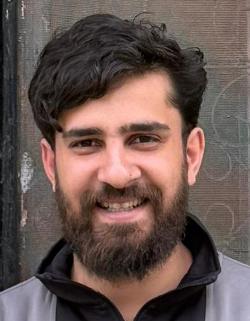
(The author is a poet based in Srinagar. The views and opinions expressed in this article are those of the author and do not necessarily reflect the official policy or position of Kashmir Life.)