by Ruqaya Akhter
Jammu and Kashmir’s handicraft exports show decades of growth led by carpets and shawls, but rising volatility, limited diversification and external shocks highlight structural vulnerabilities
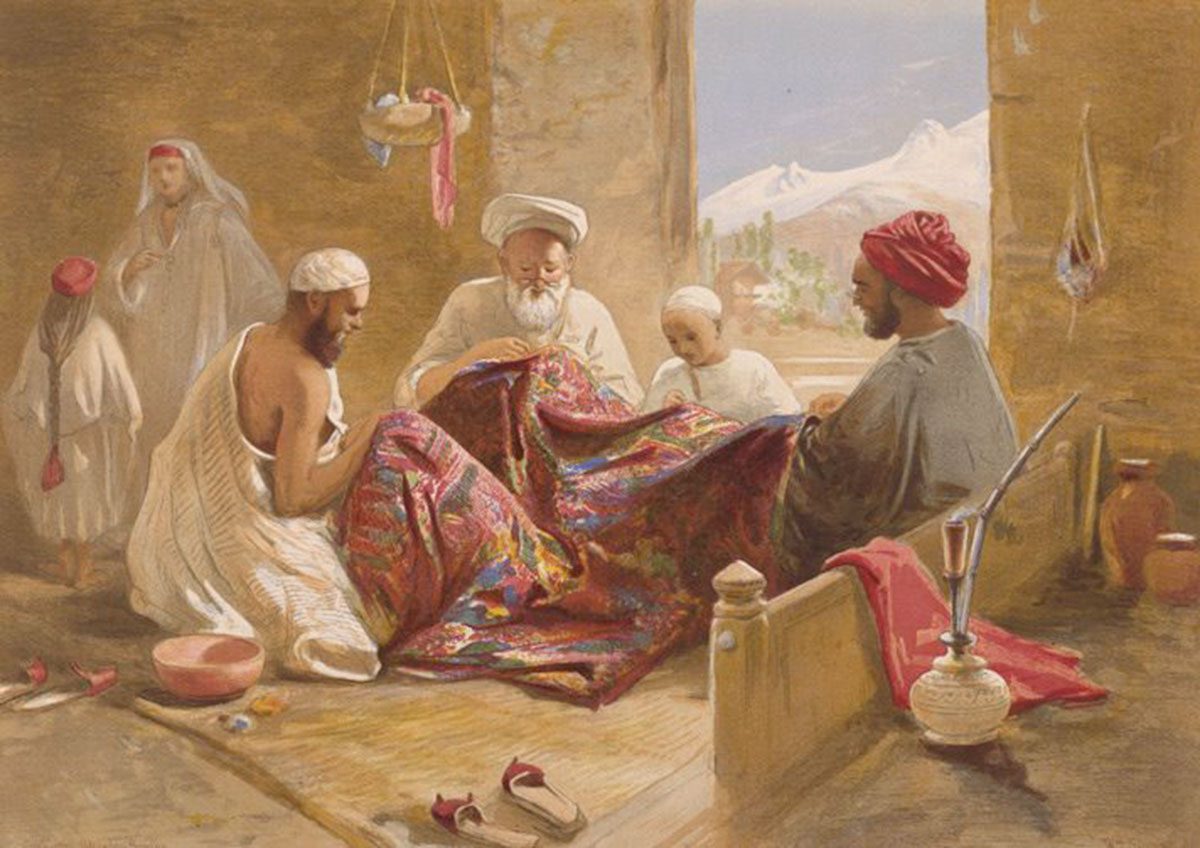
For decades, handicrafts have remained one of Jammu and Kashmir’s most distinctive economic sectors, combining cultural heritage with employment generation and export potential. The export data for handicraft items, spanning nearly five decades from the mid-1970s to 2023–24, offers a rare long-term view into how this sector has evolved, expanded and, in recent years, encountered renewed uncertainty.
The figures reveal both the historical strength of Jammu and Kashmir’s handicrafts in global markets and the growing fragility of this dependence in a changing economic environment. The export basket includes a wide range of traditional crafts, notably carpets, namda, crewel embroidery, wood carving, papier-mache, fur and leather goods, chain stitch goods, woollen shawls and other miscellaneous handicraft items.
In the early years covered by the data, handicraft exports from Jammu and Kashmir were modest in scale. During the late 1970s, total direct exports ranged between 7 crore and 20 crore rupees annually. Carpets already occupied a central position even at this stage, accounting for the bulk of export earnings, while other crafts such as namda, crewel embroidery, wood carving and papier-mache contributed marginally. Fur and leather items, chain stitch goods, woollen shawls and other handicraft products appeared only sporadically in export figures. The limited diversification reflected the structure of the handicraft economy at the time, which was heavily concentrated in a few traditional products and relied on small-scale production systems.
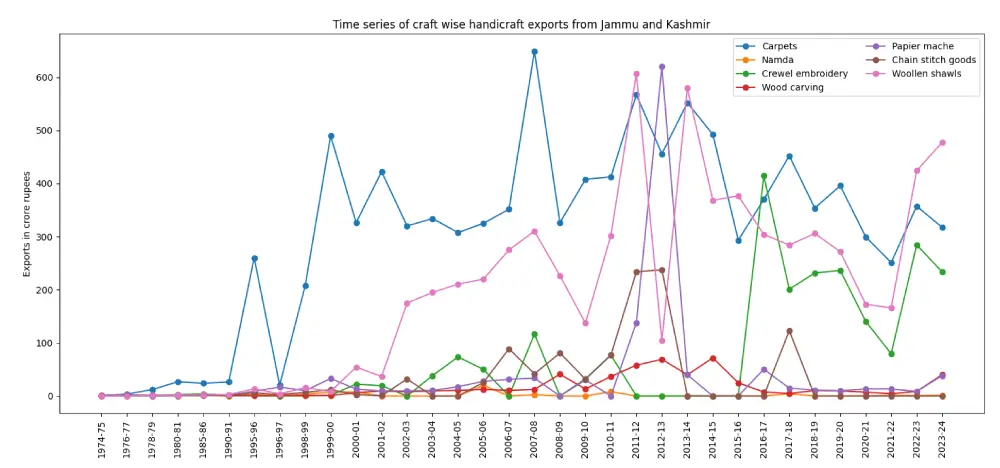
The 1980s and early 1990s marked a gradual expansion phase. Carpet exports rose steadily, crossing 200 crore rupees by the mid-1990s. Total handicraft exports increased correspondingly, touching nearly 300 crore rupees by 1995–96. Alongside carpets, small but visible contributions emerged from crewel embroidery, wood carving and papier-mache, while namda, fur and leather, chain stitch goods and woollen shawls continued to play a limited role. This period also coincided with political instability and conflict, which disrupted production cycles, supply chains and access to international markets. Despite these constraints, the resilience of the handicraft sector allowed it to maintain export momentum.
The late 1990s and early 2000s represented a phase of accelerated growth. Carpet exports surged sharply, peaking at nearly 500 crore rupees in 1999–2000. By the early 2000s, total handicraft exports consistently exceeded 500 crore rupees annually. This expansion was accompanied by greater diversification across craft categories. Crewels, woollen shawls and chain stitch goods began to contribute more significantly, while papier-mache and wood carving recorded intermittent increases. Woollen shawls, in particular, experienced notable growth, reflecting rising global demand for high-value Kashmir textiles.
The most dramatic expansion occurred between the mid-2000s and the late 2000s. Total handicraft exports crossed 1,000 crore rupees for the first time in 2007–08, reaching around 1,200 crore rupees. This period saw strong performance across multiple craft categories. Carpets remained dominant, but crewel embroidery, chain stitch goods, papier-mache and woollen shawls all recorded substantial export values. Fur and leather items and other handicraft goods also appeared more consistently in export data during this phase, suggesting broader market penetration.
However, the period after 2010 presents a more complex picture. While exports continued to grow in nominal terms and peaked again in the mid-2010s, volatility increased significantly. Total exports reached over 1,600 crore rupees in 2011–12 and nearly 1,700 crore rupees in 2013–14. Yet this growth was uneven and increasingly concentrated. Woollen shawls and carpets together accounted for a growing share of total exports, while several traditional crafts, including namda, fur and leather, wood carving and other handicraft goods, either stagnated or declined. Papier-mache and chain stitch goods showed sharp year-to-year fluctuations rather than stable growth.
In the years following 2014–15, signs of fragility became more evident. Although total exports remained above 1,000 crore rupees for several years, fluctuations became sharper. External shocks such as changes in global demand, increased competition from machine-made substitutes, logistical disruptions and, later, the impact of the COVID-19 pandemic contributed to this instability. By 2020–21, total handicraft exports fell sharply to around 600 crore rupees, affecting nearly all craft categories, including carpets, shawls and smaller traditional crafts.
The most recent data for 2023–24 show a partial recovery, with total exports at approximately 1,160 crore rupees. Carpets continue to dominate export earnings, contributing over 300 crore rupees, while woollen shawls and crewel embroidery remain important contributors. Papier-mache, wood carving, namda, chain stitch goods, fur and leather items and other handicraft goods continue to contribute relatively small shares, indicating that the recovery remains uneven and concentrated.
A key structural feature evident across the entire time series is the persistent dominance of carpets. While diversification has increased at various points, the export profile of Jammu and Kashmir handicrafts remains highly dependent on a narrow set of products. This concentration exposes the sector to demand shocks and pricing pressures in international markets. The continued marginalisation of crafts such as namda, fur and leather and several other handicraft goods highlights the difficulty of sustaining export competitiveness across a wider craft base.
The long-term data thus tell a dual story. On one hand, Jammu and Kashmir’s handicraft sector has demonstrated remarkable resilience and growth capacity over nearly five decades. On the other hand, recent volatility highlights the sector’s vulnerability to external shocks and structural limitations. Sustaining export growth in the future will depend not only on preserving traditional strengths such as carpets and shawls, but also on strengthening market access, design innovation and production resilience across a broader range of crafts.
For an economy where handicrafts continue to support a large number of households, especially in rural and semi-urban areas, these trends have clear practical implications. Fluctuations in export performance directly affect artisan incomes, work continuity and local employment opportunities. The data suggest that periods of strong export growth have not always translated into stable or broad-based gains across crafts. This underlines the need to move beyond headline export figures and examine issues of consistency, diversification and access to markets within the handicraft economy of Jammu and Kashmir, particularly from the perspective of sustaining livelihoods over time.
(The author is an Economics research scholar at the University of Kashmir. Ideas are personal.)