SRINAGAR: Israeli forces have escalated their military operation in Jenin, a city in the occupied West Bank, causing widespread destruction and displacing approximately 2,000 families. The offensive, which intensified on Wednesday, involved the bulldozing of critical streets and infrastructure, including roads leading to the Jenin refugee camp and Jenin Government Hospital. Explosions and gunfire have reportedly continued unabated, creating a dire humanitarian situation, reports in international media suggest.
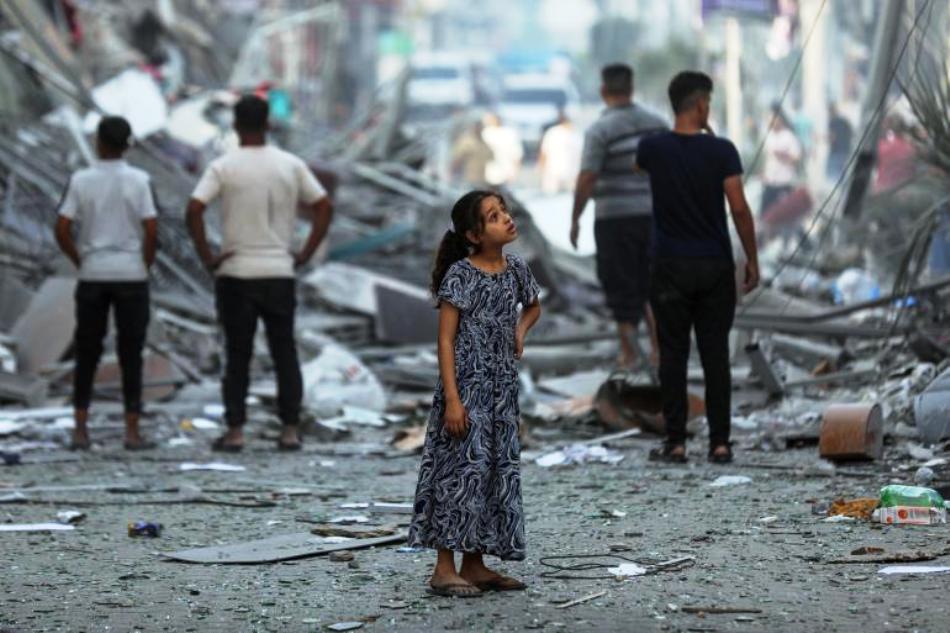
Amal, 7, contemplating her neighbourhood after neighbouring homes were levelled to the ground.
On Tuesday, Israeli ground and air attacks killed at least ten people across Jenin governorate. According to Kamal Abu al-Rub, the governor of Jenin, the destruction has been extensive, with key infrastructure rendered inaccessible. “The occupation army has bulldozed all the roads leading to the Jenin [refugee] camp and Jenin Government Hospital. There is shooting and explosions,” al-Rub said, describing the situation as “very difficult.”
Israeli forces have detained approximately 20 people from surrounding villages. In a statement, the Israeli military claimed to have targeted “terror infrastructure sites” and dismantled explosives on main routes. It confirmed that the operation, described as ongoing, aimed to address what it termed security threats.
The Jenin refugee camp, long considered a flashpoint, has been declared “nearly uninhabitable” by officials from UNRWA, the United Nations agency for Palestinian refugees. Roland Friedrich, the West Bank director of UNRWA, stated that services to the camp have been severely disrupted since mid-December. Residents described harrowing conditions, with many injured and unable to access medical assistance due to the destruction and ongoing violence.
Adel Besher, a local resident, recounted spending the night in a hospital courtyard, unable to reach his nearby home. “There are many injured people, among them doctors, nurses, and patients,” he told Al Jazeera. He added that attempts to rescue injured individuals near his house were thwarted by Israeli forces, who opened fire on those attempting to provide aid.
The raid in Jenin comes shortly after a ceasefire in Gaza, highlighting the potential for renewed violence in the West Bank. Palestinian security forces had previously conducted operations to reassert control over Jenin and its refugee camp, but Israeli incursions have intensified in recent weeks.
UN Special Rapporteur for the Occupied Palestinian Territories Francesca Albanese strongly condemned the ongoing violence, describing it as part of a broader pattern of systemic aggression against Palestinians. “If it is not forced to stop, Israel’s genocide of Palestinians will not be confined to Gaza. Mark my words,” she stated.
The violence has not been confined to Jenin. Israeli forces conducted simultaneous raids in other parts of the West Bank, including Deir Sammit near Hebron, where they targeted homes of prisoners slated for release as part of the Gaza ceasefire agreement. In Bethlehem’s Aida camp, a large-scale arrest campaign was reported, while tightened security measures created widespread disruption in the governorates.
Palestinian news agency Wafa documented significant delays at checkpoints, with videos verified by Al Jazeera showing extensive traffic jams near Ramallah. Since October 7, 2023, when Israel’s war on Gaza began, nearly 900 people have been killed in the West Bank, with more than 9,700 arrested, according to local rights groups and health officials.
Meanwhile, UN News reported that the crisis in Gaza continues to remain acute, with UN humanitarians reporting critical shortages of water, food and efforts to deliver vital aid to the war-torn region. Meanwhile, escalating violence in the West Bank has further deepened concerns over civilian safety and access to assistance.
The ceasefire and hostage release agreement, which took effect on Sunday allowed some displaced residents to return, but hundreds of thousands across the Gaza Strip remain dependent on humanitarian aid, UN spokesperson Farhan Haq told journalists at the regular press briefing in New York on Tuesday.
“With the ceasefire in place, displaced Palestinians have been making their way back home, with many returning to find mountains of rubble,” he said.
He added that over 90 per cent of housing units in Gaza have been damaged or destroyed over the past 15 months, according to partner organisations.
“Given the scale of destruction and needs in Gaza, we are working to get vital aid to people as fast as humanly possible. We also urge Member States and partners to ensure that our aid operations are funded to meet the overwhelming needs,” he said.
According to the UN Office for the Coordination of Humanitarian Affairs (OCHA), on Tuesday, 897 trucks entered Gaza, based on the information obtained through interactions with the Israeli authorities and other interlocutors. Haq also expressed deep concerns over the situation in the West Bank, in particular the safety of Palestinians in Jenin city and its refugee camp, where Israeli military operations on Tuesday resulted in fatalities and injuries.
“According to initial reports, air strikes, heavy bulldozing and the operation of undercover forces have resulted in several fatalities and dozens of injuries – including among medical personnel,” he said.
The operation follows weeks of clashes between Israeli forces and armed Palestinians. Earlier violence had displaced approximately 2,000 families from Jenin camp, with basic services like water and electricity severely disrupted.
Humanitarians have struggled to access the area safely, limiting aid distribution such as mattresses and blankets. Also on Tuesday, Muhannad Hadi, Deputy Special Coordinator for the Middle East Peace Process, shared his impressions after visiting Gaza, describing it as one of the most hopeful moments in his 35-year humanitarian career.
He said that for the first time in months, he saw people in the streets, beginning to clean roads and trying to rebuild their lives.
“It made me very happy to see that people already started moving back to their places of origin,” he said.
While acknowledging the ongoing suffering, Mr. Hadi noted a shift in attitude among Gazans, many of whom expressed a strong desire to return to work and rebuild rather than depend on aid.
Women and children he spoke to highlighted urgent needs such as education, blankets for winter and basic clothing after months of deprivation.
Hadi also visited the logistics cluster and milling facilities, where operators were eager to restart operations but faced barriers such as fuel shortages and a lack of spare parts. He also emphasised the need for international media to return to Gaza and report firsthand on the situation. The UN Relief and Works Agency (UNRWA) also underscored that it remains committed to staying in both the Gaza Strip and the West Bank and providing vital assistance and services to people in need.
That message was reinforced by Juliette Touma, UNRWA Director of Communication, in an interview with UN News.
She spoke against the backdrop of the looming implementation of the legislation passed by the Israeli Knesset in late October, which would make it impossible for Agency to continue operating in the occupied Palestinian territory.