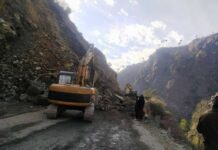
SRINAGAR: Jammu and Kashmir has been flagged as one of the states and union territories with significant landslide vulnerability, with 12 percent of its mapped hilly areas falling under the “high susceptibility” category, the Government told Parliament on Wednesday.
Replying to a question in the Lok Sabha, Minister of State (Independent Charge) for Earth Sciences Jitendra Singh said that the Geological Survey of India (GSI) has completed landslide susceptibility mapping of the Himalayan region, including Jammu & Kashmir and Ladakh, under its National Landslide Susceptibility Mapping (NLSM) programme. The exercise, done on a 1:50,000 scale, classified areas into low, moderate and high-risk zones to help state and local authorities with land-use planning and infrastructure development.
According to the data, about 19,000 sq km of JK falls in the low susceptibility zone (65 percent), 7,000 sq km in moderate susceptibility (23 percent) and 3,000 sq km in high susceptibility (12 percent). In neighbouring Ladakh, the share of high-susceptibility terrain is even higher, at 21 percent of mapped areas, underscoring the fragile Himalayan ecosystem.
Singh informed the House that landslide susceptibility mapping has been completed across all hilly and mountainous regions of India, covering 4.3 lakh sq km across 19 states and union territories. So far, GSI has compiled a database of over 91,000 historical landslides, of which nearly 34,000 have been field-validated.
These maps and inventories, uploaded on GSI’s National Geoscience Data Repository (NGDR), Bhukosh portal and Bhooskhalan mobile app, are freely accessible to planners, state governments and disaster management authorities.
Building on the baseline mapping, Singh said GSI has now scaled up to meso-level mapping at 1:10,000 and 1:5,000 scales, focusing on 200 critical sectors identified in consultation with state governments. By the end of the 2024-25 field season, 160 such sectors had been completed, with the target set for 2028.
To address the rising frequency of climate-linked disasters, GSI has also developed a Regional Landslide Forecasting System (RLFS), integrating rainfall thresholds, weather models and satellite data to issue forecasts. Since this year’s monsoon, experimental and operational landslide bulletins are being issued for 21 districts across eight states, including Uttarakhand, Himachal Pradesh, Sikkim and Nagaland.
The minister added that states with high-risk zones receive special assistance under the National Landslide Risk Mitigation Programme and NDMA’s Aapda Mitra scheme, which trains community volunteers in disaster response. These programmes are centrally funded and aimed at improving resilience in landslide-prone regions.
“High-resolution mapping and early warning systems will help vulnerable states like Jammu and Kashmir, Himachal Pradesh, Uttarakhand, Sikkim and the North-East prepare better for disasters,” Singh said.