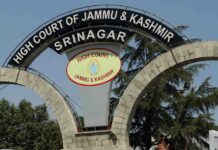
SRINAGAR: The High Court of Jammu Kashmir and Ladakh has dismissed a writ petition challenging a provision of SRO 28 of 1996 governing promotions in the Drivers’ cadre, ruling that a government employee has no vested right to promotion or to compel the government to create posts or expand cadre strength.
The court held that promotion depends on the applicable rules, availability of vacancies and administrative policy. It upheld the constitutional validity of the provision making promotions subject to the availability of posts.
Justice Shahzad Azeem delivered the judgment on July 6 after reserving the matter for orders on July 2. The petitioner was represented by advocate BA Misri, while Government Advocate Numan Idrees Malik appeared for the Union Territory administration.
The petitioner, a retired driver of the Institute of Management, Public Administration and Rural Development (IMPA), had challenged the note appended to Rule 1 of SRO 28 of 1996, which restructured the Drivers’ cadre and stipulated that promotions from Driver Grade-II to Driver Grade-I and thereafter to Chauffeur would be subject to the availability of posts. He also sought a direction to the government to grant him promotion retrospectively after completion of five years as Driver Grade-I along with all consequential benefits.
According to the petition, the employee was appointed as a Driver in March 1989 and, during his service, received three in-situ promotions under SRO 14 of 1996 as financial upgradations. However, he was never granted functional promotion because the lone post of Chauffeur in the department remained occupied by his senior.
The petitioner argued that once an employee completed five years in the feeder grade, promotion should automatically follow and should not be made dependent on the availability of vacancies. He contended that the condition attached to Rule 1 of SRO 28 was arbitrary, unreasonable and violative of constitutional guarantees, particularly because the small size of the cadre effectively denied him any promotional avenue.
The government opposed the petition, submitting that the petitioner had already been granted three in-situ promotions, which ensured financial progression despite the absence of functional promotion. It maintained that the only reason he could not be promoted as Chauffeur was the non-availability of a vacancy and that he could not claim promotion as a matter of right.
Examining the record, the court observed that the petitioner had already received three financial upgradations and had retired on attaining the age of superannuation on March 31, 2025. It noted that the petition did not disclose any financial loss suffered by him on account of the absence of functional promotion.
Justice Azeem held that if the petitioner had established that denial of promotion had resulted in financial prejudice, appropriate relief could have been considered. However, in the absence of any pleading or evidence showing such loss, no relief could be granted.
The court then addressed the broader legal issue of whether a government employee can insist upon cadre expansion or creation of posts to facilitate promotion.
It held that promotion is not a matter of right but depends upon statutory rules, eligibility, availability of vacancies and administrative policy. The only enforceable right available to an employee is the right to be considered for promotion under Articles 14 and 16 of the Constitution. That right, the court said, does not extend to compelling the government to create additional posts or enlarge the cadre.
The judgment emphasised that the government has wide discretion in determining, restructuring and reviewing cadre strength based on administrative requirements and available resources. Courts cannot direct the executive to sanction new posts or alter cadre structures merely because employees face stagnation.
Relying on the Supreme Court’s ruling in State of Odisha v. Sreepati Ranjan Dash (2026 SCC OnLine SC 879), the court observed that employees have no vested right or legitimate expectation to compel the government to fill vacancies through promotion, particularly during cadre restructuring.
The court also referred to the Supreme Court judgment in Union of India v. Ilmo Devi (2021) 20 SCC 290, which held that High Courts, while exercising jurisdiction under Article 226 of the Constitution, cannot issue directions to the government to create or sanction posts or frame service policies, as those are matters exclusively within the executive domain.
Rejecting the constitutional challenge to SRO 28, Justice Azeem observed that the petitioner had failed to produce any material demonstrating that the rule discriminated between similarly situated employees or had been applied unequally in violation of Articles 14 and 16. The court found that the rule had been uniformly implemented across departments based on cadre strength and that stagnation in a small cadre, by itself, could not render an otherwise valid service rule unconstitutional.
The court further held that the condition making promotions subject to the availability of posts was constitutionally valid and that long stagnation, though a recognised hardship, could not justify judicial rewriting of statutory rules or grant of functional promotions outside the governing framework.
Concluding that the petitioner had already received three financial upgradations and had failed to establish any financial prejudice arising from non-promotion, the court held that the writ petition was devoid of merit and dismissed it along with the connected applications, vacating all interim directions.