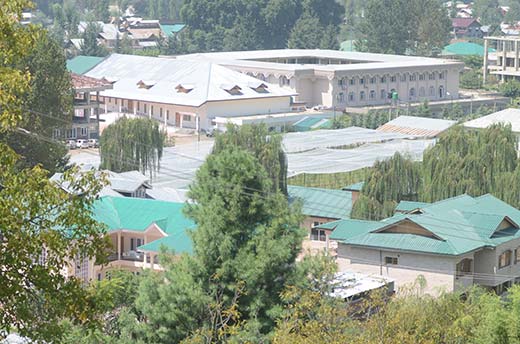
SRINAGAR: Sher-e-Kashmir University of Agricultural Sciences and Technology (SKUAST-K) is listed in the Department of Biotechnology’s recent Lok Sabha reply as operating a containment facility where apple is being gene-edited, while the CSIR-Indian Institute of Integrative Medicine in Jammu is recorded as carrying out work on Nicotiana tabacum and Cannabis sativa. The parliamentary response on Wednesday also gave a national snapshot of containment infrastructure, showing 750 biosafety level-2 laboratories, 89 BSL-3 laboratories and one BSL-4 facility registered with DBT.
The ministry’s answer makes clear that gene-editing activity in India spans a very wide set of crops — from staples and millets to high-value horticulture and medicinal plants — and lists institutions across the country engaged in contained research. The list includes saffron, tea and potato among other crops, underscoring that gene-editing R and D is not confined to a few centres but dispersed across central research institutes, state agricultural universities and several private laboratories.
Regulatory footing and safety oversight form a central pillar of the reply. Officials told Lok Sabha that gene-editing of plants in India is governed by the Rules for Manufacture, Use, Import, Export and Storage of Hazardous Micro-organisms/Genetically Engineered Organisms or Cells, 1989, and that the Ministry of Environment, Forests and Climate Change administers those provisions. The Department of Biotechnology has issued more recent implementing documents — including Guidelines for the Safety Assessment of Genome Edited Plants and Standard Operating Procedures for SDN-1 and SDN-2 categories (2022) — and it remains mandatory for institutions to constitute Institutional Biosafety Committees (IBSCs) whose minutes feed into the Review Committee on Genetic Manipulation for oversight and exemption decisions. The reply stresses that plants edited without exogenous DNA are treated differently under the rules, but still remain subject to laboratory containment and institutional review prior to any release.
The DBT response also addressed biosafety record-keeping: between 2020 and 2025 only one laboratory-acquired infection was declared in the documents submitted to parliament — an occupational exposure to vaccinia virus involving a doctoral student at the National Centre for Cell Sciences, Pune. That single reported incident is cited in the reply as the only lab-acquired infection recorded in the period.
For Jammu and Kashmir the entries are consequential in more than one sense. Apple remains the territory’s principal horticultural cash crop and any upstream R and D on disease tolerance, fruit quality or shelf life carried out under contained conditions at SKUAST Kashmir could have a material bearing on local growers — provided the pathway from containment to field evaluation, variety registration and extension is transparent and inclusive. At the same time, the presence of CSIR-IIIM Jammu on the list for work on Nicotiana and Cannabis flags research that intersects with medicinal and regulatory sensitivities; both require clear communication with local stakeholders and strict biosafety compliance.
The parliamentary reply raises immediate questions that merit scrutiny. First, the register shows a large number of containment facilities nationwide and a growing portfolio of crops under gene-editing; greater clarity is needed on where and when any field trials will be conducted, and on the local risk assessments that will precede them. Second, while the DBT highlights institutional oversight via IBSCs and RCGM, independent transparency about IBSC minutes, exemption decisions and post-containment monitoring would strengthen public confidence. Third, the lone reported lab-acquired infection does not eliminate the need for continual safety audits, worker training and public disclosure of safety incidents beyond minimal notification.