SRINAGAR: Apple production in Jammu and Kashmir remains a key contributor to the Union Territory’s economy, with an estimated 20.40 LMT produced in 2022-23, 20.64 LMT in 2023-24, and 20.56 LMT in 2024-25. The export of apples from the region has also been a focus, with 12.07 LMT exported in 2021-22, 17.48 LMT in 2022-23, 18.57 LMT in 2023-24, and 13.13 LMT exported up to February 2025.
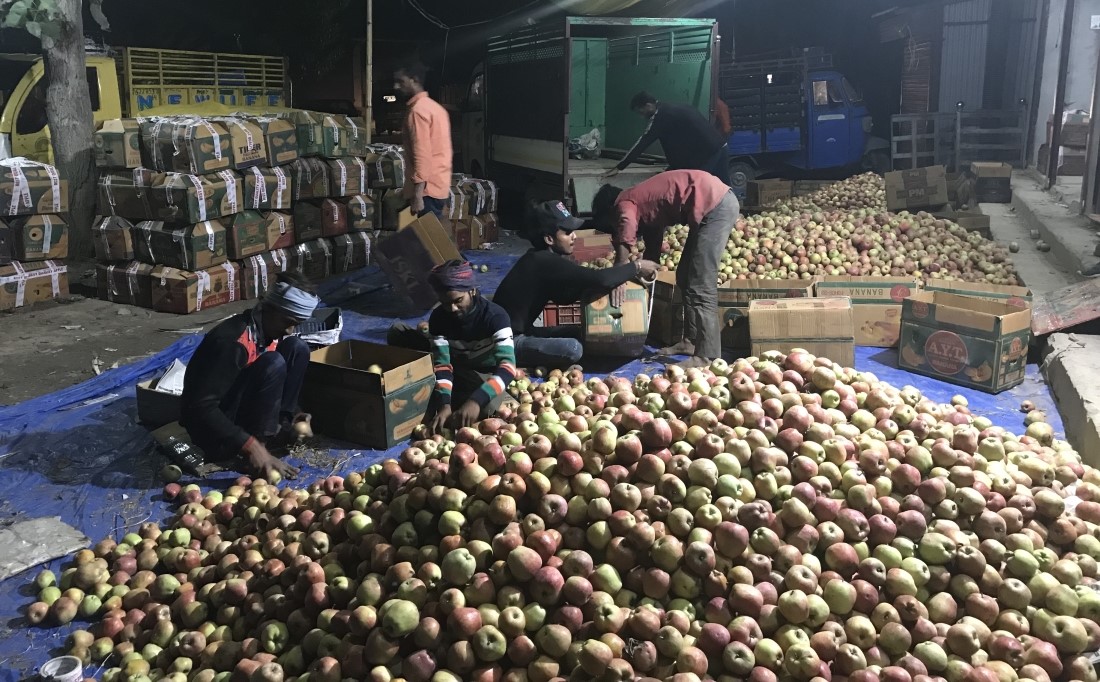
To enhance post-harvest storage and minimise losses, efforts are underway to expand controlled atmosphere (CA) storage facilities. At present, Jammu and Kashmir’s total CA storage capacity stands at 2.70 LMT, with an additional 0.37 LMT being added this year, bringing the total to 3.07 LMT. The primary CA storage hubs are located at the Industrial Growth Centre in Lassipora, Pulwama, and the Industrial Estate in Aglar, Shopian, with further expansion planned in collaboration with the Industries and Commerce Department.
The government is also monitoring the quality of pesticides and fertilisers to curb the sale of substandard products in the Kashmir Valley. Companies must register their products under the Insecticides Act of 1968, the Fertiliser Control Order of 1985, and the Seed Act of 1966. The Directorate of Enforcement of the Agriculture Department conducts regular inspections to ensure compliance and prevent the distribution of substandard agricultural inputs.
Recognising the horticulture sector’s potential for revenue generation and employment, the government has been implementing various initiatives. The High-Density Plantation scheme, launched in 2016-17, had covered 663 hectares as of March 2024, with an additional 173 hectares brought under cultivation in 2024-25, raising the total to 836 hectares. The sector supports the livelihoods of 35 lakh people, with around seven lakh families directly or indirectly dependent on horticulture.
The government is also improving marketing mechanisms through the Agriculture Marketing (e-NAM) platform. Over 50,000 farmers and traders are now registered on the e-NAM portal, facilitating electronic transactions. Since 2021-22, trade through e-NAM has grown significantly, with turnover rising from ₹20.89 crore in 2021-22 to ₹594.17 crore in 2024-25.
To further strengthen infrastructure and market accessibility, multiple schemes have been introduced, including the Holistic Agriculture Development Programme (HADP), Rainfed Area Development (RAD) for irrigation support, and the Pradhan Mantri Formalisation of Micro Food Processing Enterprises (PMFME). Additionally, a Common Incubation Centre has been established at Doabgah Sopore for apple grading and processing. However, there is currently no proposal under consideration to re-establish the juice factory at Chini-Wudar-Poshkiri-Kanelwan.